Smoke alarms may not sense fire that starts where smoke cannot reach the
units such as in chimneys, in walls, on roofs, or on the other side of closed doors. If
bedroom doors are usually closed at night, smoke alarms should be placed in each
bedroom as well as in the common hallway between them.
Smoke alarms also may not sense a fire on another level of a residence or
building. For example, a second-floor device may not sense a first-floor or basement
fire. Therefore, smoke alarms should be placed on every level of a residence or
building.
The horn in your device meets or exceeds current audibility requirements of
ANSI/UL 217. However, if the smoke alarm is located outside a bedroom, it may
not wake up a sound sleeper, especially if the bedroom door is closed or only partly
open. If the device is located on a different level of the residence than the bedroom, it
is even less likely to awaken people sleeping in the bedroom. In such cases, the
National Fire Protection Association recommends that the smoke alarms be intercon-
nected so that a unit on any level of the residence will sound an alarm loud enough to
awaken sleepers in closed bedrooms. This can be done by employing a systematic
approach by interconnecting smoke alarms together, or by using radio frequency
transmitters and receivers.
All types of smoke alarm sensors have limitations. No type of device can
sense every kind of fire every time. These types of fires include:
1) Fires where the victim is intimate with a flaming initiated fire; for example,
when a person’s clothes catch on fire while cooking.
2) Fires where the smoke is prevented from reaching the smoke alarm due to a
closed door or other obstruction.
3) Incendiary fires where the fire grows so rapidly that an occupant’s egress is
blocked even with properly located smoke alarms.
In general, smoke alarms may not always warn you about fires caused by
violent explosions, escaping gas, improper storage of flammable materials, or
arson.
NOTICE: THIS SMOKE ALARM IS NOT DESIGNED TO REPLACE SPECIAL-
PURPOSE FIRE DETECTION AND ALARM SYSTEMS NECESSARY TO PROTECT
PERSONS AND PROPERTY IN NON-RESIDENTIAL BUILDINGS SUCH AS
WAREHOUSES, OR OTHER LARGE INDUSTRIAL OR COMMERCIAL BUILDINGS.
IT ALONE IS NOT A SUITABLE SUBSTITUTE FOR COMPLETE FIRE-DETECTION
SYSTEMS DESIGNED TO PROTECT INDIVIDUALS IN HOTELS AND MOTELS,
DORMITORIES, HOSPITALS, OR OTHER HEALTH AND SUPERVISORY CARE AND
RETIREMENT HOMES. PLEASE REFER TO NFPA 101,THE LIFE SAFETY CODE,
AND NFPA 72 FOR SMOKE ALARM REQUIREMENTS FOR FIRE PROTECTION IN
BUILDINGS NOT DEFINED AS "HOUSEHOLDS."
Installing smoke alarms may make you eligible for lower insurance rates, but
smoke alarms are not a substitute for insurance. Home owners and renters
should continue to insure their lives and property.
NOTICE: GENERAL LIMITATIONS OF SMOKE ALARMS
Smoke alarms may not awaken all individuals. If children and others do not
readily awaken to the sound of the smoke alarm or if there are infants or family
members with mobility limitations, make sure that someone is assigned to assist them
in the event of an emergency.
Smoke alarms will not work without power. This smoke alarm requires a
continuous supply of power.
Smoke alarms for solar or wind energy users and battery back-up power
systems: AC powered smoke alarms should only be operated with true or pure sine
wave inverters. Operating this device with most battery powered UPS (uninterruptible
power supply) products or square wave or “quasi sine wave” inverters will damage the
alarm. If you are not sure about your inverter or UPS type, please consult with the
manufacturer to verify.
Smoke alarms may not be heard. The alarm decibel rating meets or exceeds
current UL Standards of 85 dBA at 10 feet (3 meters). However if the device is
installed outside the sleeping area, it may not awaken a sound sleeper, one who has
recently used drugs or has been drinking alcoholic beverages. This is especially true
if the door is closed or only partially open. Even persons who are awake may not
hear the sounding alarm if the sound is blocked by distance or closed doors. Noise
from traffic, stereo, radio, television, air conditioner, or other appliances may also
prevent alert persons from hearing the alarm horn. This device is not intended for
people who are hearing impaired.
Smoke alarms have a limited life. Although the device and all of its components
have passed many stringent tests and are designed to be as reliable as possible, any
of these parts could fail at any time. Therefore, you must test your smoke alarm
weekly.
PLACEMENT OF SMOKE ALARMS
THIS EQUIPMENT SHOULD BE INSTALLED IN ACCORDANCE WITH THE
NATIONAL FIRE PROTECTION ASSOCIATION'S
STANDARD 72 (National Fire Protection Association, Batterymarch Park, Quincy, MA
02269).
For your information, the National Fire Protection Association's Standard 72, reads
as follows:
550-0008
Pg. S-2
w Keep portable heaters and open flames such as candles away from combustible
materials.
w Do not allow rubbish to accumulate.
w Do not leave small children home alone
c. Develop a family escape plan and practice it with your entire family,
especially small children.
w Draw and post a floor plan of your home and find two ways to exit from each
room. There should be one way to get out of each bedroom without opening
the door.
w Teach children what the smoke alarm signal means, and that they must be
prepared to leave the residence by themselves if necessary. Show them how
to check to see if doors are hot before opening them, how to stay close to the
floor and crawl if necessary, and how to use the alternate exit if the door is
hot and should not be opened.
w Decide on a meeting place a safe distance from your house and make sure that
all your children understand that they should go and wait for you if there is a
fire.
w Hold fire drills at least every 6 months to make sure that everyone, even small
children, know what to do to escape safely.
w Know where to go to call the fire department from outside your residence.
w Provide emergency equipment such as fire extinguishers and teach your family
to use this equipment properly.
d. Bedroom doors should be closed while sleeping if a smoke alarm is installed
in the bedroom. They act as a barrier against heat and smoke.
WHAT TO DO IF THERE IS A FIRE IN YOUR HOME
If you have prepared family escape plans and practiced them with your family, you
have increased their chances of escaping safely. Review the following rules with your
children when you have fire drills so everyone will remember them in a real fire
emergency. If alarm should sound:
a. Don't panic; stay calm. Your safe escape may depend on thinking clearly and
remembering what you have practiced.
b. Get out of the house following a planned escape route as quickly as possible. Do
not stop to collect anything or to get dressed.
c. Open doors carefully only after feeling to see if they are hot. Do not open a door if
it is hot; use an alternate escape route.
d. Stay close to the floor; smoke and hot gases rise.
e. Cover your nose and mouth with a cloth, wet if possible, and take short, shallow
breaths.
f. Keep doors and windows closed unless you open them to escape.
g. Meet at your prearranged meeting place after leaving the house.
h. Call the Fire Department as soon as possible from outside your house. Give the
address and your name.
i. Never re-enter a burning building.
Contact your local Fire Department for more information on making your home
safer from fires and about preparing your family's escape plans.
NOTICE: CURRENT STUDIES HAVE SHOWN SMOKE ALARMS MAY NOT AWAKEN
ALL SLEEPING INDIVIDUALS, AND THAT IT IS THE RESPONSIBILITY OF
INDIVIDUALS IN THE HOUSEHOLD THAT ARE CAPABLE OF ASSISTING OTHERS
TO PROVIDE ASSISTANCE TO THOSE WHO MAY NOT BE AWAKENED BY THE
ALARM SOUND, OR TO THOSE WHO MAY BE INCAPABLE OF SAFELY
EVACUATING THE AREA UNASSISTED.
WHAT THIS SMOKE ALARM CAN DO
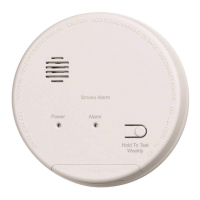
This smoke alarm is designed to sense smoke entering its sensing chamber. It
does not sense heat or flames.
When properly located, installed, and maintained, this smoke alarm is designed to
provide early warning of developing fires at a reasonable cost. This device monitors
the air and, when it senses smoke, activates its built-in alarm horn. It can provide
precious time for you and your family to escape from your residence before a fire
spreads. Such an early warning, however, is possible only if the smoke alarm is
located, installed, and maintained as specified in this User's Manual.
NOTICE: THIS SMOKE ALARM IS DESIGNED FOR USE WITHIN SINGLE
RESIDENTIAL LIVING UNITS; THAT IS, IT SHOULD BE USED INSIDE A SINGLE-
FAMILY HOME OR ONE APARTMENT OF A MULTI-FAMILY BUILDING. THIS
SMOKE ALARM CAN ALSO BE USED WITH PROTECTION SYSTEMS. IN A MULTI-
FAMILY BUILDING, THE DEVICE MAY NOT PROVIDE EARLY WARNING FOR
RESIDENTS IF IT IS PLACED OUTSIDE OF THE RESIDENTIAL UNITS, SUCH AS
ON OUTSIDE PORCHES, IN CORRIDORS, LOBBIES, BASEMENTS, OR IN OTHER
APARTMENTS. IN MULTI-FAMILY BUILDINGS, EACH RESIDENTIAL UNIT SHOULD
HAVE SMOKE ALARMS TO ALERT THE RESIDENTS OF THAT UNIT. DEVICES
DESIGNED TO BE INTERCONNECTED SHOULD BE INTERCONNECTED WITHIN
ONE FAMILY RESIDENCE ONLY; OTHERWISE, NUISANCE ALARMS WILL OCCUR
WHEN A SMOKE ALARM IN ANOTHER LIVING UNIT IS TESTED.
NOTICE: WHAT SMOKE ALARMS CANNOT DO
Smoke alarms will not work without power. A battery must be connected to the
device to maintain proper operation if AC power supply is cut off by an electrical fire,
an open fuse or circuit breaker, or for any other reason. In the event of AC power
failure, the battery will supply power for a minimum of 24 hours.


 To Next Page
 Loading...