2
TABLE 1 - SPECIFICATIONS
Model:
2026 3026 (KIT3026) 3028
# Circuits Provided
6 6 8
Max # Circuits
10 10 10
REQUIRED BREAKER FOR MAIN LOAD
CENTER
(not included in this kit)
60 amp 2-pole 60 amp 2-pole
60 amp 2-pole
Breakers Provided with Unit
2 – 15 amp 1-pole
2 – 20 amp 1-pole
1 – 20 amp 2-pole
2 – 15 amp 1-pole
2 – 20 amp 1-pole
1 – 20 amp 2-pole
2 – 15 amp 1-pole
2 – 20 amp 1-pole
1 – 20 amp 2-pole
1 – 30 amp 2-pole
Max GEN Watts
5000 7500 7500
Max GEN Amps
20 Amps 30 Amps 30 Amps
Voltage
120/240 Volts 120/240 Volts 120/240 Volts
NEMA Type Enclosure
1 – Indoor Only 1 – Indoor Only 1 – Indoor Only
Flanged Inlet (included) / NEMA config
FI-1420 / L14-20 N A FI-1430 / L14-30
Compatible Power Inlet Box (optional)
14202, 14203, 14201 14302, 14303, 14301 14302, 14303, 14301
Phase
1 1 1
Minimum Gauge Cord Size
12/4 10/4 10/4
*Note: If Ground Fault Circuit Interrupters (GFCI), Arc Fault Circuit Interrupters (AFCI), or Surge Protector Circuit Breakers were used as the branch circuit protector in
the main load center, they MUST be used in the transfer switch. GFCI and AFCI breakers require an isolated neutral connected from the load to the GFCI or AFCI. The
load neutral needs to be connected with a wire nut to a 3-6 foot piece of white wire, run through the harness conduit to the transfer switch and connected to the "load
neutral" lug or pigtail on the GFCI or ACFI breaker. Because GFCI and AFCI circuit breakers can take up more than one space, the overall maximum number of circuits
may be reduced from the number shown. Contact Gen/Tran for more information on these circuit breaker types.
STEP 1: PLANNING YOUR INSTALLATION:
1. Determine the appliances, circuits or equipment you want to operate with generator power during a power outage, such as:
• Refrigerator/Freezer
• Furnace Blower (gas/oil only)
• TV / Radio
• Lighting
• Water Heater
• Garage Door Opener
• Microwave, Coffee Maker
• Well Pump
• Security System
• Sump Pump
• Computer, Fax and Printer, Phone
• Aquarium
2. Determine the amps required for each appliance by reading the label on the appliance. IMPORTANT: No appliance should have an amperage rating that exceeds the GEN
MAIN breaker rating in the transfer switch (See Table 1). The total amperage of all circuits can exceed the generator rating, but not all circuits will be able to be used
concurrently.
3. Assign the circuit # in the load center to a circuit (A2, B2, etc.) in the transfer switch matching the size of the circuit breaker in the load center to the circuit breaker in the
transfer switch. Once you’ve determined which circuits you want to connect and the appropriate amperage, you will be ready to begin installing your GenTran
®
transfer
switch.
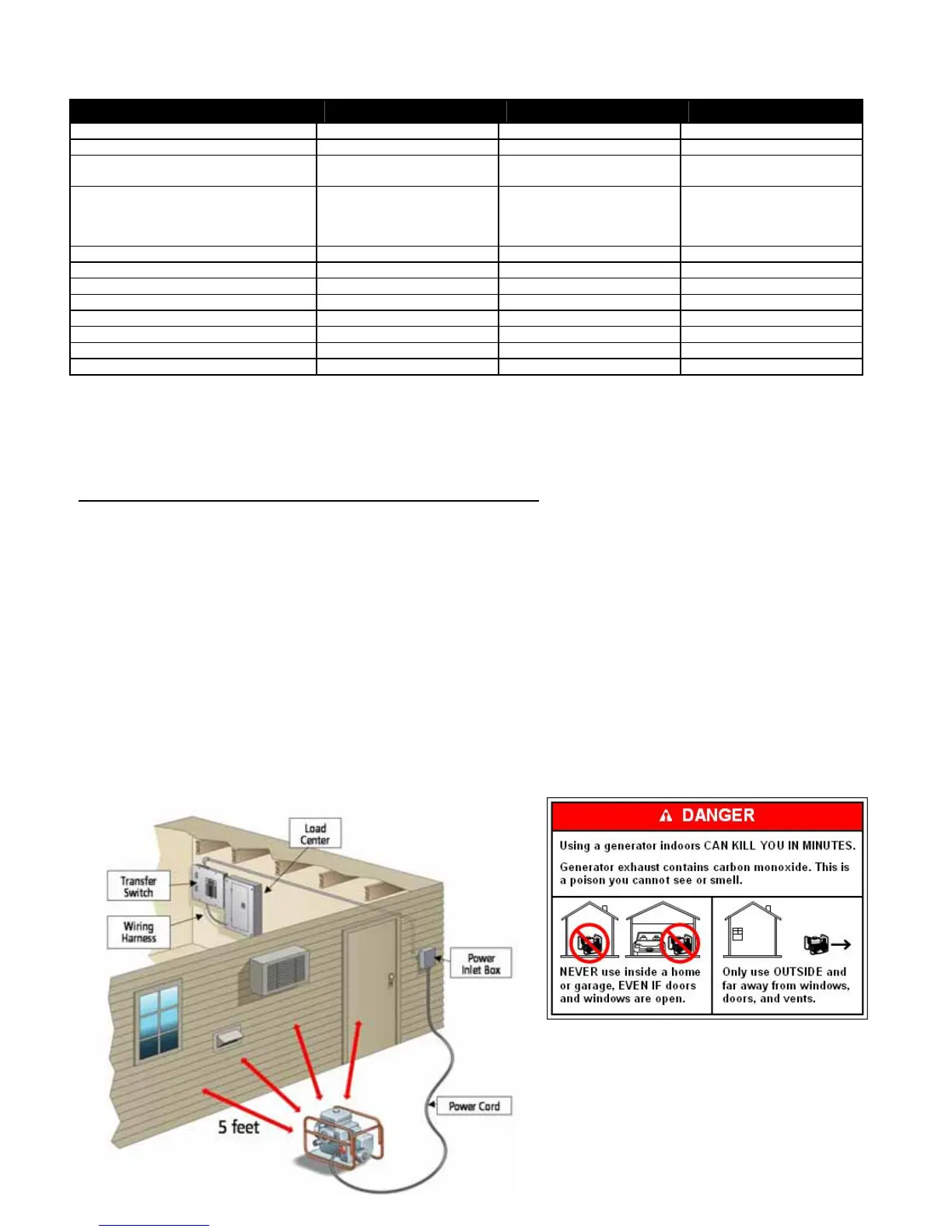
4. The location of your load center/electrical panel in your home or business will determine where the GenTran
®
transfer switch will be installed. Refer to the illustrations
below. In addition to the transfer switch, you may need additional accessories to complete your generator transfer switch installation, such as a generator cord and power
inlet box. A generator cord (sold separately) is needed to connect your generator to the GenTran
®
transfer switch or power inlet box. If your load center is in your garage,
we recommend at least a 25-foot generator cord to reach from your generator outside the garage on the driveway to the transfer switch. NEVER run a generator in an
enclosed area! If your load center is in a basement or interior room, you shall install a power inlet box (sold separately) on the exterior of your house or building to avoid
running the generator cord through a door or window. Once you have all of the essential components for your specific needs, you may proceed with the installation.
TYPICAL INSTALLATION:



 To Next Page
 Loading...