Using the GeoSafari® Talking Planetary Mat
The GeoSafari® Talking Planetary Mat has two modes: Explore (fact mode) and Mission
(game mode). We suggest starting in Explore mode, but you can press either button
to switch modes at any time.
Start on the Platform
Every new user needs to start on the platform so the unit can measure each student’s
weight. The student should stand still during the countdown for an accurate reading.
After the countdown, step on dierent celestial bodies to see your weight on the LCD
screen as you hear a fact about that destination. Listen up! These same facts will be used
as questions in Mission mode.
Follow the audio instructions. There are two modes of play.
1. Explore Mode
Step on the Explore button. While in Explore mode, you will see
your weight and hear a fact as you step on each celestial body.
2. Mission Mode
Step on the Mission button. This mode tests your knowledge
of the facts heard in Explore mode. Answer as many questions
as you can by stepping on the destination. Move quickly—you
have only 90 seconds to complete your mission. See and
hear your score at the end. Try to beat your own score.
Preflight Information
•Onlyonepersonshouldbestandingonanypartoftheplanet
mat at any time.
•TheGeoSafari®TalkingPlanetaryMathasacapacityof300poundsor136kilograms.
•Thereisa±3pound(±1.4kilogram)rateofaccuracyonthescale.
•Whenyoustepontothemat,thedigitaldisplaywillswitchorientationsoyoucanread
it correctly from the mat.
Postflight Information
•Toconservebatteries,theGeoSafari®TalkingPlanetaryMatwillgotosleepafter
45 seconds of inactivity. (Tap the platform to wake the unit from sleep, wait until the
platform finishes calibrating before using it.) To further conserve batteries, turn the unit
o using the On/O switch on the bottom of the platform. If you will not be using the
GeoSafari® Talking Planetary Mat for more than two weeks, remove the batteries.
Mass vs. Weight
The GeoSafari® Talking Planetary Mat measures weight. Students will generally identify
weight with size or bulk, so this is an excellent opportunity to explain the dierence between
mass and weight to your students.
Mass is how much matter something contains. The amount of matter in an object stays
the same regardless of where the object is measured.
Weight is how much gravity is pulling on an object. You would weigh less standing at the
top of a mountain than you would standing at sea level, because the pull of gravity
weakens as you get farther from the center of the earth.
If you go to another planet, your weight may change (so the scale reads dierently), but
you won’t look skinnier or fatter because you haven’t changed your mass. One way to
reduce your mass is to remove your spacesuit (but we wouldn’t recommend that).
Smaller planets have less gravity—they pull on you less so you weigh less.
Larger planets have more gravity—they pull on you more so you weigh more.
2 3
About Your Weight on Other Planets
Weight is determined by the mass of an object (the greater the mass, the stronger the pull
of gravity) and how strong the gravity is where the object is.
Gravity is the pull between any two objects. The strength of gravity depends on two
factors: distance and mass. The closer two objects are to each other, and the larger the
objects are, the greater the pull.
A big factor in how much you weigh on a planet is how far you (a mass) are from the
central mass of the planet. The gas giants are not very dense. If you could somehow stand
on the “surface” of the gas giants to weigh yourself, you would be standing pretty far from
the center of the planet. It might seem odd that your weight on Saturn is about the same
as it is on Earth, even though Saturn has 95 times the mass of Earth. That’s because the
mean density of Saturn is only one-eighth that of Earth. So, the “surface” of Saturn is far
from the center of the planet, and the gravity is weaker.
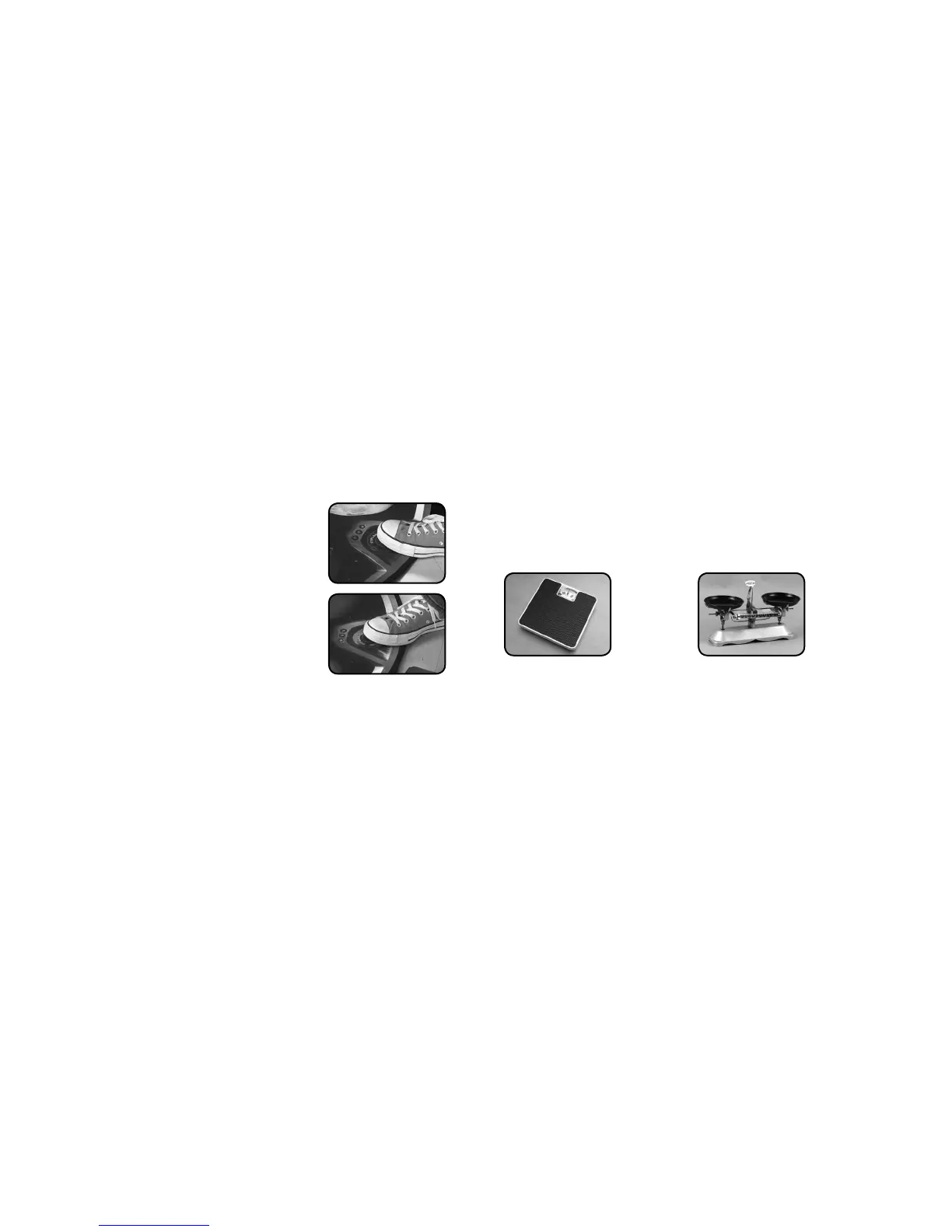
Mass is measured using
a balance, comparing
a known amount of
matter to an unknown
amount of matter.
Weight is
measured
using a scale.



 To Next Page
 Loading...