Need help?
Do you have a question about the GEYA GRT8-X1 and is the answer not in the manual?
Describes typical uses of the time relay for industrial equipment and control.
Lists key features like 20 delay modes, ultra wide delay range, and LED status indication.
Explains the naming convention for different relay models and configurations.
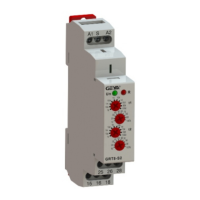
Illustrates the physical layout of the digital display time relay controls and indicators.
Shows the electrical connections for the relay, including terminals for power and output.
Details how to quickly set delay times using short and long presses of buttons.
Explains how to enter and set the specific delay function mode for the relay.
Relay delays and closes output contact after power-on delay time t.
Relay output contact closes immediately on power-on, then disconnects after delay t.
Cyclical delay operation: closes after t1, disconnects after t2, repeats until power off.
Cyclical delay operation: closes after t2, opens after t1, repeats until power off.
Relay closes on power-on, disconnects after t2, then closes after t1, repeating until power off.
Relay delays after external control signal connection, closes output contact after delay t.
Relay closes immediately on external signal, delays on signal disconnection, then disconnects.
Relay closes and delays on external signal, disconnects after t. Signal restart resets delay.
Relay closes on external signal disconnection, delays, disconnects. Signal changes reset delay.
Delays for t1 on signal connection, delays for t2 on signal disconnection.
Output contact state changes upon energization and control terminal connection.
Cyclical delay: closes after T1, disconnects after T2, repeats on external control.
Cyclical delay: opens after t2, closes after t1, repeats on external control.
Relay delays for T1, closes output, then disconnects after T2.
Relay delays for T1 on S trigger, closes output; delays for T2 on next S trigger, disconnects.
Delays for t1, disconnects. Delays for t2 after S disconnection, disconnects.
Relay delays on S connection, closes output. Disconnects when relay is de-energized.
Relay delays on S trigger, closes output. Restarting S resets delay.
Relay is closed when energized, and disconnected when de-energized.
Relay is disconnected regardless of energization state.
This document describes the GEYA GRT8 Series Digital Display Time Relay, a versatile device designed for various industrial and control applications.
The GEYA GRT8 Series Digital Display Time Relay is a multifunctional device capable of controlling industrial equipment, lighting, heating elements, motors, and fans. It offers 20 distinct delay modes, covering a broad delay range from 0.1 seconds to 99 days. These modes include:
t once power is applied, and "Interval (Power On)" where the output contact closes immediately upon power-on and disconnects after delay t.t1 and t2 as long as the S terminal is connected. Other signal-controlled modes include "On delay with external control," "Off delay with external start," "Pulse I with external start," "Pulse II with external start," "On/off delay with external control," "Pulse generator with external start," "Start-stop," "Double delay off with external control," "On delay I by external start," and "On delay II with external start."The relay's status is indicated by an LED. The device is designed for 1-MODULE, DIN rail mounting.
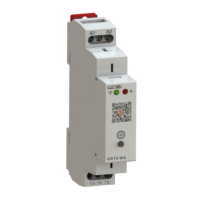
The GRT8 Series time relay is available in two contact configurations: GRT8-X1 (1×SPDT) and GRT8-X2 (2×SPDT).
Supply Terminals: A1-A2 Voltage Range: AC/DC 12-240V (50-60Hz) Burden: AC 0.09-3VA/DC 0.05-1.7W Power Input:
The GRT8 Series time relay features a digital display for easy monitoring and setting. Setting Delay Time:
Wiring Diagram: The manual provides clear wiring diagrams for both 1×SPDT and 2×SPDT configurations, illustrating connections for A1, A2 (supply), S (control signal), and the output contacts (15, 16, 18 for SPDT; 15, 16, 18, 25, 26, 28 for 2×SPDT).
Example Use Cases: The manual illustrates practical applications:
t, stopping the fan.t, the relay disconnects, stopping the pump.t, the relay disconnects, and the LED turns off.Caution: All products must be installed by qualified electricians, and all electrical connections must comply with appropriate safety standards. Disposal of Electrical Waste: All electrical waste should be disposed of in compliance with current WEEE regulations.


 To Next Page
 General