
 Need help?
Do you have a question about the Gialix 36 MA and is the answer not in the manual?
This document describes the Gialix MA electric boiler, an appliance designed for heating and domestic hot water production. The Gialix MA range is available in various power outputs, from 36 kW to 196 kW, and is designed for connection to a 400 V three-phase 50 Hz power supply.
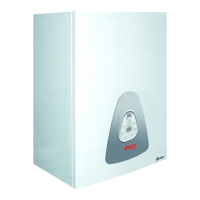
The Gialix MA electric boiler is a compact heating unit with a removable front panel for easy access to internal components. It features a heating chamber equipped with 2 to 5 stainless steel reinforced heating elements, which are accessible and removable from the bottom of the boiler. The control interface, including buttons and a digital display, is located on the front panel. An integrated electric terminal block handles power and connection terminals. Hydraulic components are positioned above the electric panel for direct and easy access from the front.
The boiler is supplied ready for connection to high-temperature systems, with an operating range of 22 to 80 °C and a maximum temperature limitation set at 100 °C. For low-temperature applications, such as underfloor heating circuits, the boiler can be configured to operate between 21 and 50 °C, with a 65 °C high-temperature limiter for water outflow. This adjustment is made by setting parameter 02 (TCMA) to a value at or below 50 °C and installing a 65 °C overheat cut-out with manual reset on the outgoing pipe.
The boiler can be used for various applications:
The Gialix MA boilers come in different models with varying power outputs and specifications:
| Description | 36 kW | 48 kW | 72 kW | 120 kW | 196 kW |
|---|---|---|---|---|---|
| Maximum power (factory supply) | 36 kW | 48 kW | 72 kW | 120 kW | 196 kW |
| Power steps | 2 | 2 | 3 | 5 | 6 |
| Power supply | 400 V TRI 50 Hz | ||||
| Water capacity | 18 L | 18 L | 18 L | 31 L | 50 L |
| Connection diameter | 1"1/4 | 1"1/4 | 1"1/4 | 2" | 2" |
| Minimum pressure | 0.5 bar | ||||
| Nominal pressure | 2 bars | ||||
| Maximum pressure | 3 bars | ||||
| Minimum temperature | 20 °C | ||||
| Maximum operating temperature (factory setting) | 80 °C | ||||
| Minimum water flow (liter/hour) | 1000 | 1350 | 2000 | 3400 | 5625 |
| Nominal water flow (liter/hour) | 2000 | 2700 | 4000 | 6800 | 11250 |
| Maximum water flow (liter/hour) | 4000 | 4000 | 4000 | 10000 | 11500 |
| Weight (kg) | 34 | 34 | 38 | 50 | 70 |
| Dimensions (mm) width | 460 | 460 | 460 | 570 | 630 |
| Dimensions (mm) height | 740 | ||||
| Dimensions (mm) depth | 280 | 280 | 280 | 350 | 400 |
| Intensity at maximum power per phase (Amp) | 70 | 80 | 120 | 200 | 325 |
| Minimum supply wire diameter per phase (mm²) | 4 x 16 + T | 4 x 25 + T | 4 x 35 + T | 4 x 70 + T | 4 x 120 + T |
| Fuse intensity at maximum power (Amp) | 80 | 100 | 125 | 250 | 400 |
Note: 'T' refers to the earth wire, which must have a diameter equal to the biggest cable.
The control panel features a top display for boiler temperature (°C) and a bottom display for pressure (bar). LEDs indicate summer/winter mode, operating status, and anti-frost control. Buttons allow for increasing/decreasing values, accessing operating values (sensor temperatures), and initiating heating or DHW settings menus. A dedicated button shifts between summer and winter modes, and an "Auto/Manu" button selects between manual and automatic operation (automatic mode requires an outside temperature sensor).
The boiler must be firmly mounted to the wall using 8 mm lag-bolts, ensuring wall solidity. A minimum height of 60 mm above any obstacle is required for access to heating elements, and 150 mm from the ceiling for pipe connections. A 10 mm clearance from side walls prevents overheating. Hydraulic connections (outgoing 'D' and return 'R') are located on top of the boiler. Electrical connections require careful tightening of terminals (1.2 N.m) and heating elements (2.5 N.m) to prevent overheating. The electrical supply must be protected by a circuit cutting device with a minimum contact distance of 3 mm (EN 60335-1) and correctly calibrated fuses or magneto-thermal circuit breakers.
Before connection, the heating circuit must be cleaned with an appropriate product to remove welding residues, sealants, grease, sludge, and metallic particles, preventing damage to the boiler. Filling water must be of high quality, with specific pH (8.5-9.5), chloride rate (<60mg/litre), and conductivity (<1000 mS/cm). Frequent or uncontrolled refilling is prohibited to avoid corrosion or scaling. A sludge decanter should be installed at the lowest point of the return heating circuit.
The capacity of the expansion vessel should be determined based on the total volume of the heating circuit. Technical information is provided for an 8-liter expansion vessel (1.5 bar inflated) and a 3-bar safety relief valve.
Parameters can be adjusted by pressing "Button +" and "Button -" simultaneously for 3 seconds. This allows setting maximum/minimum boiler temperatures, ambience thermostat connection, pump monitoring, autoadaptability, outside sensor connection, maximum/minimum outside temperatures, automatic summer switch, postponement between step activations, DHW production, DHW probe, Legionnaires' disease mode, power levels peering, and connection of power steps.
The boiler's power output can be adjusted by modifying parameters 16 to 21. For example, a 72 kW boiler can be adjusted to 24 kW or 48 kW by turning specific parameters to 0. If power is reduced, the diameters of power wires and fuses/circuit breakers must be adjusted accordingly.
Annual inspection by a qualified technician is recommended. Water pressure in the heating circuit should be checked regularly. Electric connections (power distribution, connectors, immersion heaters) should be checked for tightness after initial cut-over and annually thereafter. An anti-blocking system ensures the pump operates for 1 minute daily during periods of inactivity (e.g., summer) to prevent seizing.
The manual provides a detailed troubleshooting guide for common issues:
The boiler displays blinking warnings for sensor failures:
The manual includes tables of Ohmic values for the boiler sensor (SC) and DHW sensor (SECS) (10kΩ at 25°C), outside temperature sensor (SExt), and ambience sensor (SA) at various temperatures, useful for diagnostic purposes.

 To Next Page
 General