impedances at their optimum and avoid excess cable capacitance created in all the additional wiring. Buers
are small, aordable devices readily available through many reputable companies. Your Tone will be well-served
if you employ one to mitigate any loss incurred by the addition of your front-end eects and extra cabling.
STAY CONNECTED! Sound waves transmit through objects and your body. This can be a good thing when playing
electric guitar. It is preferable to have the combo amplifier or a cabinet sitting on the floor you are standing or
sitting on while playing. The transmission, especially of the low end, will aect how the instrument feels to play.
Keeping one speaker cabinet on the floor ensures the instrument, the amp, and your body are connecting and
resonating in a harmonious, sympathetic feedback loop that makes playing your amp more emotionally satisfying
and ultimately more expressive.
NOTE: The exception to this advice above can be when you are playing on stages with many live microphones
cranked up and/or there are large monitors and subwoofers nearby (especially if too big and too many)
...or when the stage itself is extremely resonant in the lower frequencies. In any of these cases, lifting your
cabinetry or combo amplifier o the floor, or sometimes even o of a Drum Riser, may be necessary to de-
couple it from the floor and even your instrument to prevent feedback. This type of feedback usually occurs
in the low end. In some cases and certain environments, alternatively, you can trim the low end in the live
microphones via the Mixing Console and then be able to keep the amplifier coupled to (sitting on) the floor
or stage. Having some coupling through the floor will likely always feel better to you and your hands.
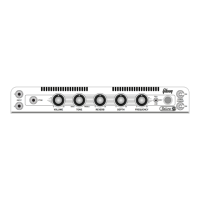
INPUTS 1 & 2 ���Headroom! The two INPUTS on your Falcon are wired for dierent degrees of headroom (Input
sensitivity), and depending on what sounds you are searching for, they can be optimized through your choice of
Inputs.
INPUT 1 – NORMAL: This is the higher gain/lower headroom Input, and it delivers your instrument’s full-strength
pickup signal to the preamp. This allows for easier clipping/overdrive of both preamp and power amp, and when
fed here, the sounds will be fuller and a bit punchier and bolder as well. This is the optimum input if you want to
push the amplifier toward clip and get some natural tube overdrive. Feel free to use this input for cleaner sounds
as well, but you will start to see breakup sooner and, with many instruments, transition into overdrive at about
11:00 -12:00 on the VOLUME control.
INPUT 2 – LOW: This input pads down the input signal and allows you to postpone the edge of clip until higher
settings of the Volume control and stay cleaner longer. When searching for edge-of-clip transition sounds, it can
be a way to “ease on” the overdrive and achieve more of a subtle breakup. It also changes the tone and rolls o
some of the immediacy in the higher frequencies.
SPEAK ACCORDINGLY! Cabinetry and speaker choice are hugely important to achieving the sound you want
and optimizing the amplifier to styles of music you may wish to play. Your Falcon 5 oers an incredible marriage
between the two with its high-quality Alnico speaker and rugged yet resonant open-back Combo cabinet.
Even with a Combo, you can add or substitute extension cabinets to tune your amplifier to the stylistic application
or environment and tune the sound physically, in addition to electronically, with the controls.
OPEN BACK cabinetry leans toward balanced, open-sounding clean sounds, adding three-dimensionality and
clarity in the top end and a low-end character with more “air” in the mix.
CLOSED-BACK cabinetry adds focus and a tighter tracking element, especially in the low end, as well as definition
and punch in the rest of the spectrum. Some players use a combination of both (open and closed-back) at the
same time to achieve a balance of the two dierent characteristics. Others lean one way or another in accordance
with their favored musical style, sounds, or popular artists.
At some point, explore the options in each category to see if perhaps one or the other of these dierent designs
unlocks sounds and response characteristics you’ve imagined but may not have yet attained with your amplifier.
You may be surprised at what percentage of a given sound speakers and cabinets account for.
4


 To Next Page
 Loading...