Need help?
Do you have a question about the Gira Dual Q and is the answer not in the manual?
Ensures proper setup and configuration only by qualified personnel as per DIN standards.
Explains the quality seal criteria for longevity, fewer false alarms, and increased stability.
Lists the included items in the package: smoke alarm device, mounting hardware, and instructions.
Details optional accessories like relay, radio, and KNX modules, and spacer sleeves.
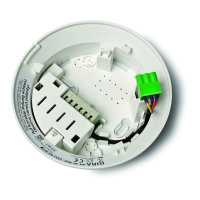
Illustrates the components of the smoke alarm device, including mounting plate and function button.
Specifies unsuitable environments for installation, such as caravans or boats.
Defines minimum and optimum protection strategies for residential units and larger buildings.
Identifies sites prone to false alarms and suggests alternative solutions or precautions.
Details how to connect up to 40 devices using a two-core cable for simultaneous alarming.
Guides users through the process of conducting a function test after installation and alarms.
Instructs on immediate replacement if the device fails the function test consecutively.
Explains how function tests behave in a network of connected smoke alarm devices.
Details signal tones and ring indicator meanings for local smoke alarm operation.
Explains signal tones and ring indicator meanings for networked smoke alarm devices.
Describes signalling differences when using the 230 V socket and base.
Recommends regular cleaning with a moist cloth and vacuum cleaner for optimal performance.
Emphasizes the requirement for annual maintenance by a qualified expert as per DIN 14676.
Clarifies that the Q label does not affect the legal warranty provisions.
Explains the device's purpose is to warn occupants, who are responsible for their own rescue.
Provides essential safety steps for occupants to follow during a fire emergency.
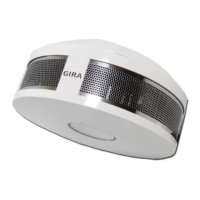
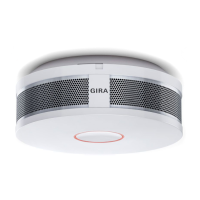
The Gira Dual Q smoke alarm device (item no. 2346 02) is a battery-operated smoke and heat alarm designed for private residential units or similarly inhabited areas, compliant with DIN 14676. Its primary function is to detect smoke development in a timely manner and warn occupants before smoke gas concentration becomes dangerous. The device provides both acoustic (tone) and optical (LED) warning signals.
The Dual Q smoke alarm device operates on a photoelectric scattering principle for smoke detection and utilizes maximum and differential functions for heat detection. It emits a loud, pulsating alarm signal of at least 85 dB (A) when smoke or heat is detected. Fire and heat alarms are differentiated by distinct alert patterns. During a function test, a muffled alarm signal of approximately 75 dB (A) is emitted to prevent hearing loss.
The device features an integrated function button that serves multiple purposes: alarm acknowledgment, function testing, and muting. Smoke detection can be optionally switched off, allowing the device to operate solely as a heat detector in rooms unsuitable for conventional smoke alarms. In this mode, an alarm is triggered if the ambient air heats up outside normal parameters or if the ambient temperature exceeds +54 °C.
The Dual Q smoke alarm device includes an automatic smoke evaluation self-test with tracking of soiling, providing a "fouling/malfunction" indication. Technical faults can be signaled, with the option to delay this indication by up to 12 hours in darkness.
Up to 40 Dual Q smoke alarm devices can be networked together using a two-core cable, enabling a simultaneous alarm across all networked devices in a residential unit. The device also includes a module interface for three optional modules (relay, radio, KNX) with simultaneous use of a networking terminal. An external button, such as an emergency switch, can be connected in parallel via the networking terminal.
The device is activated automatically when locked into its mounting plate or 230 V base. Alternatively, it can be activated by manually holding the function test button. Deactivation occurs automatically when the lock is disengaged.
For optimal protection, the device should be installed as close as possible to the center of the ceiling, with a minimum distance of 50 cm from walls, lights, and other obstructions. One smoke alarm device is recommended per room, covering a maximum area of 60 m². It should not be mounted in direct proximity to heat sources.
The function test should be conducted after initial installation, after every alarm, and after any maintenance session or fault message. To perform a function test, press and hold the function button for approximately 4 seconds. A brief acknowledgment tone will be heard, followed by a muffled signal tone, and the ring indicator will flash. Releasing the button will complete the test. If successful, pressing and holding the button again will mute the signal tone and turn off the ring indicator. If the device fails the function test twice in a row, it should be replaced immediately.
Muting functionality allows for temporary deactivation of smoke alarm operation for a maximum of 15 minutes. This is useful to prevent deceptive alarms during activities that create large amounts of dust (e.g., sweeping) or to silence alarms triggered by harmless smoke (e.g., from searing meat). To activate muting, press the function button for 1 second until an acknowledgment tone is heard. Releasing the button will cause the ring indicator to flash in a 2-second cycle, indicating that muting is active. After 15 minutes, muting automatically deactivates, and the device returns to normal operating mode.
The photocell integrated in the smoke alarm device can delay the "Smoke alarm device soiled" warning by up to 12 hours in darkness. This delay can be extended by 8 hours at a time for a maximum of 7 days if the initial signaling occurs at an unfavorable time. To activate this delay, push the function button until the first signal tone is muted.
In the event of an alarm, if a deceptive alarm is identified, the alarm message can be acknowledged by pressing the function button. It is crucial to ensure that the cause of the deceptive alarm has been eliminated. If temporary elimination is not possible, muting can be activated.
Regular care and maintenance are essential to ensure the full operability of the smoke alarm device. The device should be wiped with a moist (not wet) cloth on a regular basis. Dust can be carefully removed with a vacuum cleaner set to the lowest setting.
According to DIN 14676, smoke alarm devices must be maintained annually by a qualified expert. The results of this maintenance should be recorded in a maintenance book for smoke alarm devices. Failure to carry out this required maintenance may nullify insurance coverage in case of fire.
During renovation work, it is advisable not to install the smoke alarm device until all work is completed. If this is not possible, the device should be covered with the included covering cap (which must be removed once work is complete) or removed entirely for the duration of the work. After renovation, the functional readiness of the installed smoke alarm device must be restored and tested.
The device's battery is permanently installed and non-removable, designed for a longevity of up to 10 years after activation, contributing to fewer false alarms and increased stability against external factors. The battery life can be reduced by additional use of modules, networking via the terminal, or more frequent test alarms than prescribed. The device must be disposed of completely when the battery is flat or by the date indicated on its label. Forced removal of the battery is dangerous and can lead to an explosion if damaged.
 General
| Quantity | 1 |
|---|---|
| Detector type | Photoelectrical reflection detector |
| Mounting type | Surface-mounted |
| Product color | Silver, White |
| Alarm decibels | 85 dB |
| Interconnectable | Yes |
| Connectivity technology | Wireless |
| International Protection (IP) code | IP42 |
| Number of simultaneously connected devices (max) | 40 |
| Battery life | 10 year(s) |
| Power source | Battery |
| Battery voltage | 9 V |
| Battery technology | Lithium |
 Weight and Dimensions
| Height | 48 mm |
|---|---|
| Diameter | 125 mm |

 To Next Page