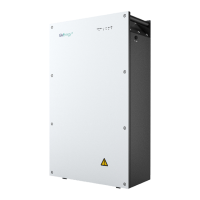
This document describes the GivEnergy 8.2kWh LiFePO4 Battery, an energy storage solution designed for photovoltaic systems. It provides comprehensive instructions for installation, operation, and maintenance, ensuring safe and efficient use.
Function Description
The GivEnergy 8.2kWh LiFePO4 Battery is a modular energy storage unit that integrates with an inverter to store excess energy generated by photovoltaic (PV) systems. This stored energy can then be used when PV generation is low or demand is high, optimizing self-consumption and providing energy independence. The battery's Battery Management System (BMS) software facilitates communication with the inverter, enabling seamless operation and monitoring. It supports both hybrid and AC couple inverter configurations and can be connected in parallel with up to four battery packs for increased capacity.
Important Technical Specifications
The GivEnergy 8.2kWh LiFePO4 Battery boasts robust technical specifications:
- Model Type: Giv-Bat8.2
- Type of Battery: LiFePO4 (Lithium Iron Phosphate)
- Battery Voltage Range: 44.8~57.6Vd.c.
- Max Charge and Discharge Current: 80Ad.c.
- Depth of Discharge: 90%DOD
- Rated Capacity: 150Ah
- Usable Capacity: 135Ah
- Short-Circuit Current: 350A
- Display: LED
- Communication: RS485/USB
- Degree of Protection: IP65
- Operating Temperature Range: 0~+50°C For Charge, -10~+50°C For Discharge
- Protective Class: I (Connect to inverter with class I)
- Weight: 69 ± 0.5kg
- Dimension (W*H*D): 480*620*198 (mm)
The battery is compatible with a range of approved inverter models, including Giv-HY3.6, Giv-HY4.6, Giv-HY5.0, Giv-AC2.0, Giv-AC3.0, ESA-3600, and ESA-5000 for new systems. For retrofit systems (existing string inverter of any brand), it is compatible with Giv-AC3.0. An external DC isolator with a recommended rating of 80Amps is required for safety and maintenance.
Usage Features
The battery offers several user-friendly features:
- Wall Mount Installation: The battery is designed for wall mounting, with specific instructions provided for securing the wall mount rack using six explosion bolts. Clearances of at least 300mm are required around the unit for proper ventilation and access.
- DC Connections: Red and black DC cables connect the battery to the inverter. The manual details the process of unscrewing waterproof terminals, threading cables, fixing them with a specified torque (1.2-1.5NM), and tightening the terminals. An external DC isolator is crucial for safety.
- BMS - RS485 Communication: An RS485 cable links the battery's BMS to the inverter, enabling communication. The manual provides detailed diagrams for connecting the RS485 communication port on both hybrid and AC couple inverters, as well as on the battery pack itself. Correct polarity is emphasized to prevent miscommunication and errors.
- Grounding Connection: The battery must be grounded using a 10mm earthing cable, with the grounding point clearly indicated.
- Multiple Battery Connections: The modular design allows up to four battery packs to be connected per inverter. The manual includes diagrams and instructions for power cable connections and BMS configurations for master and slave batteries. DIP switch settings are provided for parallel battery configuration, ensuring proper address assignment for each pack.
- Battery Start-up/Shut-down Procedure: A clear sequence of steps is outlined for turning the battery on and off, including operating the DC switch (isolator) and pressing the ON/OFF button. Audible beeps and LED indicators confirm the battery's status.
- LED Indicators: The battery features LED indicators for status (RUN/ALM) and state of charge (SOC). A table explains the meaning of different LED colors and patterns, including green for normal operation, yellow for warnings, and red for errors. The SOC is indicated by four LEDs, providing a visual representation of the battery's capacity in 25% increments.
- Monitoring Features: The GivEnergy Monitoring portal allows users to view real-time and historical data on energy generation, household consumption, battery storage, charging/discharging activity, and grid interaction. This portal also displays monitoring grid voltages, battery temperature, and individual cell state of charge.
- WiFi Configuration: The battery includes a USB Dongle for WiFi connectivity, enabling remote monitoring. The manual provides detailed instructions for configuring the WiFi module, including connecting to its network, accessing the web interface (10.10.100.254), searching for and connecting to the desired wireless network, and setting security parameters. It also covers changing the dongle's login username and password for enhanced security.
Maintenance Features
Regular maintenance is essential for the battery's longevity and performance:
- Checking Heat Dissipation: Users are advised to ensure adequate heat dissipation by maintaining safe distances from other heat sources and cleaning the heat sink or removing obstructions if the battery regularly reduces output due to high temperatures.
- Cleaning the Battery: Before cleaning, the battery and inverter must be completely shut down. The enclosure lid can be cleaned with a lint-free cloth, soap, and water. Cleaning solvents or chemicals should be avoided. Objects should not be leaned, stacked, or hung from the battery.
- Checking the DC Switch: Regular (e.g., monthly) checks for externally visible damage, discoloration of the breaker, and cables are recommended. Any signs of damage or discoloration necessitate contacting the installer or GivEnergy.
- Ventilation and Charging: The battery's ventilation points must be kept free from debris. A complete charge and discharge cycle every six months (preferably from the grid) is recommended to maintain battery health. If this cannot be performed, the distributor can facilitate it via the monitoring portal.
- Troubleshooting: The manual includes a troubleshooting section with common issues, their descriptions, and corresponding solutions. This covers problems like temperature extremes, high/low voltage, charging/discharging failures, and LED indicator issues. Users are advised not to open the battery unless qualified and to contact the GivEnergy Technical Team for assistance.
Safety is paramount, and the manual outlines critical precautions:
- General Safety: All installation and maintenance must be performed by approved technicians. The equipment carries risks of electric shock and leaked gases, requiring adherence to general precautions.
- Fire Safety: ABC or carbon dioxide fire extinguishers should be kept nearby. Water must not be used to extinguish battery fires. If the battery catches fire (e.g., when heated above 150°C), immediate evacuation of the vicinity is required, and no attempt should be made to extinguish it.
- Damage and Flooding: In case of battery damage, the GivEnergy hotline or dealer should be contacted immediately. If safe, the battery should be disconnected at the DC isolator and turned off. If flooding occurs, the unit must be shut down and not restarted until completely dry.
- Authorized Personnel: Only authorized GivEnergy sellers and technicians are permitted to install, service, maintain, or remove the unit.
- Shipping and Storage: The product should be handled with care during shipping to avoid damage from throwing, dropping, or strong vibrations. Storage should be in a cool place (between -20°C to +50°C) with average monthly relative humidity less than 90%, free from corrosive gases, flammable materials, and direct sunlight.

 Need help?
 General

 To Next Page