EasyManua.ls Logo

Global Fire Equipment GFE-S - User Manual

Global Fire Equipment GFE-S
2 pages
Print Icon
To Next Page IconTo Next Page
Loading...
GFE-S and GFE SH Detector
Installation Wiring Diagram
TYPICAL WIRING DIAGRAM
Figure 1(a) shows the typical wiring diagram of the
2-wire multiple-station smoke detector system.
INITIATING
LOOP
EN54 LISTED
COMPATIBLE
CONTROL
PANEL
+
-
FIRST DETECTOR BASE
LAST DETECTOR BASE
EOL
RESISTOR
5
2
5
2
61 34 61 34
+
-
+
REMOTE
INDICATOR
CLASS A OPTIONAL WIRING
N
O
TE: IF REM
O
TE INDI
C
AT
O
R I
S
N
O
T
US
ED. P
O
LARITY T
O
DETE
C
T
O
R MAY BE REVER
S
ED.
-
Figure 1(b) shows the typical wiring diagram of the
4-wire multiple-station smoke detector system.
WARNING
TO PREVENT DETECTOR CONTAMINATION AND
SUBSEQUENT WARRANTY CANCELLATION, THE
SMOKE DETECTOR MUST REMAIN COVERED UNTIL
THE AREA IS CLEAN AND DUST FREE.
INSTALLING THE BASE
1. To insure proper installation of the detector head to the
base, all the wires should be properly addressed at
installation:
(A) Position all the wires flat against terminals.
(B) Fasten the wires away from connector terminals.
2. If you use a jumper wire to connect the poles of
terminal 2 and 5 when testing the detector loop
continuity, be sure to remove the jumper wire prior to
the installation of the detector head.
3. The end-of-line device shown in fig. 1(a) and 1(b)
should be compatible with the control unit. The
end-of-line supervisory relay used should be rated for
the DC power voltage used.
4. Open area smoke detectors are intended for mounting
on a ceiling or a wall in accordance with the fire
standard in your country.
5. The base of the smoke detector can be mounted
directly onto an electrical junction box such as an
octagonal (75mm, 90mm or 100mm), a round (75mm),
or a square (100mm) box without using any type of
mechanical adapter.
INSTALLING THE HEAD
1. Align the components as shown in Figure 2.
2. Mate the detector head onto the base and twist
clockwise to secure it.
3. Do not install the detector head until the area is
thoroughly cleaned of construction debris, dusts, etc.
The maximum number of smoke detector installed in
the same detection zone is typically 30 units. Refer to
control panel manual.
Fig. 2 Fitting detector head onto base
ADJUSTING THE RELAY FOR NO/NC
The normal condition for the relay is normally open
(NO).
1. To adjust the normal condition of the relay to
normally closed (NC), insert a screwdriver into the
rectangular hole located on the side between the front
cover and base and rotate to remove the front cover.
2. Refer to figure 3. There is a jumper head next to the
relay on the PCB. Remove the jumper head and reinsert
it in the NC position.
3. Carefully replace the front cover.
Relay contact rating:
1A@30VDC,
0.5A@125VAC
.
TESTING
1. All remote signaling systems, releasing devices and
extinguishing systems should be disconnected
during the test period and reconnected at the
conclusion of testing.
2. After energizing the detector head for approximately
one minute, check to see the indicator green LED
flashing once every 3~5 seconds. If green LED fails to
flash, it indicates the non-functioning of the detector or
faulty wiring. Re-check the wiring or replace the
detector if necessary.
3. Allow smoke from a cotton wick or a test smoke
aerosol to enter the detector-sensing chamber for at
least 10 seconds. When sufficient smoke has entered
the chamber, the detector will signal an alarm, this
being visible by a continuous illumination of the LED.
Reset each detector and/or control unit before
attempting to test any additional detectors in the same
zone. If the alarm fails in this step, it indicates a
defective unit, which requires service.
Fig. 3 Schematic of detector structure
When front cover is open.
Question and Answer IconNeed help?

Do you have a question about the Global Fire Equipment GFE-S and is the answer not in the manual?

Summary

Installation Wiring Diagram

Typical Wiring Diagrams

Illustrates wiring for 2-wire and 4-wire multiple-station smoke detector systems.

Relay Adjustment for NO;NC

Procedure to adjust the relay contact from normally open to normally closed.

Installation Procedures

Base Installation

Instructions for properly installing the detector base, including wire management.

Head Installation

Steps for aligning and securing the detector head onto the installed base.

Testing and Maintenance

Smoke Detector Testing

Procedure to test the smoke detector's alarm function using simulated smoke.

Heat Sensor Testing

Procedure to test the detector's response to heat sources.

Detector Maintenance

Recommended annual cleaning and notes on factory-sealed components.

Product Specifications and Warranty

Detector Specifications

Technical data including wire types, voltage, currents, and timing parameters.

Limited Warranty Statement

Details of the product warranty period and limitations.

Overview

This document describes the installation, wiring, testing, and specifications of the GFE-S and GFE SH series smoke and heat detectors from Global Fire Equipment.

Function Description

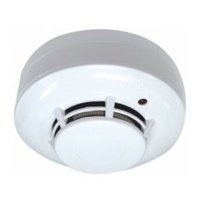
The GFE-S and GFE SH detectors are designed for use in fire detection systems. The GFE-S models are smoke detectors, while the GFE SH models are heat detectors. They are available in both 2-wire and 4-wire configurations and can be integrated into compatible control panels. The detectors feature an LED indicator for status (green for normal operation, continuous red for alarm) and some models include remote LED indicator output. The 4-wire models also include a power supervision relay module.

Important Technical Specifications

The detectors operate on DC voltage, with specific models designed for 12V, 24V, or 28/12V systems.

Smoke Detectors (GFE-S series):

  • Standby Current: 90µA (2-wire), 320µA (4-wire)
  • Alarm Current: 70mA (2-wire), 35mA (4-wire)
  • Surge Current: 120µA
  • Star-Up Time: 60 Seconds
  • Permissible Current: 80mA
  • Frequency: 3-5 Seconds (LED flash interval)
  • Alarm Contact: Form A (4-wire models)
  • Base Model: P/N772912 or P/N774912

Heat Detectors (GFE-SH series):

  • Activation Temperature: 57°C
  • Standby Current: 100µA (2-wire), 320µA (4-wire)
  • Alarm Current: 70mA (2-wire), 35mA (4-wire)
  • Surge Current: 130µA
  • Star-Up Time: 60 Seconds
  • Permissible Current: 80mA
  • Frequency: 3-5 Seconds (LED flash interval)
  • Alarm Contact: Form A (4-wire models)
  • Base Model: P/N772912 or P/N774912

Relay Contact Rating (for models with relays):

  • 1A@30VDC
  • 0.5A@125VAC

The maximum number of detectors per detection zone is typically 30 units, as per control panel manual specifications. The product is EN54 listed (parts 7 and 5/7) with certificate numbers 0845-CPD-232.1489 and 0845-CPD-232.1490 respectively.

Usage Features

Installation:

  • Wiring: The document provides typical wiring diagrams for both 2-wire and 4-wire multiple-station systems, including connections to compatible control panels, EOL resistors, and optional Class A wiring. Wires should be properly positioned flat against terminals and away from connector terminals.
  • Mounting: The detector base can be mounted directly onto standard electrical junction boxes (octagonal 75mm, 90mm, 100mm; round 75mm; or square 100mm) without mechanical adapters.
  • Head Installation: The detector head aligns with the base using alignment marks and is secured by twisting clockwise. It is recommended not to install the detector head until the area is clean and dust-free to prevent contamination.
  • Relay Adjustment: For models with relays, the normal condition can be adjusted from "normally open" (NO) to "normally closed" (NC) by accessing a jumper head on the PCB.

Testing:

  • General Testing: Before testing, all remote signaling, releasing, and extinguishing systems should be disconnected. After powering up, the green LED should flash every 3-5 seconds. Failure to flash indicates a non-functioning detector or faulty wiring.
  • Smoke Detector Testing: Smoke from a cotton wick or test smoke aerosol should be introduced into the sensing chamber for at least 10 seconds. An alarm is indicated by continuous illumination of the LED. Detectors and/or control units must be reset after each test.
  • Heat Sensor Testing: The detector should be subjected to a warm airflow between 65°C and 80°C (e.g., from a domestic hair dryer). The airflow should be directed at the thermistor guard from several inches away. The detector should alarm within 30 seconds, indicated by the red LED. After alarm, the heat source should be removed, and the detector reset. If a detector fails to activate within 60 seconds, connections and programming should be checked, or the detector replaced.

Maintenance Features

  • Cleaning: The recommended minimum maintenance is an annual cleaning of dust from the detector head using a vacuum cleaner. Specific cleaning programs should conform to NFPA-72A standards.
  • Contamination Prevention: To prevent detector contamination and warranty cancellation, the smoke detector must remain covered until the installation area is clean and dust-free.
  • Factory Sealed: This product is factory sealed and does not contain user-serviceable parts. Opening the detector head will void the warranty.
  • Warranty: Global Fire Equipment Ltd. provides a 24-month limited warranty against defects in material and workmanship from the date of purchase. For warranty claims, an RMA (Return Merchandise Authorization) number must be obtained from Global Fire Equipment directly, and shipments must be prepaid.

Global Fire Equipment GFE-S Specifications

General IconGeneral
BrandGlobal Fire Equipment
ModelGFE-S
CategorySecurity Sensors
LanguageEnglish

Related product manuals