EasyManua.ls Logo

Global WF 955 - Page 7

Global WF 955
32 pages
Print Icon
To Next Page IconTo Next Page
To Previous Page IconTo Previous Page
Loading...
case
open.
5)
Take
the
threaded
bobbin
case
by
th
e
latch
anct
place
1t
on
the
center
stud
ot
the
bobbin
case
holder
.
Release
latch
and
press
bobbin
case
on
to
center
stud
until
the
latch
catches
the
undercut
thereon
with
a
click
that
can
be
heard
.
Permit
about
5
cm
of
bobbin
thread
to
hand
down
freely.
Be
sur
e
to
push
the
slide
plate
to
the
right
before
starting
to
sew
.
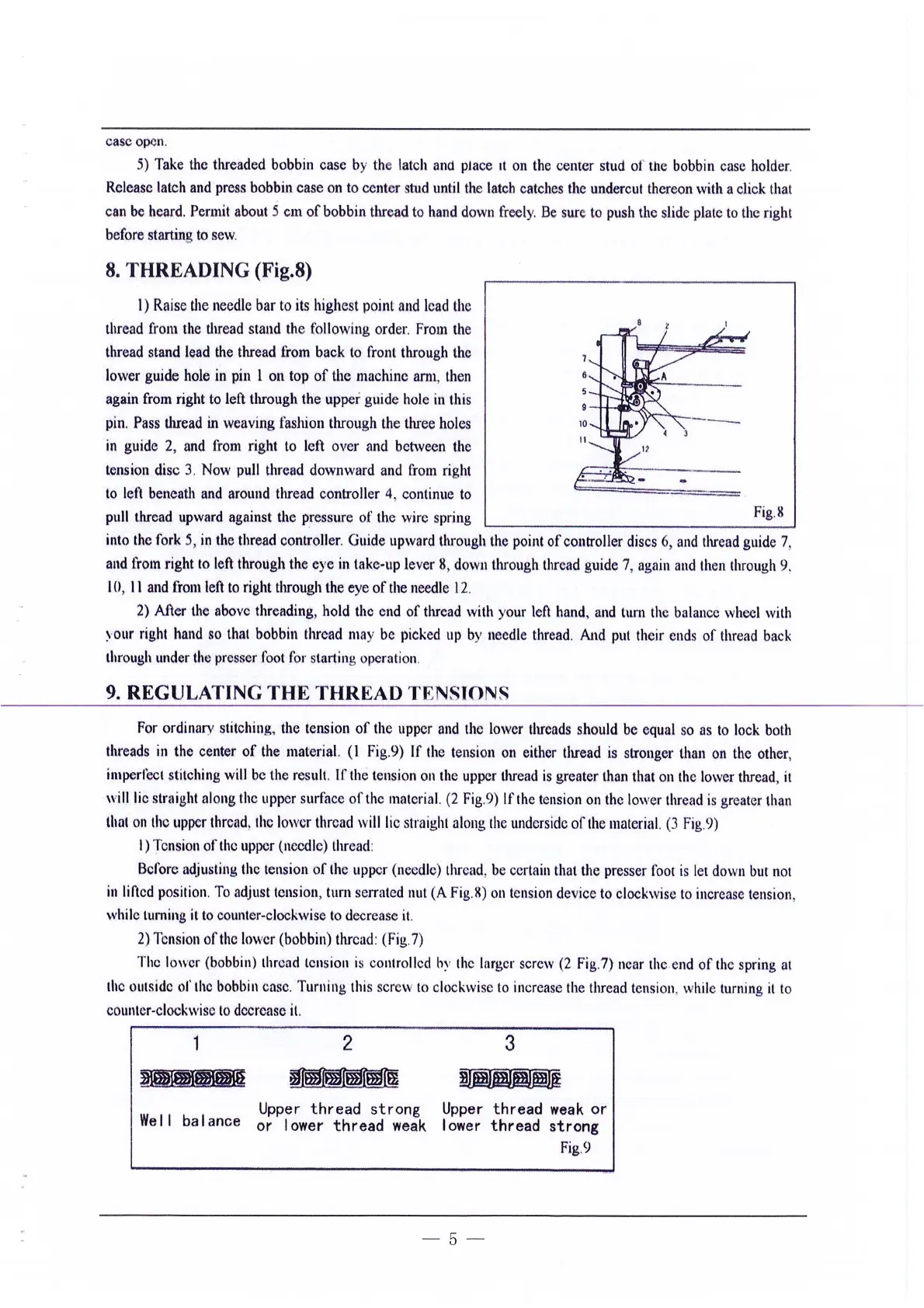
8.
THREADING
(Fig.8)
1)
Raise
the
needle
bar
to
its
highest
point
and
lead
the
thread
from
the
t11read
stand
the
following
order.
From
the
thread
stand
lead
the
thread
from
back
to
front
through
the
lower
guide
hole
in
pin
1
on
top
of
the
machine
am1
,
then
again
from
right
to
left through
the
upper
guide
hole
in
this
pin
.
Pass
thread
in
weaving
fashion
through
the
three
holes
in
guide
2,
and
from
right
to
left
over
and
between
the
tension
disc
3.
Now
pull
thread
downward
and
from
right
to
left
beneatl1
and
around
thread
controller
4,
continue
to
10
11
pull
thread
upward
against
the
pressure
of
the
wire
spring
Fig
.8
into
the
fork
5,
in
the
thread
controller.
Guide
upward
through
the
point
of
controller
discs
6,
and
thread
guide
7,
and
from
right
to
left
through
the
eye
in
take-up lever
8,
down
through
thread
guide
7,
again
and
th
en
through
9.
I 0,
11
and
from
left
to
right
through
the
eye
of
the
needle
12
.
2)
After
the
above
threading,
hold
the
end
of
thread
with
your
left
hand
,
and
tum
the
balance
wheel
with
\our
right
hand
so
thal
bobbin
thread
ma
y
be
picked
up
by
needle
thread
.
And
put
their
ends
of
thread
ba
ck
through
under
the
presser
foot
for
starting
operation
.
9.
REGULATING
THE
THREAD
T
ENSI
ONS
For
ordinary
stitching,
the
tension of
the
upper
and
the
lower
threads
should
be
equal
so
as
to
lock
both
threads
in
the
center
of
the
material.
(
1
Fig
.
9)
If
the
tension
on
either
thread
is
stronger
than
on
the
other
,
imperfect
stitching
will
be
the
result
.
If
the
tension
on
the
upper
thread
is
greater
than
that
on
the
lower
thread
,
it
will
lie
straight
along
the
upper
surface of
the
material.
(2
Fig
.
9)
If
the
tension
on
the
lower
thread
is
greater
than
thal
on
the
upper
thrcad
1
the
lower
thread
will
lie
straight
along
the
w1dersidc
of
the
material.
(3
Fig
.
9)
I)
Tension
of
the
upper
(needle)
thread
:
Before
adjusting
the
tension
of
the
upper
(needle)
thread
be
certain
that
the
presser
foot
is
let
down
but
not
in
lifted
position
.
To
adjust
tension
,
tum
serrated
nul
(A
Fig
.
II)
on
tension
de
v
ice
to
clockwise
to
increase
tension
,
while
turning
it
to
counter-clockwise
to
decrease
it.
2)
Tension
of
the
lower
(bobbin)
thread
:
(Fig.
7)
The
lower
(bobbin)
thr
e
ad
tension
is
controlled
by
th
e
larger
screw
(2
Fig
.7)
near
the
e
nd
of
the
spring
at
the
outside
of
the
bobbin
case.
Turning
this
scr
ew
to
clockwise
to
increase
the
thread
tension
,
while
turning
ii
to
counter
-
clockwise
to
decrease
it.
2
~
3
Upper
thread strong
Upper
thread
weak
or
Wei
I balance or
lower
thread
weak
lower
thread strong
Fig
.9
-5-
From the library of Superior Sewing Machine & Supply LLC - www.supsew.com

Related product manuals