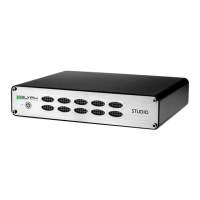
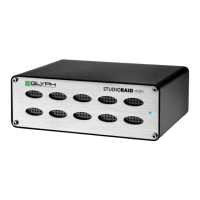
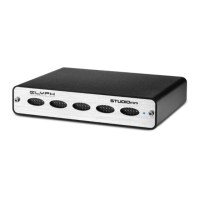
About the StudioRAID and Drive Modes
The StudioRAID enclosure contains two hard disk drives, which function as one single volume. It supports
two drive modes: RAID 1 (mirroring) and RAID 0 (striping). Each drive mode has its own advantages,
depending upon the application.
RAID 1 (mirroring) oers data redundancy and real-time backup by writing the same data to the
two hard drives at the same time. Should a drive failure happen, data is still available on the remain-
ing drive. In RAID 1 mode, the two drives are seen by the computer as one volume, but with half the
capacity. For example, a 1TB StudioRAID will be seen as a 500GB drive. Reading and writing occurs
on both drives simultaneously so that each of the drives contains exactly the same data, mirroring
each other. If either of the drives should fail the other is there to seamlessly continue to provide
operation.
RAID 0 (striping) increases the performance of the drive system by spreading the data across two
drives. RAID 0 is a proven technology for editing video, working with huge graphics les, sound
libraries, and streaming instruments that play hundreds of samples simultaneously. RAID 0 is the de-
fault shipping drive mode. In RAID 0 (striping) mode, the two drives are seen by the computer as one
large drive, and reading and writing occurs on both drives simultaneously. It is designed to increase
the performance and data throughput of the drive system. The StudioRAID's built-in RAID controller
splits each piece of data across both of the drives in segments and distributes the I/O burden. Since
data is written without any form of parity data-checking, it allows for the fastest data transfer of all
other RAID levels. However, if one drive becomes damaged, the data on both drives can become
cor-rupted. RAID 0 is not redundant or fault tolerant like RAID level 1, but the trade off is that it’s the
fastest of all RAID levels. MAKE SURE TO BACKUP YOUR DATA OFTEN!


 To Next Page