This document is an operating manual for a GM COACH MODEL PD-4104, a type of passenger bus or coach manufactured by General Motors. The manual, printed in July 1954, provides comprehensive information for the operator regarding the function, operation, and maintenance of the vehicle.
Function Description:
The GM COACH MODEL PD-4104 is designed for the transportation of passengers, likely for intercity travel or charter services, given the "Coach" designation. Its primary function is to provide reliable and comfortable transport, incorporating features for driver control, passenger comfort, and safety. The manual emphasizes the importance of proper operation to ensure efficiency and safety, highlighting that the information is directly relevant to the driver's skill, rules of the road, and highway safety practices.
Important Technical Specifications and Features:
Operator's Controls and Compartment:
The operator's compartment is meticulously designed with controls, gauges, and switches strategically located for ease of access and visibility.
- Driver's Hand Window (1): Allows the driver to open and close a window.
- Operating Control Panel (2): Central panel for various operational controls.
- Hand Brake Lever (3): Engages the hand brake.
- Spot Light Handle (4): Controls the spot light.
- Air Horn Button (5): Activates the air horn.
- Fog Light Selector (6): Selects fog lights.
- Dimmer Switch (7): Controls headlight dimming.
- Electric Horn Button (8): Activates the electric horn.
- Switch and Gauge Panel (9): Contains various switches and gauges.
- Entrance Door Control (10): Manages the passenger entrance door.
- Windshield Wiper (11): Controls the windshield wipers.
- Clutch Pedal (12): Engages and disengages the clutch.
- Brake Pedal (13): Activates the service brakes.
- Accelerator Pedal (14): Controls engine speed.
- Transmission Shift Lever (15): Used to select gears.
- Defroster Heater Control (16): Manages the defroster and heater.
- Hand Throttle (17): Provides manual throttle control.
- Front Vent Control (18): Controls the front ventilation.
Switch and Gauge Panels (Detailed):
The coach features extensive gauge and switch panels, with tell-tale lights illuminating certain conditions.
- Engine Starter Switch (1): Initiates engine start.
- Engine Control Switch (2): General engine control.
- Overrule Switch for Moto-Gard (3): Overrides the Moto-Gard system.
- Engine Emergency Stop Switch (4): Emergency engine shutdown.
- Transmission Reverse Switch (5): Activates reverse gear.
- Air Cond. Engine Low Oil Tell-Tale (GM) (6): Indicates low oil pressure for the air conditioning engine.
- Air Cond. Engine Stop Tell-Tale (Tropic-Aire) (7): Indicates air conditioning engine stop.
- Low Air Tell-Tale (8): Warns of low air pressure.
- Engine Low Oil Tell-Tale (9): Warns of low engine oil pressure.
- Engine Temperature Tell-Tale (10): Indicates high engine temperature.
- Emergency Door Tell-Tale (11): Warns if the emergency door is not secured.
- Speedometer (12): Displays vehicle speed.
- Oil Pressure Gauge (13): Shows engine oil pressure.
- Temperature Gauge (14): Displays engine temperature.
- Air Pressure Gauge (15): Shows air system pressure.
- Fuel Gauge (when used) (16): Displays fuel level.
- Generator Charge Indicator (17): Indicates generator charging status.
- Headlight High Beam Tell-Tale (18): Indicates high beam headlights are on.
- Fog Light Tell-Tale (19): Indicates fog lights are on.
- Directional Signal Flasher (20): Flashes when turn signals are active.
- Stop Light Tell-Tale (21): Indicates brake lights are on.
- Hand Brake Applied Tell-Tale (22): Indicates the hand brake is engaged.
- For Special Equip. (23): Reserved for special equipment indicators.
- Headlight Switch (24): Controls headlights.
- Marker Light Switch (25): Controls marker lights.
- Destination Sign Light Switch (26): Controls destination sign illumination.
- Defroster Heater Fan Switch (27): Controls the defroster and heater fan.
- General and Reading Light Switch (28): Controls interior general and reading lights.
- Choke Button (Air Cond. Engine) (29): Choke for the air conditioning engine.
- Starter Button (Air Cond. Engine) (30): Starter for the air conditioning engine.
- Thermostat Control Switch (31): Controls the thermostat.
- Master Switch (32): Main power switch.
- Selector Switch (33): Selects various functions.
- Passenger Chime Buzzer (34): Activates the passenger chime.
- Driver's Fan Switch (35): Controls the driver's fan.
- Windshield Fan Switch (36): Controls the windshield fan.
- Driver's Light Switch (37): Controls the driver's light.
- Aisle Seat Light Switch (38): Controls aisle seat lights.
Compartments:
The coach is equipped with various interior and exterior compartments for maintenance and access.
- Interior Compartments:
- Safety Compartment: Recessed in the dash panel, stores standard safety equipment.
- Defroster Heater Compartment: Contains the defroster heater and fans, requires periodic bleeding.
- Circuit Breakers: Covered panel to the left of the driver, houses automatic reset type circuit breakers.
- Access to Engine: Top of the engine can be serviced through a large opening under the rear cross seat cushions.
- Exterior Compartments:
- Entrance Door Release (1): External release for the entrance door.
- Front Vent (2): Front ventilation opening.
- Front License Holder (3): Mount for the front license plate.
- Spare Tire Compartment (4): Stores the spare tire.
- Tool Compartment (5): Stores tools.
- Left Air Intake (6): Air intake on the left side.
- Air Condition Unit Compartments (7): Houses air conditioning components.
- Baggage Compartments (8): Three compartments for passenger luggage, two front compartments for air conditioning units (if air conditioning is not used, four baggage compartments are on the left side).
- Battery Compartment (9): Houses the batteries.
- Emergency Door (10): Emergency exit door.
- Radiator Grille (11): Covers the radiator.
- Radiator Filler Door (12): Access to the radiator filler.
- Rear License Holder (also Access Door to Dipstick) (13): Mount for the rear license plate and access to the engine dipstick.
- Engine Compartment Doors (14): Access to the engine.
- Transmission Access Door (15): Access to the transmission.
- Regulator Compartment (16): Houses the voltage regulator.
- Air Cond. Engine Gasoline Filler (17): Filler for the air conditioning engine's gasoline tank.
Operator's Seat:
The operator's seat is highly adjustable for comfort and visibility. It can be moved fore and aft, raised/lowered, and tilted for back and cushion angle.
Door Controls:
- Passenger Entrance Door: Controlled by a lever located on the windshield ledge to the right of the operator. A "BUZZER" indicates when the door is open. The door can be partially swung open after releasing the latch.
- Emergency Door: Secured with a lever type latch handle. An alarm buzzer sounds when the latch is not secure.
Side Windows:
Front and rear halves of each passenger side window can be opened approximately 8 inches. They slide rearward and forward, or can be removed entirely for emergency exit.
Windshield Wipers:
Two knob controls on the instrument panel control the windshield wipers. The left knob controls the left wiper, and the right knob controls the right wiper. They operate at two speeds: "RUN" (fast) and "PARK" (slow/off).
Windshield Defroster:
Controlled by a three-position toggle switch ("DEFROST") on the right switch panel. It has "OFF," "LOW," and "HI" settings, directing air over the windshield through openings.
Defroster Heater Temperature Control:
A knob located on the instrument panel controls the defroster heater core temperature, increasing heat by turning clockwise.
Cooling System:
The cooling system includes a filler cap, relief valve, and level cock. The engine cooling system (not air conditioning engine) filler cap is accessible under the louvered door at the left rear upper corner of the coach. The surge tank is equipped with a push-button type relief valve and a safety-type filler cap. The relief valve button must be pressed to release steam or pressure before the level cock is opened.
Engine Crankcase Oil:
Engine oil dipstick is accessible after the rear license door is opened. The crankcase filler is located to the right of the blower starter. The dipstick shows "FULL" and "ADD" marks. The engine takes approximately three minutes to drain.
Engine Fuel Oil:
The engine fuel oil tank filler door is located on the right side of the coach, between the first and second baggage compartment doors. The tank is equipped with a "Veralarm" system and has a capacity of 40 gallons, using Diesel fuel.
Starting Engine:
The coach has two starting engine switches: "STARTER" (momentary-on toggle switch) and "ENGINE STOP-RUN" (two-position toggle switch). The "MOTO-GARD" system is an important safety feature that prevents engine damage. The engine can be started at the operator's compartment (front) or at the engine compartment (rear).
Cold Weather Starting:
Starting fluid capsules (7CC or 17CC) are used for cold weather starting, generally available from GM Truck & Coach Division. The capsules are inserted into a manifold to permit the use of ether fluid.
Alarm and Tell-Tale System:
Tell-tale lights and a buzzer provide warnings for various conditions.
- "AC STOP": Indicates that air conditioning engine is not running.
- "LOW AIR": Indicates that air pressure is below 54-66 lbs. A buzzer sounds when this occurs.
- "ENG LOW OIL": Indicates low engine oil pressure (below 3 lbs). A buzzer sounds.
- "HOT ENG.": Indicates high operating temperature of the engine. A buzzer sounds.
- "EMERG DOOR": Indicates that an emergency door is unlatched. A buzzer sounds.
- "FOG": Indicates when fog lights are being used.
- "DIRECT.": Flashes intermittently when directional signal is being used.
- "STOP": Indicates when stop lights are illuminated.
- "HAND BRAKE": Indicates when the hand brake is applied.
Moto-Gard Operation:
The Moto-Gard system monitors engine low oil pressure and high engine temperature. If either condition occurs, the engine will automatically stop to prevent damage. An "OVERRULE" switch allows the driver to override the Moto-Gard system to move the vehicle to safety, but this should only be done in case of emergency.
Engine Warm-Up and Idling:
After a cold engine has started, increase speed to a fast idle (approx. 600-1000 rpm) for warm-up. Avoid unnecessary idling. The engine oil pressure should be 25 lbs at 2000 rpm under full load. The engine temperature should be 160°-180°F.
Generator Indicator:
The generator indicator has three positions: "CHARGING" (center), "NOT CHARGING" (left), and "NOT CHARGING, generator circuit is open or broken wire" (right).
Air Pressure Build-Up:
Do not race the engine to build up air pressure. The "LOW AIR" tell-tale and buzzer will sound until air pressure is above 54-66 lbs. It is important that air pressure be brought up to 70 lbs before the coach is moved.
Engine Speeds:
The most economical and efficient operation is achieved by maintaining engine speeds of 1500 rpm minimum to 2000 rpm maximum, with engine throttle fully open. Do not use full throttle when operating at less than 1500 rpm. "Lugging" is operating the engine under 1500 rpm with throttle fully opened.
Use of Transmission:
The transmission has four forward speeds and one reverse. The shift lever is located on the front panel of the operator's compartment.
- LOW TO HIGH: Double-clutching is recommended when shifting from first to higher gears. Do not skip speeds.
- REVERSING: To reverse, depress the clutch pedal, then move the transmission shift lever from neutral into the first position. While holding "REVERSE GEAR" switch in position, move the shift lever to reverse position. To shift from reverse, the clutch pedal must be completely stopped.
Use of Lights:
Light switches controlling external and internal lights are mounted on the right switch panel in front of the driver and to the left of the operator panel.
- "HEAD LAMPS": Toggle switch for headlights.
- "FOG": Toggle switch for fog lights.
- "MARKER": Toggle switch for marker lights.
- "SIGN": Toggle switch for destination sign lights.
- "GENL.": General illumination lights on both sides.
- "OFF": Off (not marked).
- "DRIVERS LIGHT": Two-position toggle switch for operator's light.
- "SEAT LIGHT": Control aisle seat lights.
- Baggage Compartments: Controlled by automatic switches at each compartment.
- Engine Compartment: Controlled by switch on compartment panel.
- Reading Lights: Each reading light can be turned on and off with individual switches.
- Rear License Lights:
Heating and Air Conditioning:
The heating and air conditioning systems are furnished by Tropic-Aire, Inc.
- Controls: Mounted on a panel to the left of the operator. The panel includes the air conditioning compartment in the left side of the coach.
- Recirculating Air Inlet: Outside air is admitted into the underfloor heating and cooling ducts through openings on each side of the body below forward side windows. A recirculating air inlet is located under the aisle seat cushion of the second seat from the front on the right and left sides.
Operating Heating System:
Heating is in operation when the engine is running. Temperature is controlled by the "Selector" switch on the Operator's Control Panel. The system has a range of approximately 8°F from 70°F to 78°F. A small door at the left of the defroster heater compartment can be opened to direct heated air toward the operator's feet. To shut off heating, place "BLOWER SWITCH" ("MASTER SWITCH") in "OFF" position.
Ventilation:
To ensure proper ventilation:
- Make sure the main coach engine is running.
- Place "BLOWER SWITCH" in "HIGH" position for full speed blower operation or "LOW" position for reduced speed ("MASTER SWITCH" to "COOLING" or "HEATING" position).
- In addition to mechanical ventilation, outside air can be admitted at the front of the coach through a screened opening into the defroster heater compartment.
- The forward half of the entrance door window and driver's window may also be opened.
Operating Air Conditioning:
The air conditioning system is also by Tropic-Aire, Inc.
- Before the air conditioning engine can be started, the safety switch in the air conditioning engine compartment must be placed in "ON" position.
- During operation, outside air intake dampers must remain open.
- Place "IGNITION SWITCH" in "HIGH" or "LOW" position ("MASTER SWITCH" in "COOLING" position). The "AC STOP" tell-tale, on the left switch panel, will illuminate and remain lighted until the air conditioning engine starts.
- Press the air conditioning engine "START" button. Also press "CHOKE" button if the engine is cold.
- If the air conditioning engine fails to start in a reasonable time, turn "IGNITION SWITCH" to "OFF" ("MASTER SWITCH" to "OFF" position) and report for correction.
- If "AC STOP" tell-tale lights during operation, air conditioning has stopped due to one of the following conditions: engine low oil pressure, engine overheated, or out of gasoline.
- If air conditioning engine stops and "AC STOP" tell-tale does not light, the tell-tale bulb has burned out, excessively high or low refrigerant pressure exists, or an open circuit exists.
- If the coach becomes too cold or too humid, turn the temperature selector switch to "WARMER" position.
- "THERMOSTAT CONTROL" switch must be on at all times for both heating and cooling.
Air Conditioning Engine Fuel and Water:
The air conditioning engine fuel filler cap is accessible after the access door on the right side of the coach is lifted. The label reads "GASOLINE – FILL ONLY WHILE WHISTLE BLOWS." The air conditioning engine radiator filler cap is accessible after the access door on the left side is lifted.
Spare Tire Compartment:
The spare tire and wheel are stowed in a compartment behind the front bumper. A small access door in the floor of the compartment can be opened to inflate the spare tire. The wheel wrench, unscrew two bumper supporting bolts, front bumper, and compartment door may then be lowered as shown.
Standard vehicle tools such as a jack and wheel wrench are stowed in a compartment inside the tool compartment door. Safety equipment includes flares, fuses, flags, a fire extinguisher, an axe, and a spare bulb container.
Light Bulbs (Specifications):
The manual provides a detailed list of light bulbs, their quantity, location, trade number, C.P. (candlepower), and contact type (S.C. for single contact, D.C. for double contact).
- Headlight (Sealed Beam): 2, 4430, 45-35 Watt
- Gauge Panel: 6, 67, 3, S.C.
- Rear License Plate: 2, 89, 6, S.C.
- Front Corner Marker: 2, 89, 6, S.C.
- Rear Corner Marker: 2, 89, 6, S.C.
- Michigan Marker: 6, 67, 3, S.C.
- Front Destination Sign: 2, 90, 6, D.C.
- Tell-Tale Lights & Switch Bulbs: 57, 1.5, S.C.
- Emergency Door: 1, 53, 1, S.C.
- Seat Lights (Special): 57, 1.5, S.C.
- Front Step Light: 1, 1141, 21, S.C.
- Taillights: 2, 67, 3, S.C.
- Baggage Compartments: 5, 93, 15, S.C.
- Engine Compartment: 3, 93, 15, S.C.
- Air Cond. Engine Compartment: 1, 93, 15, S.C.
- Drivers Light: 1, 93, 15, S.C.
- Night Light (Blue): 2, 67M, 3, S.C.
- Fog Lights: 2, 1011, 32, S.C.
- Spot Light: 1, 1141, 21, S.C.
- Front Direct. Lights: 2, 1141, 21, S.C.
- Stop Light & Rear Direct.: 1, 1141, 21, S.C.
- Reading Lights: 40, 93J, 15, S.C.
- General Lights: 24, 93J, 15, S.C.
- Lounge Seat Reading Lamps: 1, 93J, 15, S.C.
- Freon Receiver Tank Bulb (Air Cond.): 1, 93, 15, S.C.
Usage Features:
The manual is designed to be a practical guide for the operator. It emphasizes:
- Driver Responsibility: The operator is responsible for understanding and applying the information to ensure safe and efficient operation.
- Pre-Operation Checks: The manual implicitly encourages checks of various systems (air pressure, engine oil, cooling system) before operation.
- Emergency Procedures: Details on emergency stops, emergency door operation, and the Moto-Gard system are provided for critical situations.
- Comfort Systems: Instructions for operating heating, ventilation, and air conditioning systems are included to ensure passenger comfort.
- Lighting: Comprehensive details on internal and external lighting controls for various driving conditions and passenger needs.
Maintenance Features:
While primarily an operating manual, it touches upon maintenance aspects relevant to the operator.
- Cooling System Maintenance: Instructions for bleeding the heating system, replenishing the cooling system, and draining the cooling system are provided. This includes details on filler caps, relief valves, and proper fluid levels.
- Engine Crankcase Oil: Procedures for checking and adding engine oil, including the location of the dipstick and filler.
- Engine Fuel Oil: Information on refueling the diesel engine, including tank capacity and location of the filler.
- Cold Weather Starting: Specific instructions for using starting fluid capsules in cold conditions.
- Electrical System Circuit Breakers: Explanation of the automatic reset type circuit breakers and how they protect the electrical system.
- Anti-Freeze: Recommendations for anti-freeze solutions for temperatures down to -30°F, including required quantities of ethylene-glycol.
- Spare Tire and Tools: Locations and access for the spare tire and essential tools like the jack and wheel wrench.
- Routine Checks: The importance of monitoring gauges and tell-tale lights for abnormal operating conditions is stressed, indicating a need for timely intervention or reporting for maintenance.
- Compartment Access: Detailed descriptions of how to access various interior and exterior compartments for servicing and inspection.
In summary, the GM COACH MODEL PD-4104 Operating Manual is a vital resource for anyone operating this vintage coach, providing detailed guidance on its controls, systems, and basic maintenance to ensure safe, efficient, and comfortable passenger transport.

 Need help?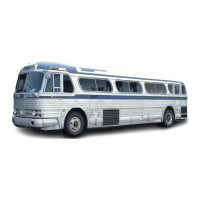

 To Next Page
 General