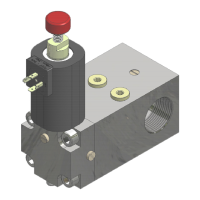
NGV A3 VALVE
INSTALLATION, USE AND MAINTENANCE
10991483 EN - 1.10 26.05.2023
4.2 CHECKS AND TESTS BEFORE PUTTING INTO SERVICE
4.2.1 PIPE RUPTURE VALVE (VC) TEST [EN81-20 §6.3.8]
WARNING
Before testing the pipe rupture valve, adjust this valve on the cylinder (refer to the technical
data on the plant and instructions of the rupture valve)
To test the pipe rupture valve follow the next procedure:
Move the car to the highest floor at full load (refer to system use manual)
After the car comes to a full stop loosen the locknut (5) and unscrew the screw (5) – 3 turns
Start the 9.2 Pipe Rupture test procedure on the PT01 programmer (please refer to the
Programming chapter)
Move the car to the lower floor. The valve, during downward, should be stop the car.
WARNING
If the valve do not stop the car, verify the settings of the rupture valve on the cylinder
4.2.2 FLOW RELIEF VALVE (VC) [EN81-20 §6.3.9]
WARNING
If a flow limit valve is installed on the cylinder, it is adjusted before performing this test
(see technical report of the system and instructions of the limiting valve)
The test procedure is the same as for the blocking valve.
An exception is point 4 in which, during the descent, the flow valve must not block the system but
limit its descent speed to the defined value.
4.2.3 PRESSURE TEST [EN81-20 §6.3.10]
The performance of this test gives ample confidence that all the organs under pressure,
including those that cannot be controlled visually, are intact.
Carry out the test according to the following
procedure:
1.Open the shutter (R/S) (position A).
2.Bring the piston to the highest level and using the
hand pump (PAM) bring the piston to the top extra-
stroke.
3.Open the pressure gauge tap (6)
4.Using the pressure gauge (MAN), operate the
hand pump (PAM) until a pressure of 200% of the
maximum static pressure is gradually reached.
5.Once pressure is reached, observe the system
for 5 minutes to determine pressure drop and
leakage.
6.When the test is complete, press the button
above the valve (VMD) to return the piston to
normal stroke condition by relieving pressure in the
system.
7.Close the pressure gauge tap (6)
8.Put the system back into operation


 To Next Page
 Loading...