EasyManua.ls Logo

GOAL ZERO Lighthouse 400 - User Manual

GOAL ZERO Lighthouse 400
9 pages
Print Icon
To Next Page IconTo Next Page
Loading...
1
Question and Answer IconNeed help?

Do you have a question about the GOAL ZERO Lighthouse 400 and is the answer not in the manual?

Summary

Frequently Asked Questions

Charging Frequency and Battery Level

Recommended to charge every 3 months. Blue LEDs indicate battery level.

Hand Crank Direction for Power

Crank in either direction for power. 1 minute of cranking equals 10 minutes of light on low.

Charge From Sources

Charge using Goal Zero products like solar panels, power packs, or Yeti solar generators.

Get To Know Your Gear

Hang It Feature

Utilize the built-in hanger to position the Lighthouse 400 anywhere.

Charging Options

Charge via USB port, dynamo crank, or Goal Zero solar panels.

Powering Other Devices

Use the USB port to recharge phones or boost tablets.

Lighting Modes

Features multiple brightness and directional lighting options, plus a red emergency light.

Stand Feature

Features convenient foldaway legs for easy transport and storage.

How It Works

Dynamo Crank Operation

Flip crank handle up and rotate. 1 min cranking yields approx. 10 min light on low.

USB Charging Function

Power up from any USB port using the built-in cord. Blue LEDs show battery level.

Directional Lighting Control

Turn the knob for different directional lighting and brightness options.

Emergency Light Activation

Push the triangle button for red, emergency alert mode.

Device Charging

Recharge smartphones and boost tablets through the USB port.

Technical Specifications

Charge Times

Charge times for Nomad 7 (7-14 hrs) and USB Source (5 hrs).

Run Times

Run times for one/both sides lit, low/high power settings (2.5-48 hrs).

Battery Details

Details on cell chemistry, capacity, lifecycles, shelf-life, and management system.

Light Output

Details on LED output (2x3W, 400 Lumens) and color temperature (3,500 Kelvin).

Hand Crank Specifications

Power output (1W at 130 RPM) and crank-to-light ratio (1 min = 10 min low).

Port Specifications

Specifications for USB output (5V, 1.5A max) and USB input (5V, 1A max).

General Specifications

Includes chainability, weight, dimensions, operating temperature, certifications, and warranty.

Summary

Frequently Asked Questions

Charging Frequency and Battery Level

Recommended to charge every 3 months. Blue LEDs indicate battery level.

Hand Crank Direction for Power

Crank in either direction for power. 1 minute of cranking equals 10 minutes of light on low.

Charge From Sources

Charge using Goal Zero products like solar panels, power packs, or Yeti solar generators.

Get To Know Your Gear

Hang It Feature

Utilize the built-in hanger to position the Lighthouse 400 anywhere.

Charging Options

Charge via USB port, dynamo crank, or Goal Zero solar panels.

Powering Other Devices

Use the USB port to recharge phones or boost tablets.

Lighting Modes

Features multiple brightness and directional lighting options, plus a red emergency light.

Stand Feature

Features convenient foldaway legs for easy transport and storage.

How It Works

Dynamo Crank Operation

Flip crank handle up and rotate. 1 min cranking yields approx. 10 min light on low.

USB Charging Function

Power up from any USB port using the built-in cord. Blue LEDs show battery level.

Directional Lighting Control

Turn the knob for different directional lighting and brightness options.

Emergency Light Activation

Push the triangle button for red, emergency alert mode.

Device Charging

Recharge smartphones and boost tablets through the USB port.

Technical Specifications

Charge Times

Charge times for Nomad 7 (7-14 hrs) and USB Source (5 hrs).

Run Times

Run times for one/both sides lit, low/high power settings (2.5-48 hrs).

Battery Details

Details on cell chemistry, capacity, lifecycles, shelf-life, and management system.

Light Output

Details on LED output (2x3W, 400 Lumens) and color temperature (3,500 Kelvin).

Hand Crank Specifications

Power output (1W at 130 RPM) and crank-to-light ratio (1 min = 10 min low).

Port Specifications

Specifications for USB output (5V, 1.5A max) and USB input (5V, 1A max).

General Specifications

Includes chainability, weight, dimensions, operating temperature, certifications, and warranty.

Overview

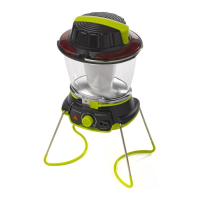
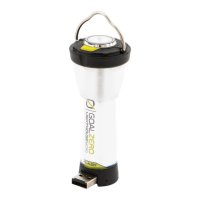
The Lighthouse 400 is a versatile lantern and USB power hub designed for portability and multiple power options. It serves as a reliable light source and a convenient way to charge small electronic devices, making it suitable for camping, emergencies, or general outdoor use.

Function Description:

The primary function of the Lighthouse 400 is to provide illumination and act as a portable power bank. It features a built-in dynamo crank, a USB input for charging its internal battery, and a USB output to power other devices. The lantern offers various lighting modes, including directional lighting and an emergency red light. Its design emphasizes ease of use, durability, and multi-functional utility.

Usage Features:

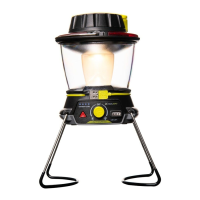
  • Illumination: The Lighthouse 400 provides multiple lighting options. Users can choose between one-sided or both-sided illumination, and adjust the brightness from low to high power. This flexibility allows for tailored lighting depending on the situation, whether it's providing ambient light for a campsite or focused light for a task. The "Dualite™ Directional Lighting" feature is controlled by turning a knob, allowing users to select different directional lighting and brightness settings.
  • Emergency Light: For emergency situations, the lantern includes a red emergency alert mode, activated by pushing a dedicated triangle button. This feature can be crucial for signaling or attracting attention when needed.
  • Charging the Lighthouse 400: The device offers several methods for recharging its internal battery.
    • Dynamo Crank: A key feature is the integrated dynamo crank. To charge, the crank handle flips up from the top of the lantern and is rotated. One minute of cranking provides approximately ten minutes of light on low power. The direction of cranking does not matter; it will generate power in either direction.
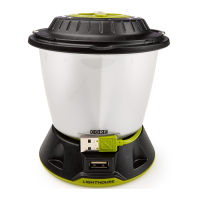
    • USB Input: The Lighthouse 400 can also be charged via any standard USB port using its built-in cord. This allows for convenient charging from wall adapters, computers, or other USB power sources.
    • Solar Charging: For off-grid charging, the Lighthouse 400 is compatible with Goal Zero Nomad Solar Panels, providing a sustainable way to replenish its battery using solar energy. It can also be charged from Sherpa Power Packs and Goal Zero Yeti Solar Generators.
  • Powering External Devices: The Lighthouse 400 doubles as a USB power hub. It has a USB output port that can be used to recharge smartphones or provide a power boost to tablets. This functionality makes it a valuable tool for keeping essential devices powered in remote locations or during power outages.
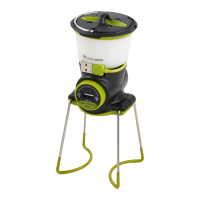
  • Portability and Storage: The lantern is designed with convenience in mind. It features a built-in hanger, allowing it to be easily suspended in various locations. Additionally, it has convenient foldaway legs that provide a stable base when standing and collapse for easy transport and hassle-free storage.
  • Battery Level Indicator: Blue LED lights on the device indicate the current battery level, allowing users to monitor the charge status and know when it's time to recharge.

Maintenance Features:

  • Regular Charging: To maintain optimal battery health, it is recommended to charge the Lighthouse 400 lantern every 3 months. This helps prevent deep discharge and prolongs the lifespan of the Li-ion NMC battery.
  • Demo Mode Deactivation: Upon initial use or if the device is in demo mode, it needs to be taken out of this mode. This is achieved by quickly turning the hand crank three times, which should be sufficient to illuminate the blue battery indicator, signaling that the device is ready for full operation.
  • Battery Lifespan: The internal battery is designed for hundreds of lifecycles, indicating a robust and long-lasting power source under normal usage and maintenance.
  • Built-in Protection: The Lighthouse 400 incorporates a management system with built-in charging and low-battery protection. This helps safeguard the battery from overcharging or excessive discharge, contributing to its longevity and safe operation.
  • Product Registration: Users are encouraged to register their product at goalzero.com/support. While not a direct maintenance feature, registration can facilitate warranty claims and access to support resources, which are important aspects of long-term product care.

GOAL ZERO Lighthouse 400 Specifications

General IconGeneral
LegsYes
Product typeBattery powered camping lantern
CertificationCE, FCC
Product colorBlack, Yellow
Number of legs2 leg(s)
Lamp typeLED
Bulb power6 W
Color temperature3500 K
Luminous flux (lantern)400 lm
Shelf life6 month(s)
Input current1 A
Input voltage5 V
Output current1.5 A
Battery voltage3.7 V
Charging sourceMechanical, Solar, USB
Battery capacity16.3 Wh
Power source typeBattery
Battery life (max)48 h
Battery charge time (USB)5 h
Battery charge time (solar)14 h
Sustainability certificatesRoHS
Operating temperature (T-T)0 - 40 °C
Weight and Dimensions IconWeight and Dimensions
Depth127 mm
Width114 mm
Height165 mm
Weight498 g

Related product manuals