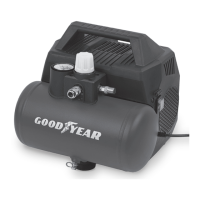
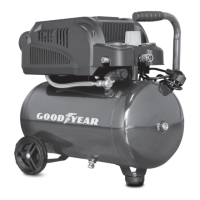
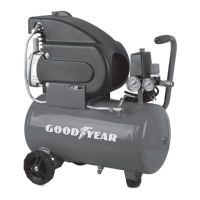
This document is a multi-language user manual for Goodyear air compressors, covering various models including GY224D, GY24DH, GY224DS, GY250D, GY250DH, GY250DS, GY350D, GY350DS, GY250B, GY250BS, GY3100B, GY3100BS, GY3101D, GY351D, GY251OFH, and GY501OFH.
Function Description
The Goodyear air compressors are designed to provide compressed air for various applications. They are suitable for tasks such as inflating, operating pneumatic tools, painting, and washing with water-based detergents. The "Silent" models (GY251OFH, GY501OFH) are specifically designed for quieter operation.
Important Technical Specifications
The technical specifications vary by model, but common parameters include:
Voltage/Tension/Spannung:
- Most models operate at 220-240 V / 50 Hz.
- Some models (GY350D, GY350DS, GY3100B, GY3100BS) also support 110-120 V / 60 Hz.
Power/Potencia/Puissance/Leistung:
- GY224D, GY24DH, GY224DS: 1.5 kW / 2.0 hp
- GY250D, GY250DH, GY250DS: 1.5 kW / 2.0 hp
- GY350D, GY350DS: 2.2 kW / 3.0 hp
- GY351D: 2.2 kW / 3.0 hp
- GY250B, GY250BS: 2.2 kW / 3.0 hp
- GY3100B, GY3100BS: 2.2 kW / 3.0 hp
- GY3101D: 2.2 kW / 3.0 hp
- GY251OFH: 0.75 kW / 1 hp
- GY501OFH: 1.1 kW / 2 hp
Tank Capacity/Capacidad del tanque/Capacité du réservoir/Tankkapazität:
- GY224D, GY24DH, GY224DS: 24 L
- GY250D, GY250DH, GY250DS: 50 L
- GY350D, GY350DS: 50 L
- GY351D: 50 L
- GY250B, GY250BS: 50 L
- GY3100B, GY3100BS: 100 L
- GY3101D: 100 L
- GY251OFH: 24 L
- GY501OFH: 50 L
Max. Air Displacement/Desplazamiento del aire/Déplacement d'air max./Max. Luftverdrängung:
- GY224D, GY24DH, GY224DS: 210 l/min
- GY250D, GY250DH, GY250DS: 210 l/min
- GY350D, GY350DS: 412 l/min
- GY351D: 412 l/min
- GY250B, GY250BS: 280 l/min
- GY3100B, GY3100BS: 297 l/min
- GY3101D: 412 l/min
- GY251OFH: 150 l/min
- GY501OFH: 350 l/min
Max. Pressure/Presión max./Pression max./Max. Druck:
- Most models: 8 bar / 115 psi
- GY351D, GY250B, GY250BS, GY3100B, GY3100BS, GY3101D: 10 bar / 145 psi
- GY251OFH, GY501OFH: 8 bar / 115 psi
RPM:
- Most models: 2800
- GY250B, GY250BS, GY3100B, GY3100BS: 1000
Weight/Peso/Poids/Gewicht:
- GY224D, GY24DH, GY224DS: 23 kg
- GY250D, GY250DH, GY250DS: 35 kg
- GY350D, GY350DS: 42 kg
- GY351D: 38 kg
- GY250B, GY250BS: 66 kg
- GY3100B, GY3100BS: 70 kg
- GY3101D: 48 kg
- GY251OFH: 21 kg
- GY501OFH: 30 kg
Head/Cabezal/Tête/Kopf:
- Most models: Coaxial
- GY501OFH: Sin Aceite - Oil free
Sound Power Level (for GY251OFH): 79 dB(A)
Usage Features
The manual outlines a clear set of steps for using the compressor:
- Assembly: Attach wheels and foot.
- Air Filter: Screw on the air filter.
- Oil Level (for lubricated models): Check oil level with the sight glass and top up if necessary using premium quality SAE 15W/40 oil.
- Electrical Connection: Verify that the compressor's data plate matches the electrical system specifications (within +/- 10% of nominal value). Insert the power cord plug into a suitable outlet, ensuring the pressure switch button is in the OFF position.
- Transport Cap: Replace the transport cap with the compensation valve (for models that have one). Failure to do so can cause internal damage.
- Start-up: Lift the pressure switch; the compressor will start and inject air into the tank.
- Automatic Operation: The compressor stops automatically when the upper calibration value is reached and restarts when the pressure drops to the lower calibration value (2 bar between top and bottom).
- Pressure Monitoring: Tank pressure can be checked on the provided gauge.
- Pressure Regulation: All compressors are equipped with a pressure regulator. Turn the knob clockwise to increase pressure and counter-clockwise to decrease it. Tighten the nut below the knob to secure the setting.
- Tool Compatibility: Ensure that the air consumption and maximum working pressure of pneumatic tools are compatible with the compressor's output.
- Shutdown: Always unplug the compressor and drain the tank after use.
- Restart Delay: Wait at least 10 seconds after the compressor shuts off before restarting.
Maintenance Features
Regular maintenance is crucial for the longevity and safe operation of the compressor. The manual provides a schedule:
After the first 100 hours of operation:
- Clean and/or replace the inlet filter element.
- Change the oil (for lubricated models).
- Tighten the head tension rods (at start-up and after the first hour of operation).
Every 100 hours of operation:
- Clean and/or replace the inlet filter element.
- Check the oil level and quality (for lubricated models).
Every 300 hours of operation:
- Clean and/or replace the inlet filter element.
- Change the oil (for lubricated models).
Periodically and at the end of work:
- Drain the tank (purge). This prevents corrosion and maintains tank capacity by removing condensate that forms due to humidity in the air.
General Maintenance Guidelines:
- Always unplug the appliance before any work.
- Operate components only when there is no more air inside.
- Before each use, check the machine for damage, especially the cord and plug.
- Check the safety valve.
- The machine must not be used if any safety components are damaged.
- Use only original spare parts and accessories.
- Do not clean the machine and its parts with solvents, flammable or toxic materials.
- Use only a damp cloth.
- Exhausted and condensed oil must be disposed of in accordance with environmental protection standards and current legislation.
- The compressor must be disposed of in accordance with local regulations.
The manual emphasizes several safety regulations and warnings:
- General Safety: Read the manual carefully before use. Keep it handy.
- Personal Protective Equipment: Wear appropriate shoes, protective glasses, and suitable gloves when using the machine.
- Workplace Safety: Keep the workplace dry, well-lit, and free of obstructions, grease, oil, and debris. Do not expose the machine to rain, snow, or humid conditions.
- Electrical Safety: Do not use the machine barefoot or with wet hands/feet. Ensure the electrical system matches the compressor's specifications. Unplug immediately if the cord is damaged. Avoid using extensions longer than 5 meters or with a cross-section less than 1.5 mm2.
- Moving Parts: All guards and covers must be installed. Do not operate if damaged. Keep the power cord free of twists and kinks.
- Burns: Surfaces like the compressor pump and outlet tube can become very hot. Allow the equipment to cool before maintenance.
- Throwing Objects: Always wear safety glasses with side shields. Never point the nozzle at people or animals.
- Inhalation Risk: Avoid using in confined areas. Ensure adequate clearance (30 cm) around the compressor. Do not use for breathing air.
- Explosion/Fire Risk: Never operate near combustible materials, gasoline, or solvent vapors. If spraying flammable materials, position the compressor at least 6 meters away from the spray area.
- Bursting Risk: Drain the tank daily or after each use. Replace the compressor if the tank leaks. Never modify factory settings that control tank pressure or other functions.
- Pacemakers: Individuals with pacemakers should consult their physician before use due to potential electrical interference.
- Pressure Release Valve: Do not alter or remove the factory-sealed pressure release valve.
- Unattended Operation: Do not leave the compressor unattended while plugged in.
Troubleshooting
The manual provides a troubleshooting guide for common issues:
- Air leak from pressure switch valve with compressor off: Check the valve for wear or dirt on the gasket. Solution: Unscrew the hexagonal head of the retention valve, clean the valve seat and rubber gasket (replace if worn), reassemble and tighten.
- Reduced performance, frequent start, low pressure: Excessive performance request, check for leaks in couplings/hoses. Inlet filter may be clogged. Solution: Replace gaskets, clean or replace the filter.
- Compressor stops and restarts automatically after a few minutes: Thermal differential trip due to motor overheating. Solution: Clean air passages in the compression unit, ventilate the work area, reset the thermal differential. For lubricated and V-type models, check oil level and quality. For V models, check voltage.
- Compressor does not start after several restart attempts: Thermal differential trip due to motor overheating (plug removal with compressor running, low power voltage). Solution: Activate the ON/OFF switch, ventilate the work area, wait a few minutes. The compressor will restart independently. For 3 HP V models, reset the thermal differential. Remove any power cord extensions.
- Compressor does not stop and safety valve disconnects: Irregular compressor operation or broken pressure switch. Solution: Remove the plug and contact the nearest Service Centre.

 Need help?
 General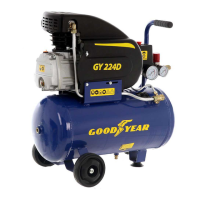

 To Next Page