The Graden SW04 Swing-Wing Verticutter/Scarifier is a specialized piece of machinery designed for turf maintenance, primarily used for verticutting, scarifying, and de-thatching on various sporting fields such as golf courses, bowling greens, cricket wickets, and tennis courts. It is a tractor-driven implement, connecting via a Power Take-Off (PTO) shaft, and features a belt drive system.
Function Description:
The primary function of the SW04 is to cut into the turf to remove thatch, improve air and water penetration, and promote healthier grass growth. It achieves this through a series of high-speed cutting blades. The "Swing-Wing" design suggests that the machine has articulated sections that can follow ground contours, allowing for a consistent cutting depth across uneven surfaces. The machine is not intended for use on turf areas with rocks or other hard foreign bodies, as this can cause premature wear, blade damage, and potentially project objects at dangerous speeds, leading to injury or machine damage. Any use outside of specified soil profiles may void the warranty.
Important Technical Specifications:
- Model: Graden SW04 Swing-Wing Verticutter
- P.T.O. Horsepower: Requires a tractor with 20 - 35 h.p.
- Drive: Belt drive via Tractor PTO
- Gearbox: Comer T27A Increasing Gearbox
- Gearbox oil: Gear Oil - SAE 80W90
- Cutting Reels: Consists of 1 Fixed (13 blades) and 2 Floating (8 blades each) reels.
- Cutting width: 1520mm (60 inches)
- Cutting depth (nominal): Adjustable from 0 to 40mm (maximum with standard blades).
- Blades:
- Standard: Tungsten carbide tipped spring steel, 210mm x 2mm tip (Part No. 0232).
- Optional: 210mm x 3mm tip (Part No. 0217) and 210mm x 1mm tip (Part No. 1122).
- Blade tip speed: 1250m/min (with standard blades at normal PTO speed of 540 rpm).
- Weight: 290 kg
- Height: 1110 mm (machine on stands)
- Overall Width: 1980 mm
- Length: 1330mm
- Tyres: 4.10/3.50 - 4 Slick Pattern (6 per machine).
- Tyre pressure: 275 - 345 kPa (40 -50 psi).
- Rotor belts: A47 Dayco Super 2 Series (8 per machine).
Usage Features:
The SW04 is designed for efficient and precise operation, with several features to ensure optimal performance and safety:
- Depth Adjustment: Cutting depth is set via four height adjustment screws, allowing for precise control from 0 to 40mm. Clockwise rotation of the screws results in a shallower cut, while anti-clockwise rotation deepens it. Indicator arms on the wheel axles assist in setting consistent heights.
- Ground Following: The upper tractor arm hitch point can be moved to a long slot, allowing the machine to tilt forward and back with ground undulations, ensuring a consistent cut.
- Transport Mode: For transport, the Swing-Wing is raised clear of the turf, the PTO is disengaged, and the tractor is driven smoothly to the next destination, avoiding excessive speed over rough terrain.
- Operational Safety: Emphasizes raising the unit and disengaging the PTO before starting the tractor, crossing non-turf areas, or performing any adjustments. Operators are warned to maintain minimum ground speed on rough or sloping ground and to be alert for obstacles.
- Blade Rotation: Blades rotate anti-clockwise when viewed from the right side, counter-rotating to the forward rotation of the tractor wheels.
- Straight Line Operation: Operators are instructed to steer the tractor in a straight line while cutting to prevent furrowing or scalping and to reduce stress on the machine.
- Shut Down Procedure: Includes steps for raising blades, disengaging PTO, dropping the machine, cleaning, and preparing for storage on castor wheels. High-pressure water cleaning is explicitly prohibited around bearings and gearbox seals to prevent damage.
Maintenance Features:
Routine maintenance is crucial for the safe and effective operation of the SW04.
- Support for Maintenance: Maintenance can be performed with the machine on its supplied castor wheel-equipped supports or securely blocked up on jack stands if still attached to the tractor. Relying solely on tractor hydraulics for height is not recommended.
- Belt Tension Adjustment:
- Centre Rotor Belts: Driven by three belts. Tension is adjusted by loosening a lock nut on the idler adjuster and screwing an adjusting nut. Recommended tension is 1.0 - 1.5 Kgf (2.2 - 3.3 lbf) for a 6mm (1/4 in.) deflection.
- Wing Rotor Belts: Driven by five belts. Tension is maintained by a wide idler pulley. Adjustment involves loosening the long bolt, tapping the idler pulley forward, and re-tightening. If belt stretch prevents sufficient tension, idler brackets can be repositioned or belts replaced.
- Blade Replacement: Detailed procedures are provided for both centre and wing blade reels, involving removal of belt guards, slackening idler adjusters, removing belts, loosening eccentric locking collars and bearings, and then removing blades and spacers. Emphasis is placed on correct blade orientation and configuration during reassembly.
- Universal Joint Alignment: Critical for wing blade reels; if universal joints are disturbed, they must be correctly aligned before operation to prevent significant damage.
- Gearbox Maintenance: The gearbox generally requires minimal servicing, with annual checks of oil level and quality. SAE 80W90 gear oil is specified for topping up.
- Maintenance Schedule:
- After first 4 hours: Check tension on all blade reel belts and adjust as needed. Check for loose nuts or fittings, especially blade reel retaining bolts.
- Daily (Before Use): Check for worn/damaged belts and blades, even tyre pressure, loose nuts/bolts/fasteners, and ensure all guards are secure.
- Daily (After Use): Clear debris from rotor blades and around the PTO shaft.
- Every 40 Hours: Grease rotor shaft bearings, universal joints, and PTO shaft splines.
- Every 6 Months: Grease all bearings. Check all belts for wear and tension; replace if necessary.
- Every 12 Months: Annual service including all above checks. Check gearbox oil level and quality. Recommend changing all belts unless in good condition.
- Genuine Parts: Only genuine Graden parts should be used to maintain warranty validity and ensure safety and performance standards.

 Need help?
 General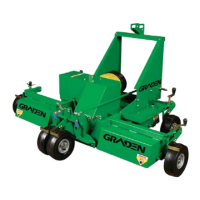

 To Next Page
