Pilot’s manual for BiGolden4 6
quickly. Additionally, if landing is thermic, it is often very difficult to land without using a rapid-descent method.
There are three main methods for achieving a rapid descent and they are: Big Ears, B-Line Stall and Spiral Dive.
Practise these manoeuvres under the supervision of an instructor and with a reserve parachute. Never
compromise your and passenger safety.
5.2.1. Big Ears
This is the easiest technique for a rapid descent. Depending on how much of
the wing tip you deflate, 3 m/s to 6 m/s sink rate can be achieved.
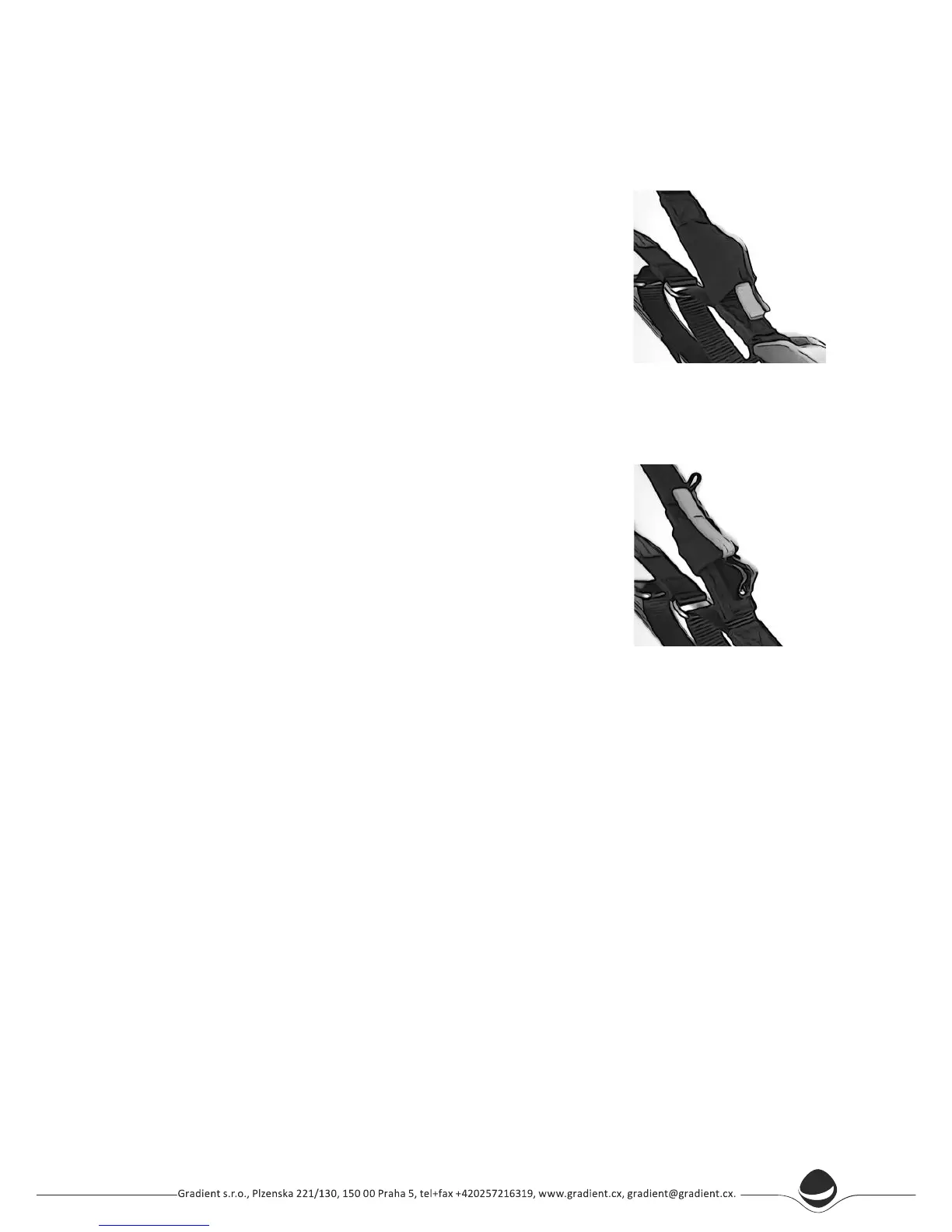
BiGolden4 has the cleat on the D-riser which makes it possible to fix the outer
A-lines so they can be held in for an extended period. With big ears applied,
the BiGolden4 can be steered using the brakes. Before using the cleats it is
necessary to uncover the neoprene safety covers by pulling the red webbing
on it up. After the big ears manoeuvre, put the neoprene cover down to avoid
catching any lines.
NOTICE: The outside A-line is divided in two pieces (A0.3 and A1.3) due to fast
and easy repair if the cover of line is damaged. Line A0.3 is Edelrid 7850-200,
length after sewing is 50,0cm (valid for size 37 and 42).
Initiation: Grab the outer A-lines or outer split A-risers on both sides as high
as possible and pull them down smoothly. Hold them firmly. The effective area of the glider is reduced equally on
both sides of the wing. The size of the deflated area depends on how deeply
the lines are pulled down (or on the number of lines pulled – one or two outer
lines on both sides). Be sure to pull both sides equally.
Recovery: Under normal circumstances BiGolden4 will open automatically
when the A-lines are released. Opening may be accelerated by gently
pumping the brakes (repeated symmetrical braking on both sides).
NOTICE: The bigger sink rate of the glider increases the angle of attack. By
opening trimmers, this effect is compensated.
5.2.2. B-Line Stall
B-line stall can be used on BiGolden4. This is an effective rapid descent
technique. Depending on how far the B-risers are pulled down, the sink rate
is between 6m/s and 10m/s.
Initiation: Grab the B-risers at the top and smoothly pull them down until the
canopy shows a spanwise crease where the B-lines attach to the sail. Your sink rate will increase considerably while
your forward speed will decrease practically to zero. Don't be startled when the airflow over the top surface is
interrupted and the glider enters a parachutal stall without moving forward. It will soon stabilise above your head.
Recovery: On releasing the B-risers BiGolden4 automatically returns to normal flight without staying in deep stall or
shooting in front of the pilot. Let go of the risers smoothly and symmetrically.
CAUTION: Do everything symmetrically and at the same time. If the B-risers are released unevenly the canopy can
enter a turn. If the risers are released slowly and very unevenly you could enter a spin.
5.2.3. Spiral Dive
The Spiral Dive is the most effective way of making a fast descent. Every pilot should be able to perform a spiral dive
and one day you may need to. In a Spiral Dive always stay aware of your altitude, which decreases very rapidly. The
sink rate reached in a Spiral Dive can be more than 20m/s. During the manoeuvre the pilot and glider will experience
strong centrifugal forces. Forces of greater than 3G are possible – a great strain on the pilot as well as the glider.
Initiation: Smoothly pull on one brake so that the glider goes from a normal 360-degree turn into a steep turn and
from there into a spiral dive. The transition into a spiral dive can be made easier by weight shifting to the inner side
of the turn. Keep an eye on the tension of the brakes all the time: reduced tension signals an overload of the glider
and danger of falling into a negative spin.
Recovery: BiGolden4 recovers from a Spiral Dive automatically as soon as the brakes are released. Release them
smoothly and always finish a Spiral Dive with safe altitude!
CAUTION: When exiting the Spiral Dive make sure your position in the harness is neutral. Recovery from a Spiral Dive
can be delayed if you are weight shifting to the inner side of the turn.


 To Next Page
 Loading...