5 Pilot’s manual for BiGolden4
the brake lines run freely through the pulleys
the knots on the brake handles are secure
the karabiners on the risers are tightened
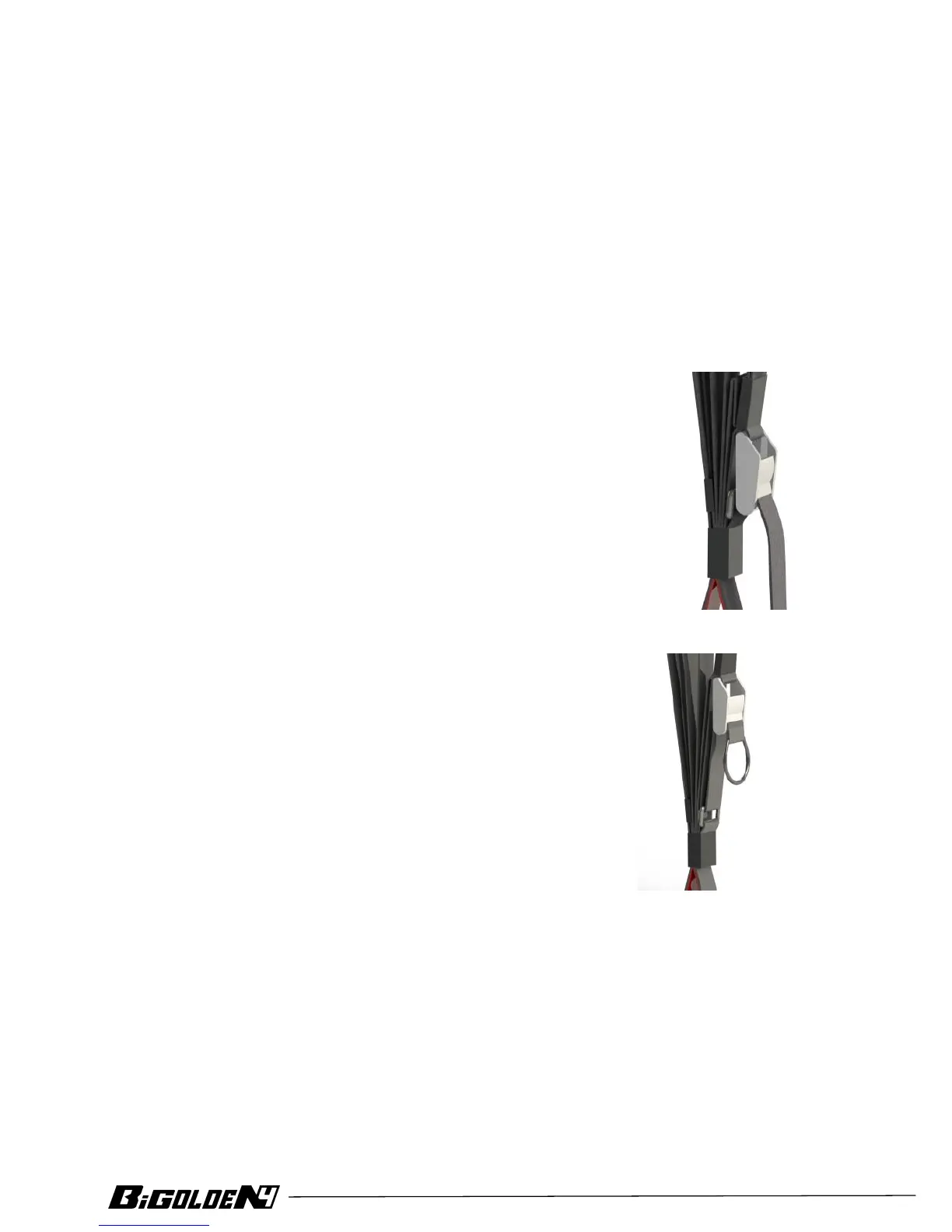
Trimmers on both side of risers are equally adjusted.
5.1.2. Launch
Launching BiGolden4 is straightforward, either by front launch or by reverse launch. A dynamic pull of the front
risers (A-risers, coloured red and yellow) will bring the canopy simply and easily above the pilot's head. The canopy
inflates from the centre equally and smoothly. The BiGolden4 has no tendency to outrun the pilot and quickly
stabilises above the pilot. Don´t forget to visually check the canopy and the lines before taking off. Take off can be
made easier by a light pull on the brakes.
For takeoff it is recommended to set the trimmer to basic position for nil or weak wind condition. For stronger wind
conditions it is recommended to release the trimmers 1cm to 3cm above basic position.
NOTICE: The BiGolden4 requires no modification or particular manoeuvre for launching by winch.
5.1.3. Flight
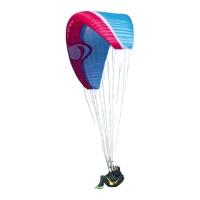
When the trimmers are adjusted to the Basic position and brakes are loose, the
BiGolden4 is trimmed to fly at best glide angle.
The best sink rate is produced with trimmers in Basic position (pulled down)
and both control lines drawn down evenly to about 10%-15% of their range.
When the trimmers are fully open, the BiGolden4 is trimmed to fly at maximum
speed.
CAUTION: When the trimmers are fully open, the brake handles are in a higher
position than in unaccelerated flight.
Maximum speed is one of the strong points of Gradient paragliders and the
BiGolden4 is no exception. Not only does the glider have a very high maximum
speed, but unlike some other paragliders, the full speed range is useable.
Don’tbforget that any collapse at full speed will be more severe than the same
event experienced at normal trim speed. Always keep both hands on the
controls when flying fast in turbulence. Use the speed system very carefully,
or not at all at low altitude.
Flying in turbulent conditions
When flying through severe turbulence, stabilise the canopy with
simultaneously applying a little brake to both sides. Flying with a little brake
applied will also help to prevent deflations and give you more feedback about
the air is doing and how the glider is reacting. Responding correctly to the
paraglider's movement by means of the brakes and weight shift is known as
‘active flying’. A pilot demonstrating good active-flying skills will significantly
reduce both the number and severity of collapses he or she experiences.
Turning
BiGolden4 is very comfortable and pleasant in turns. Handling characteristics
are responsive and accurate and demand no special habits or non-standard
procedures. When developing BiGolden4 special attention was devoted to the
brake pressure. The result is that brake travel and pressure have been
optimised. Brake pressure is reassuringly progressive. In flight, brakes are firm but responsive and precise and allow
perfect communication with the canopy. In an emergency (e.g. a broken brake line) the glider can be steered with
the rear risers or by weight shift.
5.1.4. Landing
Landing with BiGolden4 is very simple and shouldn’t cause any problem. On your first flights you may be surprised
at how well it glides. Take account of this when making your landing approach! Into wind, at about one metre above
the ground pull the brakes down all the way. In nil-wind conditions, or if forced to make an emergency landing
downwind, you may prefer to take a wrap around each control line to enable a more dynamic flare.
5.2. Fast descent
Sooner or later every pilot will need to descend quickly. It might be because of a sudden and unexpected change in
the weather, reaching cloud base and not wishing to enter cloud, or simply because you need to finish your flight


 To Next Page