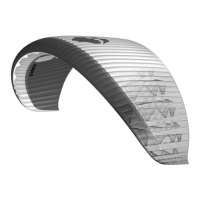
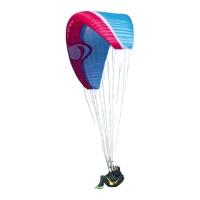
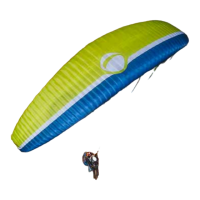
Pilot´s manual GOLDEN 3 Prepared January 2010
http: www.gradient.cx tel., fax: +420 257 216 319mail: gradient@gradient.cx
Before launch spread the canopy out in a slight arc and check that:
all cell openings are free•
no lines are looped around or under the canopy•
no lines are tangled or have a knot in them•
any twigs, grass or other objects are not tangled in the lines or the canopy•
risers are not twisted•
control lines run freely through the pulleys•
knots on control handles are secure•
karabiners on risers are tightened•
5.1.2. Launch
Launching the Golden3 is straightforward, either by forward (Alpine) launch or
by reverse launch. A dynamic pull on the front risers (A, coloured red) will bring
the canopy simply and easily above the pilot‘s head. The canopy inates from the
centre equally and smoothly. The Golden3 has no tendency to outrun the pilot and
quickly stabilises above the pilot. Once there, visually check the canopy and the
lines before taking off. Take off can be made easier by a light pull on the brakes.
5.1.3. Flight
The Golden3 is trimmed to y at best glide when the brakes are fully up. Best sink
rate is achieved when both brakes are drawn down evenly to about 20-25% of their
range.
Turbulent conditions
When ying through severe turbulence stabilise the canopy by simultaneously
applying a little brake to both sides. Flying with a little brake applied will also help to
prevent deations and give you more feedback about what the air is doing and how
the glider is reacting. Responding correctly to the paraglider‘s movement by means
of the brakes and weight shift is known as „active ying“. A pilot demonstrating
good active-ying skills will signicantly reduce both the number and severity of
collapses he or she experiences.
Turning
The Golden3 is very comfortable and pleasant in turns. Handling characteristics
are responsive and accurate and demand no special habits or non-standard
procedures. When developing the Golden3 special attention was devoted to the
brake pressure. The result is that brake travel and pressure have been optimised.
Brake pressure is reassuringly progressive. In ight, brakes are rm but responsive
and precise and allow for perfect communication with the canopy. You will nd that
a harness with fairly loose cross-bracing will help the glider turn. In an emergency
(eg a broken brake line) the glider can be steered with the rear risers or by weight
shift.


 To Next Page