
 Need help?
Do you have a question about the Graham Field Lumex TP332 and is the answer not in the manual?
Detailed steps for correctly applying the Toileting Sling, from patient preparation to securing loops.
Instructions for cleaning the sling using mild soap and water, and avoiding harsh cleaners.
Details on sling design, intended use, HCPCS code, and maximum weight capacity.
Defines what the warranty covers, its duration, and how to obtain service.
Lists conditions and actions that void the warranty, such as misuse or improper maintenance.
States GF's warranty is exclusive and disclaims other warranties, plus notes on claims.
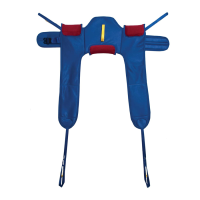
The Lumex TP332/TP333 Padded Toileting Sling is a crucial aid designed to facilitate safe and comfortable transfers for individuals requiring assistance with toileting and incontinence care. This device is an integral part of a comprehensive patient lift system, intended to be used in conjunction with a compatible spreader bar and lift mechanism. Its primary function is to provide secure support to a user during a lift, allowing caregivers to safely move individuals from one location to another, such as from a bed to a commode, or to assist with changing incontinence pads.
The Padded Toileting Sling is engineered to cradle the user's body, offering support from the middle of the back down to the middle of the thighs. This design ensures that the user is held securely and comfortably during the lifting process, minimizing the risk of discomfort or injury. A key feature of this sling is its open area, which is specifically designed to allow for easy access to the perineal region. This open design is particularly beneficial for toileting, as it enables the user to be positioned directly over a commode without needing to remove the sling. It also greatly simplifies the process of changing incontinence pads, as caregivers can access the area without fully transferring the user out of the sling.
The sling incorporates multiple loops and straps that connect to a spreader bar on a patient lift. These connection points are crucial for distributing the user's weight evenly and maintaining stability during the lift. The sling's design includes color-coded adjustment straps, which are positioned on the outside when the sling is correctly applied. These straps, along with the red padded sections, guide the caregiver in properly positioning the sling under the user's arms and around their back. A hook and loop belt is also integrated into the design, intended to be fastened across the user's chest to provide additional security and prevent forward slippage during the transfer.
The leg straps, labeled C and D, are designed to loop around and under the user's legs. These straps are then crossed over, with one loop passing through the other, before being hooked to the spreader bar. This specific configuration of the leg straps is vital for preventing the user from sliding out of the sling and for maintaining a stable, balanced position during the lift. The various loop options (long, center, short) allow for different positioning of the user, ranging from a reclined to a most upright position, catering to individual needs and comfort levels during the transfer.
Prior to any lift, it is imperative to verify the user's weight to ensure it does not exceed the sling's maximum weight capacity. This is a critical safety measure to prevent equipment failure and potential injury. The application process begins by carefully positioning the sling under and behind the user's back, ensuring the color adjustment strap is on the outside and the red padded sections are correctly placed under the user's arms. The hook and loop belt is then secured across the user's chest for added stability.
The leg straps are then looped around and under the user's legs. It is essential to cross these straps over, passing one loop through the other, before attaching them to the spreader bar. This specific method of securing the leg straps is fundamental to the sling's safe operation. The user's arms should remain outside the sling loops throughout the process. Once all loops (A, B, C, and D) are securely hooked to the corresponding hooks on the spreader bar, the lift can commence.
An important operational guideline is to avoid locking the caster brakes on the patient lift during the transfer. This allows the lift to properly balance the weight of the user, contributing to a smoother and safer transfer. The sling's multiple loop options (long, center, short) provide flexibility in positioning the user. The long loop typically results in a reclined position, the center loop in a semi-reclined position, and the short loop in the most upright position. This adaptability allows caregivers to select the most appropriate and comfortable posture for the user based on their specific needs and the nature of the transfer.
Regular inspection of the sling is a crucial usage feature. Caregivers must carefully inspect the sling weekly for any signs of wear or damage, including to seams, fabric, straps, and strap loops. Any tears, cuts, fraying, or broken components can compromise the sling's integrity and lead to serious personal injury. Only slings that are in good condition should be used; old or unusable slings must be discarded and destroyed to prevent accidental use.
Maintaining the Lumex Padded Toileting Sling is straightforward and essential for its longevity and continued safe operation. The cleaning process involves using a mild soap and water solution with a clean cloth. After cleaning, the sling should be thoroughly rinsed with clear water to remove any soap residue. Following rinsing, the sling must be allowed to air dry completely before being stored or used again. This simple cleaning regimen helps to maintain hygiene and prevent the accumulation of dirt or contaminants.
It is explicitly stated that solvents, abrasive cleaners, or scouring pads should never be used on any part of the Toileting Sling. These types of cleaning agents can damage the fabric, straps, and other components of the sling, compromising its structural integrity and potentially leading to premature failure. Adhering to the recommended cleaning method ensures that the sling remains in optimal condition without being subjected to harsh chemicals or abrasive materials that could degrade its performance or safety.
Regular inspection, as mentioned in the usage features, also serves as a critical maintenance feature. By routinely checking for wear and damage, caregivers can identify potential issues early and take appropriate action, such as replacing a damaged sling. This proactive approach to maintenance is vital for ensuring the safety of both the user and the caregiver. The sling's design, with its durable materials, is intended to withstand repeated use and cleaning cycles, provided that the recommended maintenance procedures are followed. Proper maintenance not only extends the life of the sling but, more importantly, ensures that it continues to provide a safe and reliable means of support during patient transfers.
 General
| Product Name | Graham Field Lumex TP332 |
|---|---|
| Category | Sling |
| Material | Nylon |
| Adjustability | Yes |
| Color | Blue |

 To Next Page