Need help?
Do you have a question about the Grainfather Conical Fermenter and is the answer not in the manual?
Explains how to attach and use the dual valve tap for sediment removal and sampling.
Details the steps for assembling the dual valve for cleaning and maintenance purposes.
Explains the main screen of the digital temperature controller and its basic functions.
Details the menu screen of the controller and navigation options.
Describes the settings screen for adjusting parameters like units, hysteresis, and mode.
Outlines the built-in profiles (Ale, Lager, Custom) and how to select them.
Explains options for managing running profiles: quit, skip stage, or extend stage.
Describes pressure transfer for clean beer transfer, reducing oxygen exposure.
Explains the cooling pump kit for temperature control with cold water.
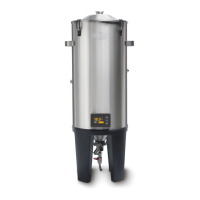
The Grainfather Conical Fermenter is a professional-grade fermentation system designed for homebrewers, offering precise control over the fermentation process, similar to commercial breweries. Its primary function is to provide a consistent, controlled temperature environment for beer fermentation, minimizing oxygen exposure, and ensuring a clean and sterile fermenter.
The fermenter's design incorporates a 304 stainless steel body with double-insulated walls, creating a cavity between the outer and inner surfaces. This cavity houses a 30W, 12V heating element that gently heats the environment surrounding the liquid, rather than directly heating the liquid itself. This method ensures even and gentle heating, which is beneficial for yeast health. The 10 mm (0.4") thick layer of polyurethane foam insulation between the stainless steel surfaces maintains a stable internal temperature, protecting the liquid from external environmental changes.
For cooling, the fermenter features a cooling sleeve integrated within the double-insulated walls. This sleeve is designed for use with the Grainfather Glycol Chiller (sold separately), which circulates glycol through the sleeve to cool the liquid. The cooling sleeve never comes into direct contact with the wort or beer, eliminating the need for cleaning or sanitization and preventing any compromise to the beer. The Glycol Chiller allows for cold crashing and lagering and can connect to up to four fermenters simultaneously, each with independent temperature and fermentation schedules.
The fermenter is equipped with a digital temperature controller that easily snaps into place using magnets and pogo pins. This controller allows users to accurately set and maintain a target temperature, as well as program complex temperature schedules. The main screen displays the current temperature, target temperature, unit symbol (Celsius or Fahrenheit), and the current temperature control status (Heating/Cooling/Off). If a profile is running, it also shows profile information. Users can adjust the target temperature directly from this screen or access a menu for more advanced settings.
The settings menu offers options to switch between Metric and Imperial units, adjust the hysteresis (temperature variation margin) from 0.1-2.0°C (32.2-35.6°F), and select the control mode (Heat/Cool, Heat Only, Cool Only, or Off). An "Auto Proceed" option, set to YES by default, allows the fermenter to automatically advance through programmed steps in a fermentation schedule. If set to NO, manual progression to the next step is required.
The profiles screen provides four built-in fermentation profiles: Ale, Lager, Custom 1, and Custom 2. The Ale profile is a 2-step process with default values for time and temperature, allowing for editing and auto-proceed for step 1. The Lager profile is a 4-step process with default values, also allowing for editing and auto-proceed for steps 1-3. Custom 1 and Custom 2 profiles allow users to specify up to 5 steps and edit all values. Any changes made to profiles or settings are stored in the controller's memory, persisting even after the device is turned off. When a profile is selected, users can choose to "Brew" (start the profile) or "Edit" (modify the step values). If a profile is already running, the "Profile Options" screen allows users to quit the profile, skip to the next stage, or extend the current stage time.
A key feature of the Conical Fermenter is its dual valve tap, located at the bottom of the fermenter. This innovative 'valve within a valve' design allows for both sediment dumping and beer sampling/transferring. The large opening, facing out at a 90-degree angle, is used for removing yeast and sediment. It is designed to be large enough to prevent clogging, provided sediment is removed regularly (every 2-3 days). This part opens and closes with a spring-loaded lever to minimize beer wastage. The bottom opening is for taking beer samples during fermentation and for transferring beer after fermentation is complete. It includes a beer inlet piece that attaches to the top of the valve, drawing beer from above the yeast sediment to ensure a clean and clear sample. Two different heights for the beer inlet are available: 110 mm for most beers and 160 mm for batches with a lot of dry hops (200 g (7 oz) +).
For setup and cleaning, the fermenter requires assembly of the valve and beer inlet, which are attached to the bottom using a ferrule seal and tri clamp. The 2 m (6.6 ft) power cord connects to the back of the fermenter and then to a power adapter, which plugs into a wall outlet. Initial cleaning involves filling the fermenter halfway with water and a cold water cleaner detergent, scrubbing all surfaces with a non-abrasive cloth, rinsing with clean water, and then sanitizing with a no-rinse sanitizer. The dual valve tap should also be opened during cleaning to ensure all internal parts are flushed.
Maintenance of the dual valve tap involves regular disassembly for thorough cleaning after each fermentation. The entire valve can be taken apart for cleaning and then reassembled. It is crucial to sanitize the valve before each use. For yeast dumping, the yeast dump valve should be opened slowly, collecting about 300 ml (10 US fl oz) of dead yeast and sediment until the liquid runs clear. For yeast harvesting, it is best to collect the final sample of yeast dumped after fermentation. The beer valve can be used at any time to collect samples for gravity testing or to transfer beer by connecting a 10 mm (0.4") inner diameter hose to the opening. When dry hopping, it is recommended not to dump the dry hops but to allow them to sit in the beer for the duration specified by the recipe before transferring the beer.
The Grainfather Conical Fermenter also offers additional accessories to enhance the brewing experience. The Pressure Transfer kit allows for clean and simple beer transfer without lifting the fermenter, especially useful with a CO2 supply, ensuring less oxygen exposure. The Cooling Pump Kit enables temperature control with cold water by pumping it through the insulated sleeve, including a submersible pump and cooling connection kit with insulated hoses for easy attachment.
 General
| Capacity | 30L |
|---|---|
| Height | 800mm |
| Temperature Control | Yes (with optional cooling system) |
| Insulation | Optional neoprene jacket |
| Pressure Rating | Not pressure rated for pressurized fermentation without additional equipment. |
| Included Accessories | sample valve |
| Material | 304 Stainless Steel |

 To Next Page