15
• Clean the device with brush or delicate cloth.
• Store the device in a dry place, beyond reach of children.
• Store the device with the battery removed.
REPLACEMENT OF CUTTING PARTS
The grass trimmer is supplied with 20 spare cutting parts that are
attached to the auxiliary handle. Use only recommended cutting
parts.
• Put larger hole of the cutting part (12) over the pin (22) of the
head (13) and pull outwards, so the pin (22) is in the smaller hole
of the cutting part (12) (g. L).
• Repeat the action for the second cutting part.
• Removal of the cutting part (12) is similar to installation, only the
sequence of actions is reversed.
All defects should be repaired by service workshop authorized by
the manufacturer.
TECHNICAL PARAMETERS
RATED PARAMETERS
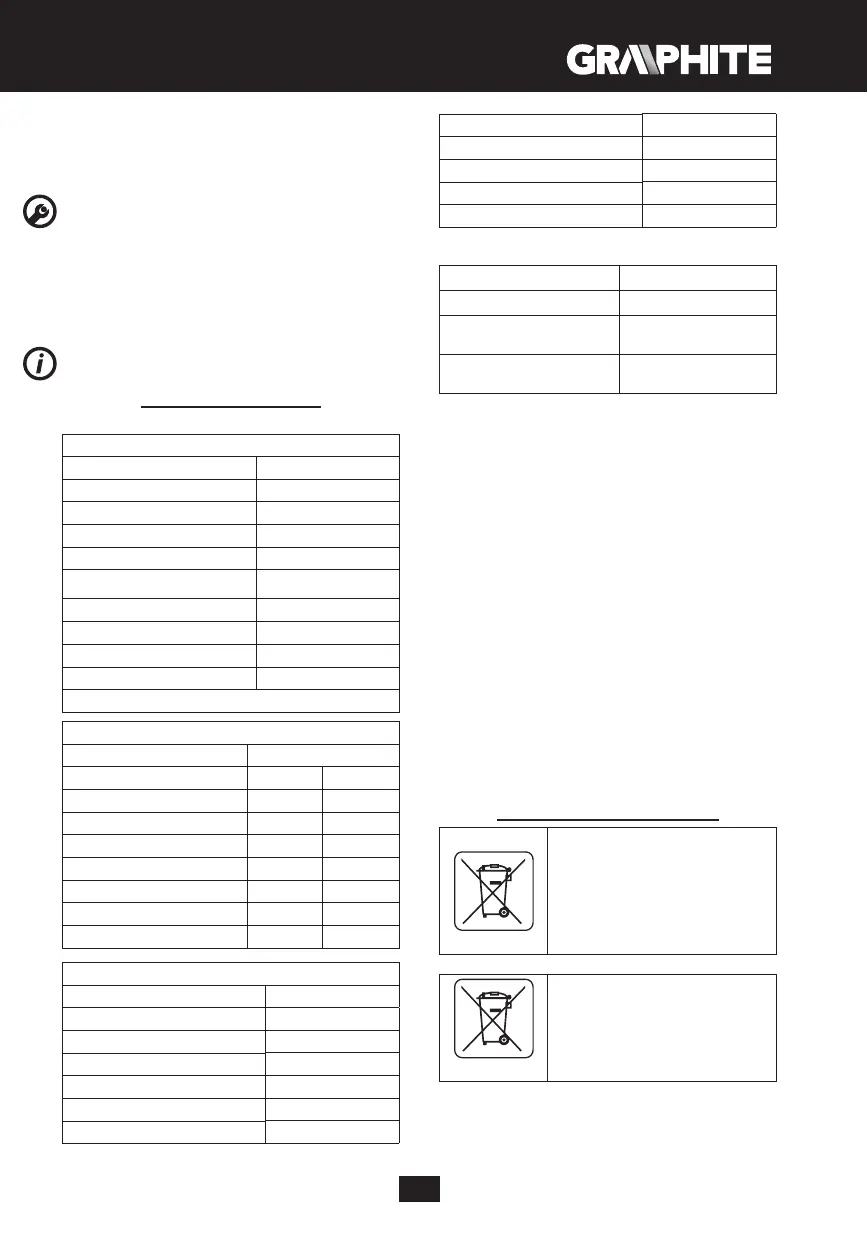
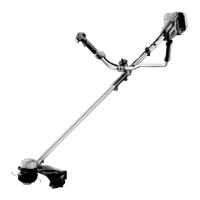
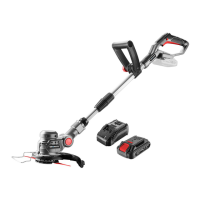
Cordless Grass Trimmer 58G030
Parameter Value
Battery voltage 18 V DC
Spindle rotational speed with no load 9000 min
-1
Cutting width 254 mm
Polymer blades 88,5 mm
Number of blades attached to the
head
2
Handle length adjustment 1,1 ÷1,4 m
Protection class III
Weight 1,8 kg
Year of production 2020
58G030 denes type and indication of the device
Graphite Energy+ System Battery
Parameter Value
Battery 58G001 58G004
Battery voltage 18 V DC 18 V DC
Battery type Li-Ion Li-Ion
Battery capacity 2000 mAh 4000 mAh
Ambient temperature range 4
0
C – 40
0
C 4
0
C – 40
0
C
Charging time for charger 58G002 1 h 2 h
Weight 0,400 kg 0,650 kg
Year of production 2020 2020
Graphite Energy+ System Charger
Parameter Value
Charger type
58G002
Supply voltage
230 V AC
Power supply frequency
50 Hz
Charging voltage
22 V DC
Max. charging current
2300 mA
Ambient temperature range
4
0
C – 40
0
C
Charging time of the battery 58G001
1 h
Charging time of the battery 58G004
2 h
Protection class
II
Weight
0,300 kg
Year of production
2020
NOISE LEVEL AND VIBRATION PARAMETERS
Sound pressure L
PA
= 79,5 dB(A) K=3dB(A)
Sound power L
WA
= 91,9 dB(A) K=2,23dB(A)
Vibration acceleration (main
handle)
a
h
= 1,453 m/s
2
K=1,5 m/s
2
Vibration acceleration (auxiliary
handle)
a
h
= 3,224 m/s
2
K=1,5 m/s
2
Noise and vibration information
Noise produced by the device is dened with: level of produced
sound pressure L
PA
and level of sound power L
WA
(where K is
measurement uncertainty). Vibrations produced by the device
are dened with vibration acceleration value a
h
(where K is
measurement uncertainty).
Sound pressure L
PA
, sound power L
WA
and vibration acceleration a
h
specied in this manual have been measured in accordance with the
standard EN 60335-1:2012; EN 50636. Specied vibration level a
h
can
be used to compare tools and for initial evaluation of exposition to
vibrations.
Specied vibration level is typical only for the main applications
of the device. When the device is used for other purposes or with
dierent working tools, the vibration level may change. Insucient
or too rare maintenance may increase vibration level. The
abovementioned factors may lead to higher exposure to vibrations
during whole working time.
In order to precisely dene exposure to vibrations, include periods
when the device is switched o and when it is switched on but not
used for working. Once all factors have been carefully considered,
total exposition to vibrations may be signicantly lower.
To protect the user from results of exposure to vibrations, use
additional safety measures such as: device and working tool periodic
maintenance, proper hand temperature conditions, good work
organisation.
ENVIRONMENTAL PROTECTION
Electrical equipment must not be disposed o
with household waste and, instead, should be
utilized at appropriate facilities. Information
on utilization can be provided by the product
vendor or the local authorities. Waste electrical
and electronic equipment contains substances
that are not neutral to the natural environment.
Equipment that is not recycled constitutes a
potential hazard to the environment and to
human health.
Li-Ion
Storage batteries/batteries must not be disposed
with domestic waste, put in a re or into the
water. Damaged or used up storage batteries
must be properly recycled in compliance with the
current directive pertaining to disposal of storage
batteries and batteries.
* Right to introduce changes is reserved.
“Grupa Topex Spółka z ograniczoną odpowiedzialnością” Spółka komandytowa
with seat in Warsaw at ul. Pograniczna 2/4 (hereinafter Grupa Topex) informs,
that all copyrights to this instruction (hereinafter Instruction), including, but not
limited to, text, photographies, schemes, drawings and layout of the instruction,


 To Next Page