GB - 26
COOLING SYSTEM
Checking Coolant Level
Check coolant level when
engine is cold. Check coolant
level at overflow reservoir.
1. Place hood in the daily
service position (see
Service Positions on
page 17).
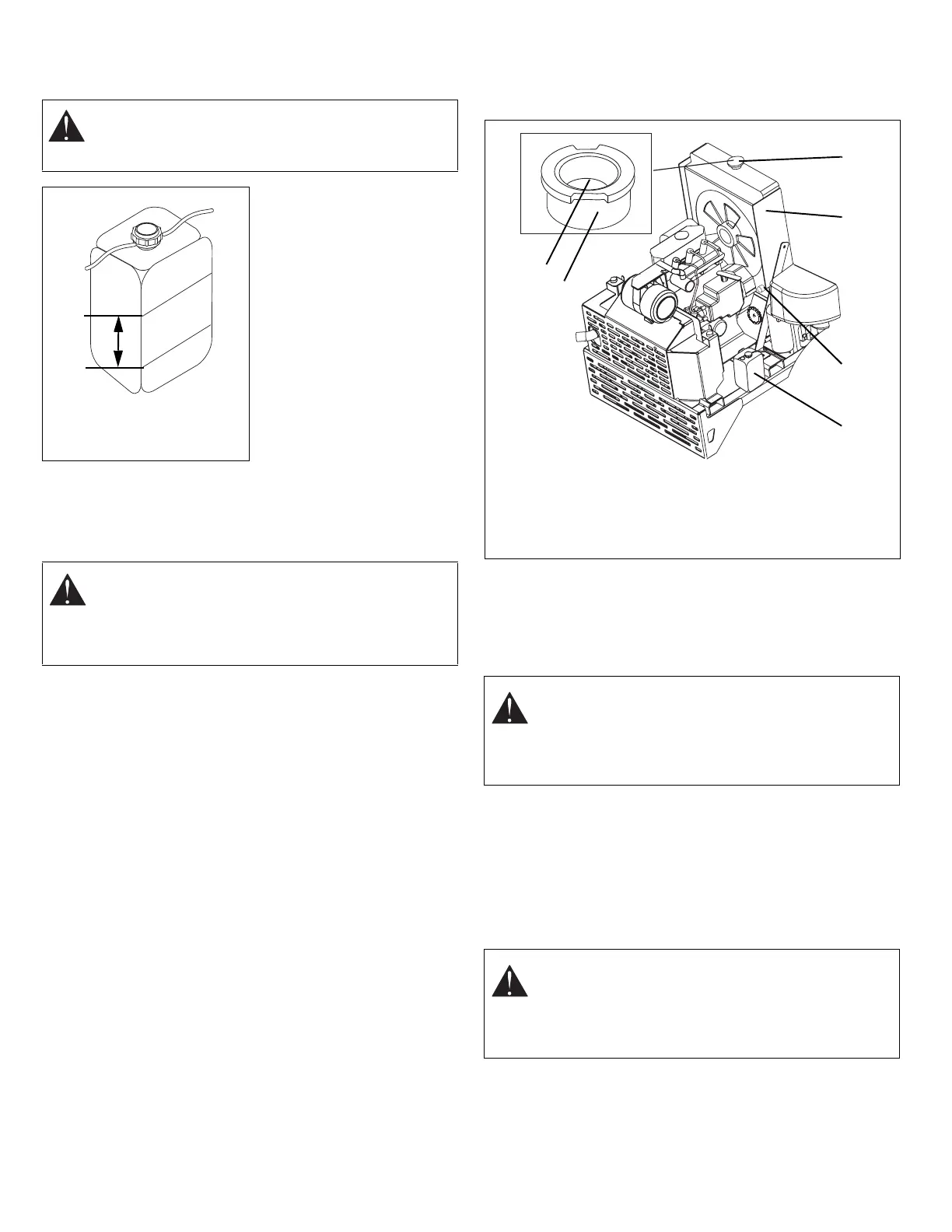
2. Check coolant reservoir.
Coolant should be
between the low and full
marks with engine cold.
3.If coolant is below the low
mark, remove cap, and add
coolant to the full mark. Refer
to Engine Manual for the
correct type of coolant.
Changing Coolant
Diesel Units (992060, 061, 318, 319)
1. Remove transmission belt (see Transmission Belt
Removal on page 22).
2. Remove radiator cap (figure 24).
3. Place suitable container under drain plug.
4. Remove drain plug and allow coolant to drain
completely.
5. Install drain plug on radiator.
6. Remove coolant reservoir from coolant reservoir
bracket.
7. Drain coolant from coolant reservoir.
8. Install coolant reservoir on coolant reservoir bracket.
9. Install transmission belt (see Transmission Belt
Removal on page 22).
NOTE: Refer to Engine Manual for the correct type of
coolant. See Specifications on page 30 for cooling system
capacity.
10.Fill radiator to bottom of radiator filler neck with coolant.
11. Fill coolant reservoir to the FULL mark.
IMPORTANT: Air in cooling system must be removed.
12.Install radiator cap.
13.Start engine, warm engine up thoroughly, and then shut
off engine.
14.Remove radiator cap.
15.Fill radiator to bottom of radiator filler neck with coolant.
If necessary, fill coolant reservoir to the full mark.
16.Install radiator cap.
NOTE: Dispose of used coolant at a certified recycling
center.
Gas Units (992058, 059)
1. Place hood in the daily service position (see Service
Positions on page 17).
2. Remove radiator cap (figure 25).
3. Place suitable container under drain plug.
WARNING: To avoid personal injury DO NOT
remove radiator cap when engine is hot. Check
coolant level at coolant reservoir, not at radiator.
WARNING: To avoid personal injury DO NOT
remove radiator cap when engine and coolant is hot.
When safe, loosen cap slightly to the first stop to
relieve any excess pressure before removing cap
completely.
FULL
LOW
OF3226
2
3
1. Operating Range
2. Full
3. Low
1
WARNING: To avoid personal injury DO NOT
remove radiator cap when engine and coolant is
hot. When safe, loosen cap slightly to the first stop
to relieve any excess pressure before removing
cap completely.
WARNING: To avoid personal injury DO NOT
remove radiator cap when engine and coolant is
hot. When safe, loosen cap slightly to the first stop
to relieve any excess pressure before removing
cap completely.
1. Radiator Cap
2. Radiator
3. Drain Plug
4. Coolant Reservoir
5. Radiator Filler Neck
6. Bottom of Filler Neck
Figure 24
OF3307
1
2
3
4
6
5



 To Next Page