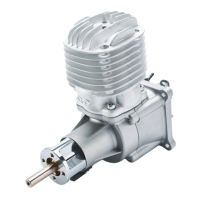
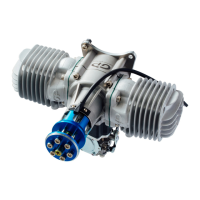
This document is an instruction manual for Great Power Engines, a series of two-stroke internal combustion engines designed for model aircraft. The manual provides detailed technical specifications, safety instructions, operational procedures, and maintenance guidelines for various single-cylinder and twin-cylinder models.
Function Description
Great Power Engines are designed to power model aircraft, offering a range of horsepower outputs suitable for different aircraft sizes and performance requirements. These engines operate on a mixture of unleaded gasoline and synthetic oil, utilizing an ignition system to combust the fuel mixture and drive a propeller. The manual emphasizes safe operation and proper maintenance to ensure optimal performance and longevity.
Important Technical Specifications
The manual details specifications for several engine models, categorized into single-cylinder and twin-cylinder configurations.
Single-Cylinder Models:
-
GP38:
- Bore: 38 mm
- RPM Range: 1600-10000 RPM
- Net Weight: 1038 g
- Ignition Weight: 136 g
- Output: 5 Horsepower
- Fuel: Unleaded 89-93 Octane Fuel
- Lubrication: 40:1 Mixture of Octane Fuel and Synthetic Oil
- Pitts Muffler Weight: 144 g
- Recommended Propellers: Two-Blades (19x10, 20x8, 20x9), Three-Blade (18x10, 19x11 Narrow). Maximum power at 10000 RPM, do not exceed 9200 RPM during ground running.
- Propeller Bolts: M4x40 (65 in-lbs for Wood Prop, 70 in-lbs for Carbon Prop)
-
GP61:
- Bore: 46.5 mm
- RPM Range: 1600-8900 RPM
- Net Weight: 1507 g
- Ignition Weight: 136 g
- Output: 6.5 Horsepower
- Fuel: Unleaded 89-93 Octane Fuel
- Lubrication: 40:1 Mixture of Octane Fuel and Synthetic Oil
- Muffler Weight: 160 g
- Recommended Propellers: Two-Blades (22×12, 23×10, 24×8, 24×10), Three-Blade (21×12, 22×10). Maximum power at 8900 RPM, do not exceed 7700 RPM during ground running.
- Propeller Bolts: M5x45 (70 in-lbs for Wood Prop, 75 in-lbs for Carbon Prop)
-
GP88 V2:
- Bore: 53 mm
- RPM Range: 1200-8500 RPM
- Net Weight: 1980 g
- Ignition Weight: 136 g
- Output: 10 Horsepower
- Fuel: Unleaded 89-93 Octane Fuel
- Lubrication: 40:1 Mixture of Octane Fuel and Synthetic Oil
- Muffler Weight: 345 g
- Recommended Propellers: Two-Blades (26×10, 26×12, 27×10, 28×10). Maximum power at 8500 RPM, do not exceed 7300 RPM during ground running.
- Propeller Bolts: M5x45 (75 in-lbs for Wood Prop, 90 in-lbs for Carbon Prop)
Twin-Cylinder Models:
-
GP76:
- Bore: 38 mm
- RPM Range: 1400-9000 RPM
- Net Weight: 1720 g
- Ignition Weight: 202 g
- Output: 8 Horsepower
- Fuel: Unleaded 89-92 Octane Fuel
- Lubrication: 40:1 Mixture of Octane Fuel and Synthetic Oil
- Muffler Weight: 200 g
- Recommended Propellers: Two-Blades (22×12, 24×9, 24×10, 24×10TH, 25×8, 26×8), Three-Blades (21×12, 22×10, 22×12, 23×10). Maximum power at 9000 RPM, do not exceed 7700 RPM during ground running.
- Propeller Bolts: M5x45 (75 in-lbs for Wood Prop, 90 in-lbs for Carbon Prop)
-
GP123 V2:
- Bore: 46.5 mm
- RPM Range: 1500-8900 RPM
- Net Weight: 2300 g
- Ignition Weight: 202 g
- Output: 12 Horsepower
- Fuel: Unleaded 89-93 Octane Fuel
- Lubrication: 40:1 Mixture of Octane Fuel and Synthetic Oil
- Muffler Weight: 330 g
- Recommended Propellers: Two-Blades (27×12, 28×10, 28×12, 29×10), Three-Blades (25×12, 26×12). Maximum power at 8900 RPM, do not exceed 7300 RPM during ground running.
- Propeller Bolts: M5x50 (90 in-lbs for Wood Prop, 110 in-lbs for Carbon Prop)
-
GP178:
- Bore: 53 mm
- RPM Range: 1100-9000 RPM
- Net Weight: 3550 g
- Ignition Weight: 202 g
- Output: 21.5 Horsepower
- Fuel: Unleaded 89-92 Octane Fuel
- Lubrication: 40:1 Mixture of Octane Fuel and Synthetic Oil
- Muffler Weight: 430 g
- Recommended Propellers: Two-Blades (30×13, 31×12, 32×10). Maximum power at 9000 RPM, do not exceed 6700 RPM during ground running.
- Propeller Bolts: M6x55 (90 in-lbs for Wood Prop, 110 in-lbs for Carbon Prop). Special alloy (SNCM439) M6x55 screws are provided for GP178 due to high horsepower.
General Engine Specifications:
- Fuel and Oil Mixture: Always use 40-50 units of unleaded 89-93 octane fuel mixed with 1 unit of synthetic oil (mixture ratio 40-50:1). Recommended oils are Red Line Two-Stroke Racing Oil and Motul 710. Do not use mixed fuel older than 90 days or synthetic oils intended for garden appliances.
- Ignition System: Voltage Input: 6.6V~8.4V. Do not use the tachometer port for power.
- Screw Torque Values:
- Spark Plug: 100 in-lbs (All Engines)
- Hub Screw: 250-280 in-lbs (All Engines)
- Crankcase Bolts: 90-100 in-lbs (M5x18 for GP38/GP88, M5x20 for GP61/GP76/GP178)
- Cylinder Base Bolts: 90 in-lbs (M5x16 for GP38/GP61/GP76/GP123), 90-100 in-lbs (M5x18 for GP88, M5x20 for GP178)
- Carburetor Mount Bolts: 70 in-lbs (M5x65 for GP38, M5x50 for GP61, M5x75 for GP76, M5x45 for GP88/GP123, M5x108 for GP178)
Usage Features
The manual provides comprehensive instructions for engine installation, propeller selection, end point adjustment, needle setting, and starting procedures.
Maintenance Features
The manual outlines regular maintenance checks and a limited warranty policy.
-
Regular Checks:
- Regularly check for fuel seepage, which can indicate a lean fuel/air ratio and cause erratic running or damage.
- Spark plug replacement is recommended every 20 hours of running.
- Reed valve check is recommended after 50 hours.
- A complete engine checkup by authorized service centers is recommended after 300 hours.
- For GP178, certain parts (pistons, piston rings, needle bearings, spark plugs) may wear out more quickly and require occasional replacement to maintain peak performance.
- Regularly check and tighten all engine, firewall, and propeller screws to their specified torque values.
-
Limited Warranty:
- Duration: TWO (2) YEARS from the date of original purchase from authorized dealers.
- Validity: Requires the GP-issued Warranty Card with Date of Purchase and dealer's/seller's name, or proof of purchase. If not available, the Manufacture Date recorded by GP will be used.
- Transferability: Only the original owner is eligible.
- Coverage: Covers parts of GP engines and ignitions (CDI).
- Exclusions: Does NOT cover mufflers (given free). Does NOT cover damage from misuse, mishandling, unskilled repair, unauthorized modification/disassembly, crash/crush, use of aftermarket parts, or low-quality/improper fuel/additives.
- Includes: Repair and replacement of defective parts/engines, shipping charges, and labor charges.
- Claim Process: Requires Warranty Card, Maintenance Form (from www.gpengine.world/news/11), and photos/videos of issues.
- GP has absolute discretion to approve or reject claims.
The manual also provides QR codes for the GP Official Website, GP Facebook, and GP Instagram for more information.

 Need help?
 General

 To Next Page