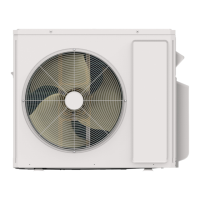
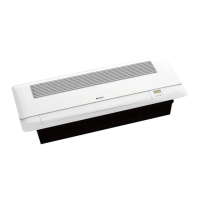
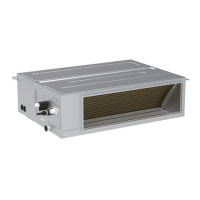
This document is a user manual for GREE UNIX air handling units and condensing units, specifically designed for the Canadian market. It provides essential information for the safe and efficient operation, maintenance, and troubleshooting of these HVAC systems.
Function Description
The GREE UNIX series encompasses both low static and high static air handlers, as well as condensing units, designed for residential and commercial heating and cooling applications. These systems are engineered to provide comfortable indoor environments by regulating temperature and airflow. The air handlers are responsible for circulating conditioned air throughout a space, while the condensing units work in conjunction with the air handlers to facilitate the refrigeration cycle, either removing heat from the indoor air (cooling) or extracting heat from the outdoor air (heating). GREE emphasizes its commitment to innovation, energy efficiency, and eco-friendliness, utilizing R410A refrigerant, which is considered environmentally friendly. The company's mission is to provide advanced, reliable, and comfortable air conditioning solutions globally.
Important Technical Specifications
The manual lists specific models covered, categorized by their function:
- Low Static Air Handlers:
- GUD24A/A-D(U)
- GUD36A/A-D(U)
- GUD48A/A-D(U)
- GUD60A/A-D(U)
- High Static Air Handlers:
- GUD24AH2/A-D(U)
- GUD36AH2/A-D(U)
- GUD48AH2/A-D(U)
- GUD60AH2/A-D(U)
- Condensing Units:
- GUD36W/A-D(U)
- GUD60W/A-D(U)
While specific capacity ratings (e.g., BTU/hr) are not detailed in this introductory section, the model numbers typically indicate capacity. For example, "24," "36," "48," and "60" often correspond to nominal capacities in thousands of BTUs per hour (e.g., 24,000 BTU/hr or 2 tons). The "A" in low static models likely denotes a standard configuration, while "AH2" in high static models suggests a design capable of handling higher external static pressure, suitable for more extensive ductwork systems. The "W" in condensing units indicates their outdoor placement and function. The "(U)" suffix might denote a universal or specific market variant. The use of R410A refrigerant is a key technical specification, highlighting the system's compliance with modern environmental standards for refrigerants.
Usage Features
The manual implicitly highlights several usage features through its "Energy Saving Tips" and "Troubleshooting" sections:
- Programmable/Wi-Fi/Smart Thermostat Compatibility: The systems are designed to work with programmable, Wi-Fi, and smart thermostats, allowing users to monitor and control temperature settings remotely via smartphones, tablets, or computers. This feature enables optimized scheduling and energy savings through intelligent algorithms that adjust settings based on operating history.
- Optimized Scheduling: Users can program occupied and unoccupied schedules to prevent unnecessary operation, thereby saving energy and extending equipment lifespan.
- Environmental Control Recommendations: The manual advises users on how to optimize system performance based on external conditions, such as closing window coverings during cooling season to block radiant heat and opening them during heating season to utilize solar gain.
- User-Friendly Troubleshooting: A comprehensive troubleshooting guide helps users diagnose common issues, such as power supply problems, obstructed airflow, incorrect temperature settings, and dirty filters, before requiring professional service. This empowers users to resolve minor issues independently.
- Safety Information: The manual includes a "Safety Symbols Description" section, using DANGER, WARNING, CAUTION, and NOTE indicators to alert users to potential hazards and important operational instructions, ensuring safe interaction with the equipment.
Maintenance Features
The manual places significant emphasis on routine maintenance for optimal performance and longevity:
- Air Filter Maintenance: Users are instructed to check and clean or replace the indoor return air filter every 30 days during cooling and heating seasons. The manual provides a visual guide (STEP 1 and STEP 2) for accessing and removing the filter from the indoor unit. This is a critical user-performable maintenance task.
- Professional Indoor Unit Inspection: A licensed HVAC contractor is required for regular inspection and maintenance of various indoor unit components, including:
- Electric box
- Centrifugal fan
- Fan motor
- Secondary drain pan
- Evaporator
- Primary drain pan
This ensures that complex internal components are functioning correctly and are free from issues.
- Professional Outdoor Unit Inspection: Similarly, a licensed HVAC contractor must regularly inspect and maintain the outdoor unit, focusing on:
- Condenser coil
- Electric box
- Fan motor
- Compressor
These inspections include cleaning the blower motor, blower wheel, and housing; inspecting and tightening electrical connections; cleaning the evaporator coil, condensate drain pan, and drain line; and testing equipment operation.
- Outdoor Unit Environmental Care: Users are advised to keep the area around the outdoor unit clear of debris and leaves. Crucially, in heating mode, the underside of the unit must be cleared of snow or ice to prevent accumulation from defrost cycles, emphasizing that the outdoor unit should never be buried by snow or ice. Recommendations for heat pump shelters in areas with frequent heavy snow are also provided, suggesting consultation with a GREE Canada-certified installer.
- Pre-Season Routine Maintenance: Scheduling pre-season maintenance with a licensed HVAC contractor is recommended to improve system performance and efficiency.
Overall, the GREE UNIX manual provides a clear framework for understanding, operating, and maintaining these HVAC systems, balancing user-performable tasks with the necessity of professional service for complex components.



 To Next Page
 General