Unaided Test
Based on the Carhart Method (1946).
Seat the patient in a sound field room (6 feet by 6 feet) at a distance equal to one meter from the
speakers. The patient’s ears should be at the same level with the face of the speaker.
The Insert phone may be selected as an alternate transducer for hearing aid evaluation.
Adjust Ext A and/or Mic to peak at an average of 0 on the VU meter.
Score each correct response by pressing the Correct button and each wrong response by
pressing the Incorrect button to obtain an unaided Speech Reception Threshold (SRT).
Live speech or recorded spondees will be presented in the test ear.
Continue with unaided word discrimination testing to obtain a word discrimination score.
Obtain an unaided estimate of tolerance limits (Uncomfortable Loudness Level or UCL).
The patient should be told that the clinician’s voice will be uncomfortably loud, but he
should report whether he actually feels a pressure, a tickle or pain. Beginning at the speech
reception threshold level, the patient is requested to answer simple questions while the
attenuator for the selected channel is increased in 5 dB steps. Continue this procedure
until a reading of 80 to 90 dB HL is reached or until the patient indicates that the sound is
painful.
1.
2.
3.
4.
5.
6.
This narrow band masking allows for a noise intensity signal necessary to achieve the
desirable greater threshold shifts at lower frequencies.
Assist the patient with earphone (or insert phone) placement and with positioning the bone
vibrator on the forehead.
Using Channel 1 with Phone and Tone selected, establish the patient’s air conduction
thresholds in each ear for each frequency to be tested. Frequencies between 250 and 4000
Hz are suggested as the most useful for the purposes of this test.
Using Channel 2, select Bone and Narrow Band Noise.
Determine air conduction thresholds again for each ear in the presence of bone conducted
noise.
Determine the patient’s threshold shift caused by noise.
The “sensorineural loss” at each frequency is the difference between the patient’s
threshold produced with the noise and the amount of shift normal hearing adults experience
unde
the same conditions.
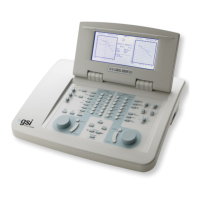
Grason-Stadler GSI
®
61 CLINICAL AUDIOMETER
Sensorineural Acuity Level (SAL) Test
A modification of the Rainville Method.
A procedure for the measurement of sensorineural sensitivity comparing threshold shifts
roduce
one conducted maskin
noise in normal hearin
sub
ects and in
atients.
Hearing Aid Evaluation
1
.
2
.
3
.
4
.
5
.
6
.
4-6
1761-0100 Rev. B


 To Next Page
 Loading...