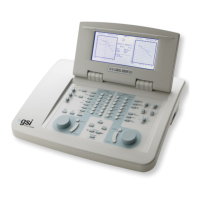
The microprocessor based circuit design of the GSI 61 Clinical Audiometer should provide
trouble-free service for a long time period. It is recommended to routinely make and file the
audiogram of one person for the purpose of biologic calibration. This person (or group of
persons) should have a known stable audiometric curve that does not exceed 25 dB HL at
any frequency. This procedure should start when the GSI 61 is first installed and then be
continued. Remember that individual threshold can shift by as much as 5 dB from day to day;
however variations that exceed this range may point to difficulties which require attention.
Periodic Checks
The routine maintenance checks described below may point to the source of some instrument
problems. If they do not, the instrument should receive technical service before further use.
The checks should be made at periodic intervals, even if biologic checks reveal no problems.
Earphone and Bone Vibrator Cords
With extended use, earphone and bone vibrator cords tend to fray internally at the connectors.
This fraying can decrease or increase the signal level or an intermittent signal as the cord is
flexed.
To check for either condition, turn on the GSI 61. Set the HL to a comfortably audible level.
Activate both Interrupt buttons to ON. Bend the cord next to the plug at both ends of each
earphone. Listen for an intermittent signal, abrupt changes in the signal level, or a scratchy
sound that coincides with the flexing of the cord. The presence of any of these conditions
signifies that the cord should be replaced.
Repeat the test for the other earphone, the bone vibrator and the insert phones.
Hum and Noise
With the GSI 61 initialized to Tone test type and the Channel 1 Interrupt button in the ON
mode, turn the Channel 1 Hearing Level control from 0 to 60 dB HL. Listen for low
frequency hum (60 or 120 Hz) and any other noise (hiss or low rushing sound) at all attenuator
levels through the earphone. Some audible noise at levels above 70 dB is permissible. If
these noises are detected below 70 dB, the audiometer should be schedule for maintenance.
Repeat this procedure with the Channel 2 Hearing Level control.
5-1
5
e
Routine Maintenance
Biological Calibration Check
Chapter 5
Routine Maintenance
1761-0100 Rev. B


 To Next Page
 Loading...