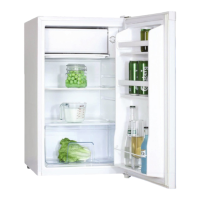
This document provides comprehensive instructions for the GVA 41L Bar Fridge, model G41BFW15, covering its function, usage, and maintenance. It emphasizes safety, environmental responsibility, and optimal performance.
Function Description
The GVA 41L Bar Fridge is a compact refrigeration appliance designed for short-term storage of fresh food. It operates by maintaining a cool internal temperature, allowing users to preserve perishable items. The appliance utilizes a compressor-based cooling system with a flammable refrigerant (isobutane R600a) and cyclopentane (R141b) for cabinet insulation. Its primary function is to provide a convenient and efficient cooling solution for household and similar applications, such as staff kitchen areas, hotels, motels, bed and breakfast environments, and catering services. The unit is designed to be freestanding and is not intended for built-in installation.
Usage Features
Installation and Setup:
The bar fridge requires careful installation to ensure proper operation and safety. It should be placed on a sturdy, level floor capable of supporting its weight when fully loaded. The appliance is heavy, so a two-person lift or mechanical aid is recommended during installation to prevent injury. Adequate ventilation is crucial; the front of the unit must be completely unobstructed, and ventilation openings should be kept clear. The recommended clearances are at least 50mm between the rear of the appliance and the wall, 25mm between the sides and wall, and 25mm above the top. The unit should be located in a cool, well-ventilated indoor area with ambient temperatures between 10°C and 43°C, away from direct sunlight, ovens, grills, or other heat sources to optimize power consumption.
Before plugging in the new bar fridge, it should stand upright for approximately 2 hours to allow refrigerant gases to settle, reducing the possibility of a malfunction in the cooling system. After plugging it into a dedicated 220-240V, 50Hz, 3-prong, earthed power outlet with a 15A fuse, allow the unit to cool down for two to three hours before placing food inside. An adapter or extension cord should not be used. The power cord must be secured behind the unit to prevent tripping hazards and accidental disconnection.
Door Reversal:
A notable feature is the capability to reverse the door swing, allowing it to open from either the left or right side to suit individual installation requirements. This process involves tilting the unit, removing hinge covers, unscrewing and removing hinge brackets, moving the core cover, and then reattaching the door and hinges on the opposite side. It is crucial to ensure the bar fridge is disconnected from the power supply during this procedure and that all parts removed are kept for re-installation.
Temperature Control:
The temperature control knob is located in the compressor compartment at the back of the unit. It offers settings from "O" (OFF) to "5" (coldest setting). "1" represents the warmest setting, suitable for low ambient temperatures (around 16°C), while "2-3" is recommended for ambient temperatures around 25°C. Settings "4" or "5" provide lower (colder) temperatures. The internal temperature is influenced by room temperature, frequency of door opening, and the appliance's location. Experimentation may be necessary to find the correct setting. If the unit is unplugged or loses power, a three to five-minute delay is required before restarting to prevent damage to the compressor.
Food Storage:
The fresh food compartment is designed for short-term storage. To maintain good cooling efficiency and save energy, avoid overloading the fridge and ensure enough space around stored items for cold air circulation. Do not block ventilation openings. Opening the door for extended periods or too frequently should be avoided.
Normal Operating Sounds:
Users may hear characteristic noises during operation, such as clicks when the compressor switches on or off, humming when the compressor is running, and bubbling/splashing noises as refrigerant flows through the thin tubes. These sounds are normal.
Maintenance Features
Defrosting:
For optimal efficiency and energy consumption, the bar fridge should be defrosted when the frost accumulated on the evaporator is approximately 5mm thick. To defrost, turn the thermostat dial to the "O" position, unplug the unit, and remove all perishable food items, storing them in another fridge or cooler bag. Defrosting typically takes a few hours. After defrosting, the food compartments should be dried thoroughly before returning the thermostat dial to the desired position. For quicker defrosting, remove all food and leave the door open. It is critical not to use boiling water, sharp, or metallic instruments to remove frost, as this can damage plastic parts or the cooling system and void the warranty. A plastic scraper is recommended if needed.
Cleaning:
Before cleaning, ensure the temperature control is set to "O," the bar fridge is unplugged, and all food and shelves are removed. The interior surfaces should be cleaned with a warm water and baking soda solution (approximately 2 tablespoons of baking soda per 1.2L of water). Excess water should be wrung out of the sponge or cloth, especially when cleaning around the temperature control or any electrical parts. Shelves, the inside, and the outside of the fridge should be cleaned with a mild detergent solution and warm water, then rinsed and dried thoroughly. Acids, chemical thinners, petrol, benzene, or similar solvents should never be used for cleaning any part of the bar fridge. Periodically cleaning the refrigeration system at the back of the appliance with a duster or vacuum cleaner is advisable.
Power Failure:
Most power failures are short-lived and should not significantly affect the fridge's temperature if the door is opened minimally. For longer power outages, appropriate steps should be taken to protect stored food.
Moving the Bar Fridge:
When moving the appliance, remove all food, tape the door shut, and secure all loose items inside. The leveling feet should be turned up to the base. It is recommended to move the fridge in its original packaging or protect its exterior with a blanket or similar item. Avoid applying force to external parts like pipes, the condenser, or the door. The fridge should remain in an upright position, not tilted more than 45 degrees from upright.
Switching Off the Appliance:
To switch off the appliance for an extended period, turn the temperature regulator to "O," remove all refrigerated items, unplug the unit or disconnect the electricity supply, and clean it thoroughly. To prevent odors and mold growth, leave the door open slightly. After turning off, allow the unit to settle for about 10 minutes before turning it back on to prevent compressor damage.
Energy Saving Tips:
To save energy, place the fridge in the coolest area of the room, away from heat sources and direct sunlight. Allow hot foods to cool before placing them inside. Properly wrap foods and wipe containers dry to reduce frost build-up. Avoid lining fridge storage bins with aluminum foil, wax paper, or paper towels, as this interferes with cold air circulation. Do not leave the fridge door open longer than necessary.



 To Next Page
 General