ES0755 rev A 1/11
16
Z-Axis
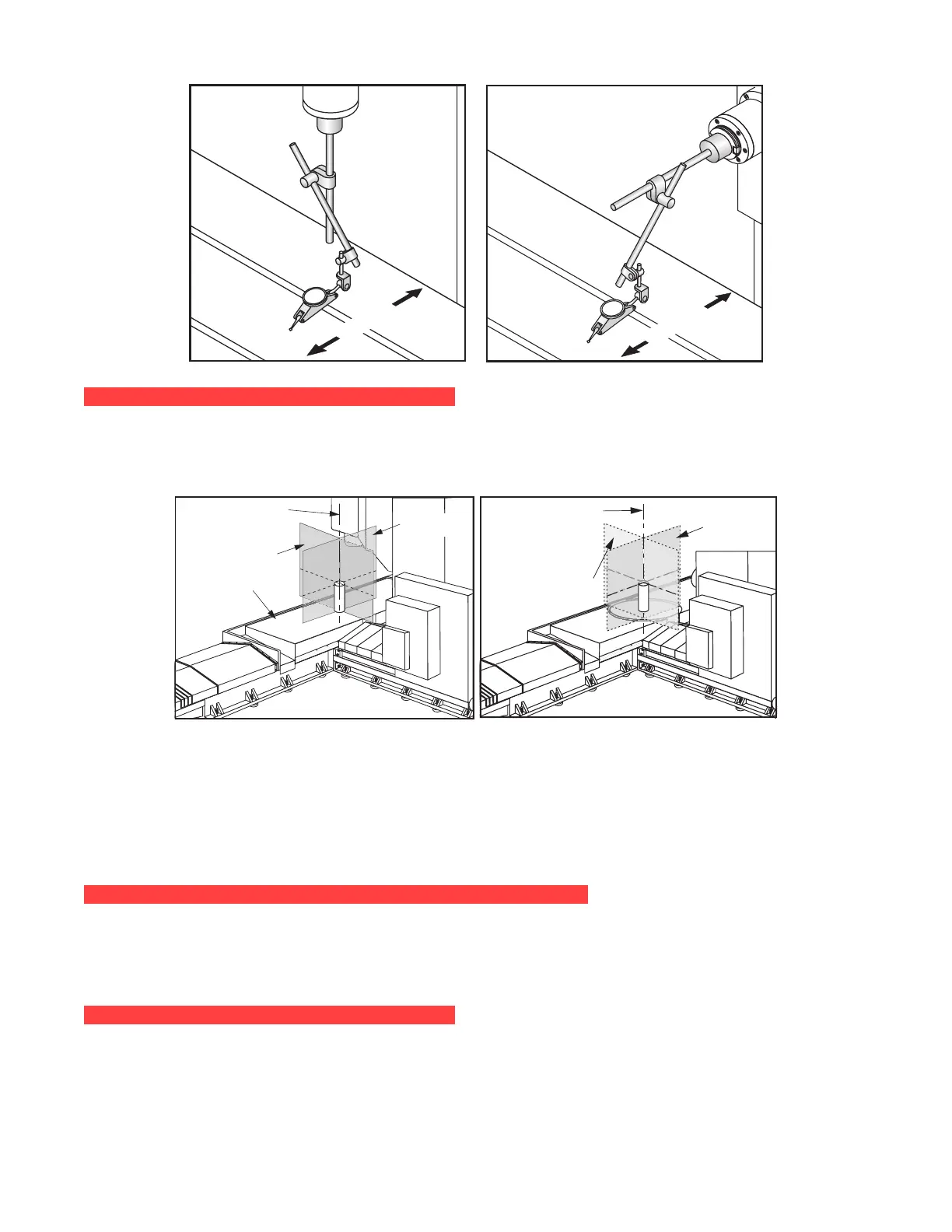
sweePinG the y-axis / z-axis
Before continuing to the nal attachment of the column base to the table base the Y-axis (VS) / Z-axis (HS)
needs to be swept. Until now we have assumed that the geometry of the column is perfectly perpendicular to
the plane of the column base, but that may not be close enough to maintain the required machine geometry.
Z-Axis Motion Will
Be Swept Parallel To
Line Of Intersection
Y-Z Plane
X-Y Plane
X-Z Plane
Y-Axis Motion Will
Be Swept Parallel
To Line Of
Intersection
X-Y Plane
Y-Z Plane
Sweeping the Z-axis is accomplished using a cylinder square. The purpose of this sweep is to verify that the
line of motion of the Z-axis is perpendicular to the X-Y plane described by the motion in the Y-axis and the
motion in the X-axis. The X-Y plane, as dened by the leveling process, should be equivalent in the squar-
ing function as the parallel plane described by the surface of the table. The line of motion of the Z-axis will
be checked by comparing it to the line of intersection of the two most convenient relative planes, that of the
X-Z plane and the Y-Z plane. By assuring that each of these planes are perpendicular to the X-Y plane within
specication, the machine geometry will be preserved.
final connection of the column base to the table base
1. Before inserting and tightening all the connecting screws, recheck the table level to be certain
that the leveling process of the column base did not affect table level.
2. Tighten the connecting screws with lock washers in place to 500 ft-lb..
Geometry check after matinG the two bases
Before continuing two fundamental geometry checks need to be made. The rst is the perpendicularity of the
X-axis to the Y-axis, and the second is to verify the sweep of the Z-axis.
1. The sweep of the X-axis to the Y-axis is accomplished using a granite square. Set zero by sweep-
ing the Y-axis on one side of the square, and then to verify that the motion of the X-axis is per-
pendicular by sweeping the adjacent side of the square. If the X-axis and Y-axis are not found to


 To Next Page
 Loading...