EasyManua.ls Logo

Haban 402-E - Page 8

Default Icon
25 pages
Print Icon
To Next Page IconTo Next Page
To Previous Page IconTo Previous Page
Loading...
sickle
Knife
Ad
1
u
St
menf
I_.j
Check
the
}K>silion
of
the
forward
emis
of
the
live
knife
Hcotions
(Ji)
to
make
sure
that
they
protrude
past
the
forwaixl
eiuls
of
Iho
shear
finger
plates
(K).
For
cutting
loose
precut
hay.
dense,
fine
and
loose
under
growths,
etc.,
without
clogging,
the
live
moving
knives
must
contact
the
material
ahead
of
any
stationary
shear-plate.
1/32"
to
1/16*'protrusion
of
the
knife
is
sufficient.
If
your
"wear-plates"
(A)
are
worn
half
way
thru
on
the
front
edge,
moving
the
wear
plate
forwanl
will
place
the
sickle
in
the
proper
position.
If
the
wear
plate
Is
worn
too
much
for
making
the
proper
adjustment
they
shouhl
lx>
roplaood.
KNIFE
ASSEMBLY
HKMOVAL
When
it
becomes
necessary
to
remove
the
knife
for
sharpening,
section
replacement
or
complete
knife
replacement,
remove
the
Iwlls
holding
the
knife
head
to
bar
and
slide
knife
out
of
guard
assembly.
ALIGNMENT
OF
LEIX}Ed
PLATE
SUUFACES
Remove
the
knife
assembly
and
check
all
shear
fingers
for
alignment
of
surfaces.
TTie
align¬
ment
may
be
checked
by
using
a
straight
edge
or
drawing
a
string
tightly
across
these
sur¬
faces.
Any
shear
finger
being
too
high
will
create
excess
clearance
between
the
shear
finger
and
the
knife
sections.
Misalignment
can
be
corrected
by
bending
shear
fingers
up
or
down,
as
required.
Hammer
only
on
solid
portion
of
guard
beyond
the
lip.
WEAK
PLATE
ADJUSTMENT
(Fig.
10)
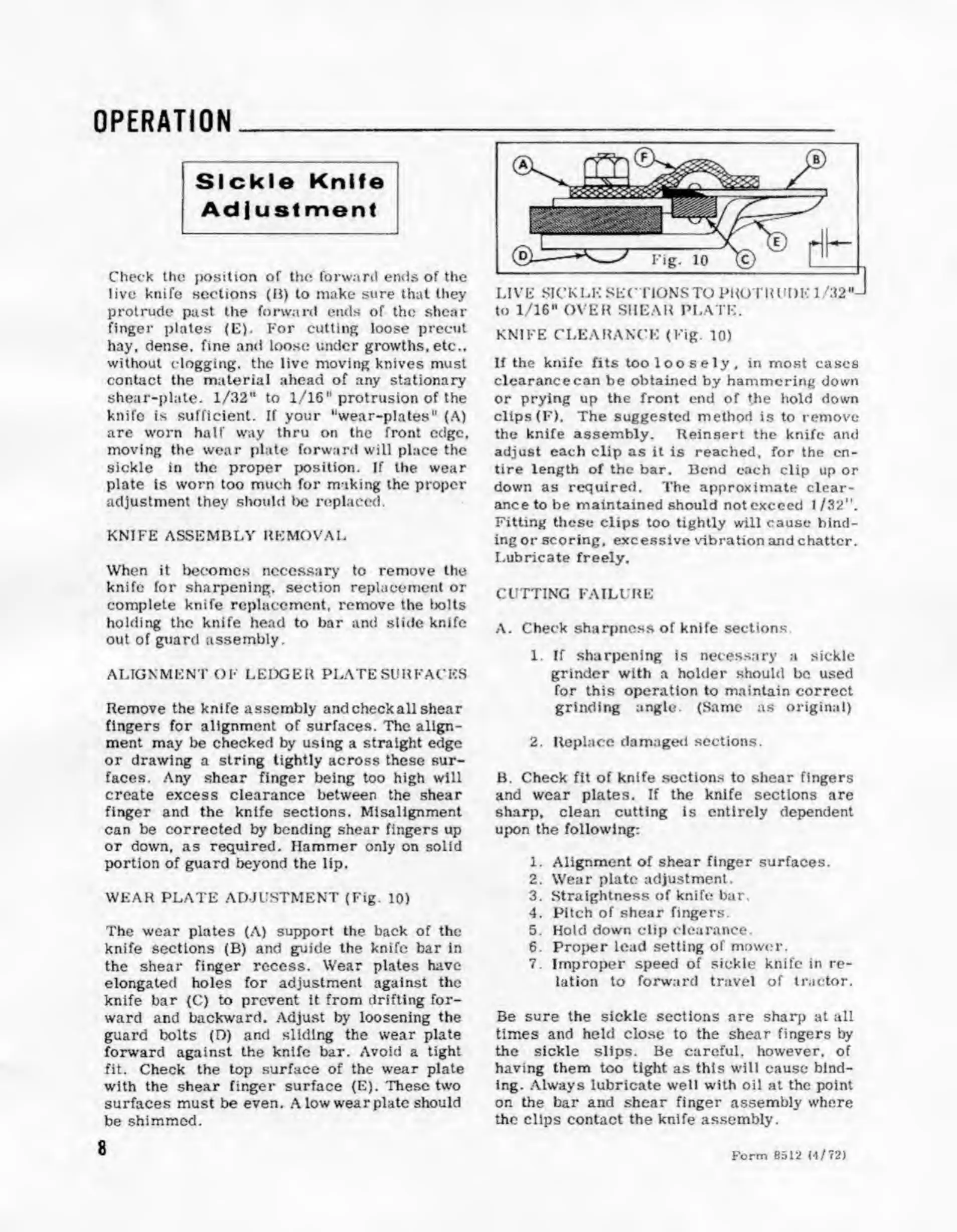
The
wear
plates
(A)
support
the
back
of
the
knife
sections
(B)
and
guide
the
knife
bar
in
the
shear
finger
recess.
Wear
plates
have
elongated
holes
for
adjustment
against
the
knife
bar
(C)
to
prevent
it
from
drifting
for¬
ward
and
backward.
Adjust
by
loosening
the
guard
bolts
(D)
and
sliding
the
wear
plate
forward
against
the
knife
bar.
Avoid
a
tight
fit.
Check
the
top
surface
of
the
wear
plate
with
the
shear
finger
surface
(E).
These
two
surfaces
must
be
even.
Alowwearplatc
should
be
shimmed.
8
KNIFE
CLEAKANrEC
(Fig.
10)
If
the
knife
fits
too
loosely,
in
mo.st
cases
clearancecan
be
obtained
by
hammering
down
or
prying
up
the
front
end
of
the
hold
down
clips
(F>.
The
suggested
method
is
to
remove
the
knife
assembly.
Reinsert
the
knife
and
adjust
each
clip
as
it
is
reached,
for
the
en¬
tire
length
of
the
bar.
Bend
each
clip
up
or
down
as
required.
The
approximate
clear¬
ance
to
be
maintained
should
not
exceed
t/32".
Fitting
these
clips
too
tightly
will
cause
bind¬
ing
or
scoring,
excessive
vibration
and
chatter.
I.ubricate
freely.
CUTTING
FAILURE
A.
Check
sharpness
of
knife
section.s
1.
If
sharpening
Is
necessary
a
sickle
grinder
with
a
holder
should
be
used
for
this
operation
to
maintain
correct
grinding
angle.
(Same
us
original)
2.
Replace
damage<i
sections.
B.
Check
fit
of
knife
soctlon.s
to
shear
fingers
and
wear
plates.
If
the
knife
sections
are
sharp,
clean
cutting
is
entirely
dependent
upon
the
following:
1.
Alignment
of
shear
finger
surfaces.
2.
Wear
plate
adjustment.
3.
Straightness
of
knife
bar.
4.
Pitch
of
shear
fingers.
5.
Hold
down
clip
cleai'ance.
6.
ProjKjr
load
setting
of
mower.
7.
Improper
speed
of
sickle
knife
In
re¬
lation
to
forward
travel
of
tractor.
Be
sure
the
sickle
sections
are
sharp
at
all
times
and
held
close
to
the
shear
fingers
by
the
sickle
slips.
Be
careful,
however,
of
having
them
too
tight
as
this
will
cause
bind¬
ing.
Always
lubricate
well
with
oil
at
the
point
on
the
bar
and
shear
finger
assembly
whore
the
clips
contact
the
knife
assembly.
Form
8512
(^1/721