EasyManua.ls Logo

Haban 402-E - Page 7

Default Icon
25 pages
Print Icon
To Next Page IconTo Next Page
To Previous Page IconTo Previous Page
Loading...
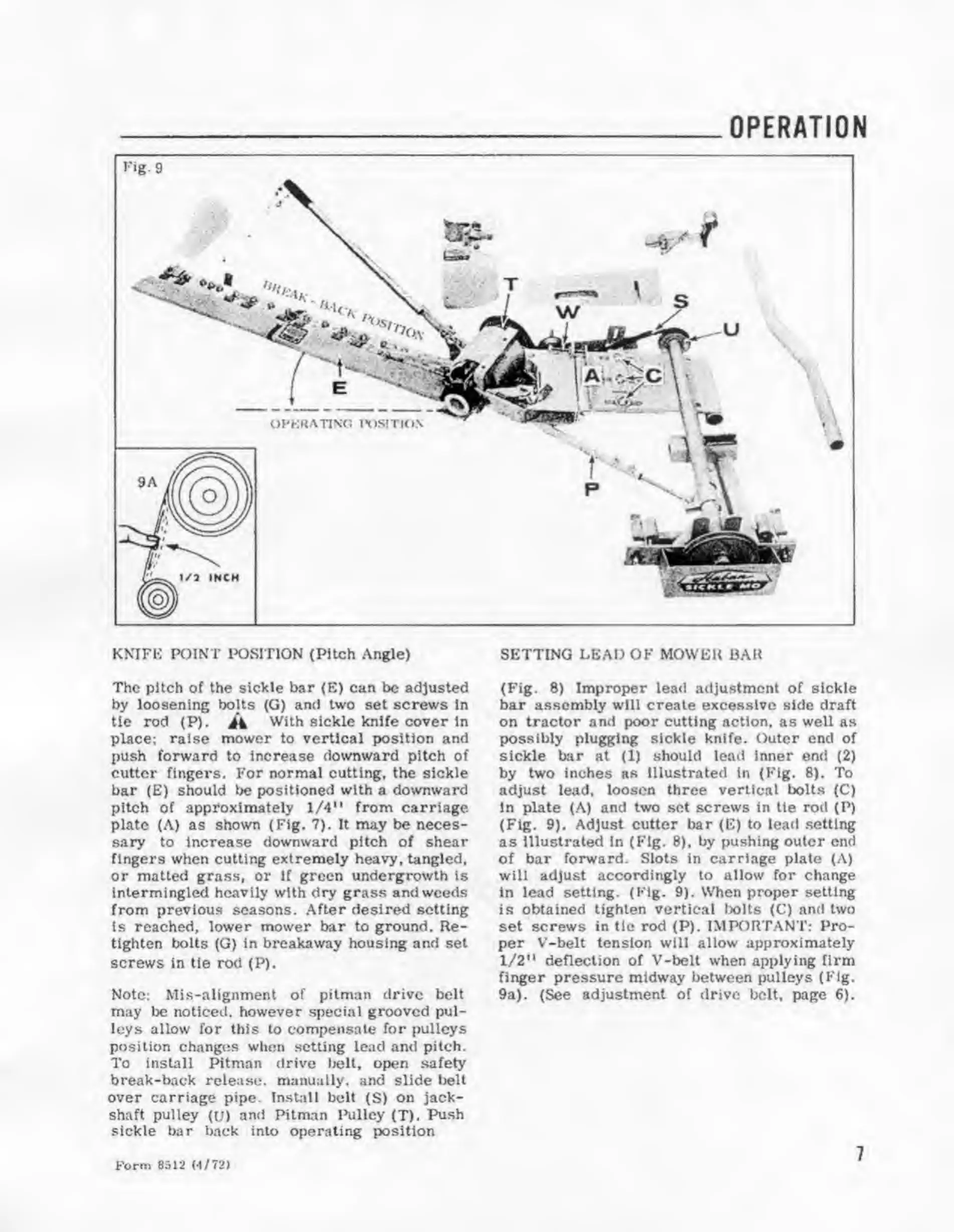
KKIFi:
POINT
1>OS1TION
(Pitch
Angle)
The
pitch
of
the
sicVle
bar
(E)
can
bo
adjusted
by
loosening
bolts
(G)
and
two
set
screws
In
tie
rod
(P),
^
With
sickle
knife
cover
in
place;
raise
mower
to
vertical
position
and
push
forward
to
Increase
downward
pitch
of
cutter
fingers.
For
normal
cutting,
the
sickle
bar
(E)
should
be
positioned
with
a
downward
pilch
of
approximately
1/4**
from
carriage
plate
(A)
as
shown
(Fig.
7).
It
may
be
neces¬
sary
to
increase
downward
pitch
of
shear
fingers
when
cutting
extremely
heavy,
tangled,
or
matted
grass*
or
If
green
undergrowth
Is
intermingled
heavily
with
dry
grass
and
weeds
from
previous
seasons.
After
desired
setting
Is
reached,
lower
mower
bar
to
ground.
Re-
tlghtcn
bolts
(G)
in
breakaway
housing
and
set
screws
in
tie
rod
(P).
Note:
Mis-alignmenl
of
pitman
drive
belt
may
be
noticed,
however
special
grooved
pul¬
leys
allow
for
this
to
compensate
for
pulleys
position
changes
when
sotting
load
and
pitch.
To
insUill
Pitman
drive
l)eli.
open
safety
break-back
release,
manually,
and
slide
I>eU
over
carriage
pipe.
InsbiU
belt
(S)
on
jack-
shaft
pulley
(U)
ami
Pitman
I^lley
(T).
Push
sickle
bar
hack
into
operating
position
SETTING
LEAD
OF
MOWER
BAR
(Fig.
8)
Improper
lea<l
adjustment
of
sickle
bar
assembly
will
create
excessive
side
draft
on
tractor
and
poor
cutting
action*
as
well
as
possibly
plugging
sickle
knife.
Outer
end
of
sickle
bar
at
(1)
should
lead
Inner
end
(2)
by
two
inches
as
Illustrated
In
(Fig.
8).
To
adjust
lead,
loosen
three
vertical
bolts
(C)
in
plate
(A)
and
two
sot
screws
in
lie
rod
(P)
(Fig.
9).
Adjust
cutter
bar
(E)
to
lead
sotting
as
illustrated
In
(Fig.
8),
by
pushing
outer
end
of
bar
forward.
Slots
in
carriage
plate
(A)
will
adjust
accordingly
to
allow
for
change
in
lead
setting.
(Fig.
9).
When
proper
setting
is
obtained
tighten
vertical
bolts
(C)
and
two
set
screws
in
tie
rod
(P).
IMPORT
.ANT:
Pro¬
per
V-belt
tension
will
allow
approximately
1/2**
deflection
of
V-belt
when
applying
firm
finger
pressure
midway
between
pulleys
(Fig.
9a).
(^e
adjustment
of
drive
belt,
page
€).
Form
8512
(4/72)
7