The Red Tide USB650 Fiber Optic Spectrometer is a preconfigured, off-the-shelf spectrometer designed for general-purpose use in teaching and research labs. It offers a cost-effective solution with a compact footprint, making it suitable for various absorbance, reflection, and emission applications when combined with Ocean Optics accessories.
Function Description:
The Red Tide USB650 functions as a fiber optic spectrometer, measuring the amount of light and transforming collected data into digital information. It connects to a computer via a USB port (USB 2.0 or 1.1) and draws power from the host, eliminating the need for an external power supply. The device is also compatible with Pasco's Xplorer GLX, a datalogger and lab analysis tool that can be used without a computer.
The spectrometer's optical bench is designed with fixed components, ensuring stability and preventing wear or breakage. Light enters through an SMA 905 connector, passes through a slit and an optional filter, reflects off a collimating mirror onto a grating, and then is focused by a focusing mirror onto the detector. An optional L4 Detector Collection Lens can be attached to increase light-collection efficiency, especially with large diameter slits or in low light conditions, and to reduce stray light effects. The detector converts the optical signal into a digital signal, which is then transmitted to the SpectraSuite software.
Important Technical Specifications:
- Detector: Sony ILX511 linear silicon CCD array detector.
- No. of elements: 2048 pixels.
- Wavelength Range: 350–1000 nm (detector responsive from 350 to 1000 nm).
- Detector Range: 200-1100 nm.
- Sensitivity: Up to 75 photons/count at 400 nm.
- Optical Resolution: ~2.0 nm (FWHM).
- Entrance Aperture: 25 µm-wide slit.
- Pixel Size: 14 µm x 200 µm.
- Pixel Well Depth: ~62,500 electrons.
- Signal-to-Noise Ratio: 250:1 (at full signal).
- A/D Resolution: 12 bit.
- Dark Noise: 3.2 RMS counts.
- Corrected Linearity: >99.8%.
- Integration Times: From 10 microseconds to >60 seconds (detector's limit is ~15 seconds), with a typical maximum of 15 seconds.
- Stray Light: <0.05% at 600 nm; <0.10% at 435 nm.
- Dynamic Range: 2 x 10^8 (system); 1300:1 for a single acquisition.
- Fiber Optic Connector: SMA 905 to single-strand optical fiber (0.22 NA).
- Data Transfer Rate: Full scans into memory every 13 milliseconds with USB 2.0 port.
- Interfaces: USB 2.0, 480 Mbps (USB 1.1 compatible).
- Dimensions: 89.1 mm x 63.3 mm x 34.4 mm.
- Weight: 190 g.
- Power Consumption: 90 mA @ 5 VDC.
- Operating Systems: Windows (98/Me/2000/XP), Apple Macintosh (OS X version 10.0 or later), and Linux (Red Hat 9 or later, Fedora, Debian 3.1 Sarge, SUSE 9.0 or later).
- Analog Channels: None.
- Embedded Microcontroller: Allows programmatic control of all operating parameters.
- EEPROM Storage: Stores wavelength calibration coefficients, linearity coefficients, and the unique serial number.
- Programmable Strobe Signals: 2 available.
- Connector: 24-pin connector for interfacing to external products.
- Certification: CE Certified.
Usage Features:
- Hot-Swapping Capability: The EEPROM memory chip stores calibration and linearity coefficients, along with the spectrometer's serial number. This allows the SpectraSuite software to read these values directly, enabling users to "hot-swap" spectrometers between computers without manual data entry.
- Modular Software: Controlled by SpectraSuite, a Java-based spectroscopy software platform compatible with Windows, Macintosh, and Linux. SpectraSuite offers advanced acquisition and display, real-time data collection, and control over system parameters for various spectroscopic measurements (absorbance, reflectance, emission).
- Accessory Compatibility: Designed for use with a wide range of Ocean Optics spectroscopic accessories, including light sources, sampling optics, integrated sampling systems (USB-ISS-UV-VIS, USB-ISS-VIS), pulsed blue LED modules (USB-LS-450), and deuterium tungsten light sources (USB-DT). Most accessories feature SMA connectors for easy interchangeability.
- Standalone Operation: Programmable for standalone operation, although specific details on this mode are not provided in the excerpt.
- 10-Pin Accessory Connector: Features a 10-pin connector for interfacing with external products, providing pins for power (VCC, VUSB, or 5VIN), ground, TTL input trigger, TTL output strobe signals (continuous and single), and I²C clock (SCL) and data (SDA) signals for communication with other I²C peripherals. RS232 Tx and Rx pins are present but noted as "Not used."
Maintenance Features:
- Factory-Secured Components: All optical bench components are permanently secured at the time of manufacture. This design minimizes the need for user maintenance or adjustments to internal optical elements.
- Technician-Replaceable Components: Only Ocean Optics technicians can replace interchangeable components such as the slit, filter, grating, and add or remove the L4 Detector Collection Lens. This ensures that critical optical alignments are maintained by trained personnel.
- Software-Based Troubleshooting: The manual provides clear instructions for troubleshooting common installation issues, particularly for Windows operating systems, including steps to remove improperly installed device drivers and files.
- Documentation and Support: Comprehensive documentation, including operating instructions and product information, is available on the Ocean Optics website and the Software and Technical Resources CD. Customer Support is available for assistance with upgrades or changes to the system, requiring a Return Merchandise Authorization (RMA) number for product returns.

 Need help?
 General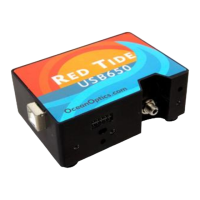

 To Next Page
