EasyManua.ls Logo

HARDKORR 200AH - User Manual

HARDKORR 200AH
18 pages
Print Icon
To Next Page IconTo Next Page
Loading...
INSTRUCTION MANUAL
v1.5.0 - June 2022
200AH LiFePO
4
DEEP CYCLE BATTERY
Question and Answer IconNeed help?

Do you have a question about the HARDKORR 200AH and is the answer not in the manual?

Summary

General Information and Safety

Models Covered by this Manual

Lists the specific battery model covered by the manual.

Safety Warnings and Precautions

Important warnings and cautions regarding battery use and handling.

Contents and Specifications

Specifications

Details technical specifications like voltage, capacity, dimensions, and certifications.

Pack Contents

Lists the items included in the product package.

Setup and Storage

Installation

Instructions for installing the battery safely and correctly.

General Connection Guidelines

Best practices for connecting cables to battery terminals.

Connecting Batteries in Parallel

Guide for connecting multiple batteries side-by-side.

Connecting Batteries in Series

Guide for connecting multiple batteries end-to-end.

Storage, Shipping, and Disposal

Procedures for storing, transporting, and disposing of the battery.

Charging

Charge Methods

Overview of various methods to charge the lithium battery.

DC-DC Charger Charging

How to use a DC-DC charger for optimal battery charging.

Solar Panel Charging

Using solar panels with a regulator to charge the battery.

AC Charger Charging

Using AC mains power chargers for the battery.

Charging in Sub-Zero Temperatures

Warning against charging the battery in freezing conditions.

Frequently Asked Questions

Battery Charger Requirements

Addresses the need for a specific charger for lithium batteries.

Mounting Location Considerations

Discusses safe and recommended mounting locations for the battery.

Using Battery with an Inverter

Guidance on using the battery with an inverter.

Warranty

How to Claim Warranty

Steps to follow for submitting a warranty claim.

Warranty Void Conditions

Lists conditions that will void the product warranty.

Discontinued Items Policy

Policy regarding warranty for discontinued product items.

Overview

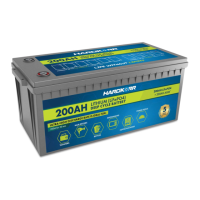
The Hardkorr 200Ah LiFePO4 Deep Cycle Battery is a high-quality lithium iron phosphate battery designed for deep cycle applications, offering a reliable and long-lasting power solution. It serves as an excellent alternative to traditional AGM batteries, providing a 200Ah LiFePO4 capacity equivalent to a 320Ah AGM battery. This instruction manual, version 1.5.0 from June 2022, covers the model HKPBATL200C, which is a 200Ah LiFePO4 Bluetooth Deep Cycle Battery.

Function Description

The Hardkorr 200Ah LiFePO4 Deep Cycle Battery is engineered to provide a stable and consistent power supply for various applications requiring a high discharge rate. Its lithium iron phosphate chemistry offers superior performance and longevity compared to lead-acid alternatives. The battery is ideal for powering a range of appliances and tools, including hair dryers, microwaves, toasters, kettles, coffee machines, and power tools, thanks to its ultra-high discharge rate of 200A for 30 minutes. The integrated Bluetooth functionality allows for convenient monitoring and management of the battery's status.

Important Technical Specifications

  • Nominal Voltage: 12.8V
  • Capacity (C20): 200Ah
  • Max Series/Parallel Configurations: 4S/6P (up to 4 in series for 48V, up to 6 in parallel for 1200Ah @ 12V)
  • Self-discharge: <3% per month
  • Cycle Life: 3000 cycles (100% DOD) / 6000 cycles (80% DOD)
  • Normal Charge Voltage: 14.4 ± 0.2V
  • Discharge Cut-off Voltage: 10.0V
  • Max Discharge Current (constant): 200A
  • Pulse Current (3s): 400A
  • Optimum Charge Temperature: 0°C to 45°C
  • Optimum Discharge Temperature: -20°C to 60°C
  • Optimum Storage Temperature: 0°C to 40°C
  • Weight: 23.0kg
  • Dimensions: 521mm (l) x 238mm (w) x 218mm (h)
  • Terminal Type: M8
  • Certifications: UN 38.3, UL 1642, IEC 62133-2:2017, UN3840, IEC 62619:2017, CE, RoHS

Usage Features

Installation: The battery can be installed in any orientation, including upside-down, provided it is secured firmly to the mounting surface to prevent movement. The installation area must be dry and well-ventilated, ensuring the battery is not exposed to temperatures exceeding the maximums specified. Mechanical ventilation, such as fans, may be considered if heat is a concern. It is crucial to prevent terminals from coming into contact with metal surfaces or objects to avoid short-circuiting. The battery should not be installed in wet areas (e.g., boat decks, open ute trays, chassis mounts) or compartments dedicated to gas storage. Hardkorr recommends professional installation by a qualified individual.

Multiple Battery Connections:

  • Parallel Connection: Up to six batteries can be connected in parallel to increase total capacity while maintaining the nominal voltage. For example, six 200Ah 12.8V batteries in parallel create a 1200Ah 12.8V system. When connecting in parallel, use appropriately rated busbars. The maximum discharge current of the system will be the maximum discharge of a single battery multiplied by the number of batteries in the bank (e.g., 100A per hour x 6 = 1200A per hour for six batteries). Cables used for parallel connections must be of the correct gauge for the maximum discharge current and must be exactly the same length.
  • Series Connection: Up to four batteries can be connected in series to increase the nominal voltage while maintaining the capacity of a single unit. For instance, four 200Ah 12.8V batteries in series create a 200Ah 48V system. When connecting in series, the negative connection should be taken from the opposite end of the bank to the positive connection. Similar to parallel connections, cables must be of the correct gauge for the system's voltage and maximum discharge current, and they must be exactly the same length.

Terminal Connections: No more than four cable lugs should be connected directly to a battery terminal. If more are needed, a fuse block and negative busbar should be used. Terminals must be clean before connecting lugs. Cable lugs should be stacked from heaviest draw (thickest cables) at the bottom to lightest draw (thinnest cables) at the top. Insulating terminal boots and lug protectors are recommended. All termination lugs should be well crimped (not soldered). Spring washers provided with the battery terminal bolts must be used, stacked on top of the cable lugs, to ensure sufficient pressure without over-tightening.

Charging Methods: Lithium batteries require a specific charging profile. Suitable charging devices include DC-DC chargers, solar panels with regulators, and AC (mains power) chargers, all of which must have a lithium charge profile.

  • DC-DC Chargers: These allow charging from a vehicle's alternator. They moderate current flow, protecting the alternator from overheating, and use a multi-stage charging algorithm for optimal battery charging and extended service life. Some DC-DC chargers also support solar panel input, prioritizing solar charging when available.
  • Solar Panels with Regulators: Both fixed and portable solar panels (e.g., solar blankets, solar mats) can be used. Fixed panels are permanently mounted, while portable panels are used when stationary. The regulator must have a lithium charge profile.
  • AC Chargers: For charging at home or powered campsites, AC (mains power) battery chargers can be used. These must also have a lithium charge profile.
  • Charging Recommendations: For optimum battery longevity, the charging current should be 30% or less of the battery's capacity.
  • Charging Restrictions: DO NOT use a charge profile with a "Pulse" or "Equalisation" stage, as this will damage the battery and void the warranty. DO NOT charge the battery directly from an alternator or via a VSR.
  • Sub-Zero Charging: Charging in sub-zero conditions is strictly prohibited and will void the warranty. For cold climate charging, a specific 240Ah Lithium Cold Climate Lithium (LiFePO4) Deep Cycle Battery with Bluetooth (HKPBATL240BH) is required.

Maintenance Features

Storage: The battery should be stored in a dry, clean, shaded, and well-ventilated environment within the optimum storage temperature range (0°C to 40°C). It is recommended to store the battery at around 40-50% State of Charge (SOC). The stored battery's voltage should never drop below 11.5V. These batteries self-discharge at approximately 3% per month, so the SOC should be checked regularly and topped up if necessary.

Disposal: Lithium batteries must not be disposed of with ordinary refuse due to the risk of fires and environmental contamination. Contact an authorized lithium battery recycling facility, such as Battery World, Aldi, or Officeworks, for proper disposal.

Warranty: The Hardkorr 200Ah LiFePO4 Deep Cycle Battery comes with a comprehensive 5-year warranty from the date of purchase, which is non-transferable. To claim warranty benefits, proof of purchase must be retained. The warranty covers defects in material and workmanship.

  • Warranty Claim Process:
    1. Obtain a Return Authorization (RA) number by completing the form on the Hardkorr website and awaiting contact from the warranty team.
    2. Ship the product back to Hardkorr at your own expense, ensuring the RA number is clearly marked on the packaging.
    3. Hardkorr technicians will inspect the returned product and notify you of the claim's outcome.
    4. If the claim is accepted, Hardkorr will repair, replace, or refund the goods at their discretion and reimburse shipping costs. Replaced or refunded products become Hardkorr property.
    5. If the claim is denied, Hardkorr will advise the reason, and the product must be collected within 30 days, or it may be destroyed.
  • Voiding the Warranty: The warranty is voided by:
    • Negligence (improper installation, extreme use, use contravening the manual).
    • Abuse (road hazards, damage beyond normal wear and tear).
    • Unauthorized repair.
    • Disassembly or tampering with the product.
    • Consequential damage caused by the failure of another component in the vehicle or device.
    • Incorrect charger (not suitable for lithium batteries).
    • Under-bonnet use.
    • Overcharge/over-discharge beyond stipulated rates.
    • Water ingress.
    • Natural capacity decrease of less than 10% per year of ownership is not covered.
    • Exterior finish fading due to exposure is not covered.

Discontinued Items: Discontinued items still under warranty will be reviewed. If covered, they may be replaced by an equivalent or superior item. If no equivalent is available, Hardkorr will determine the resolution terms on a case-by-case basis.

HARDKORR 200AH Specifications

General IconGeneral
BrandHARDKORR
Model200AH
CategoryCamera Accessories
LanguageEnglish