8
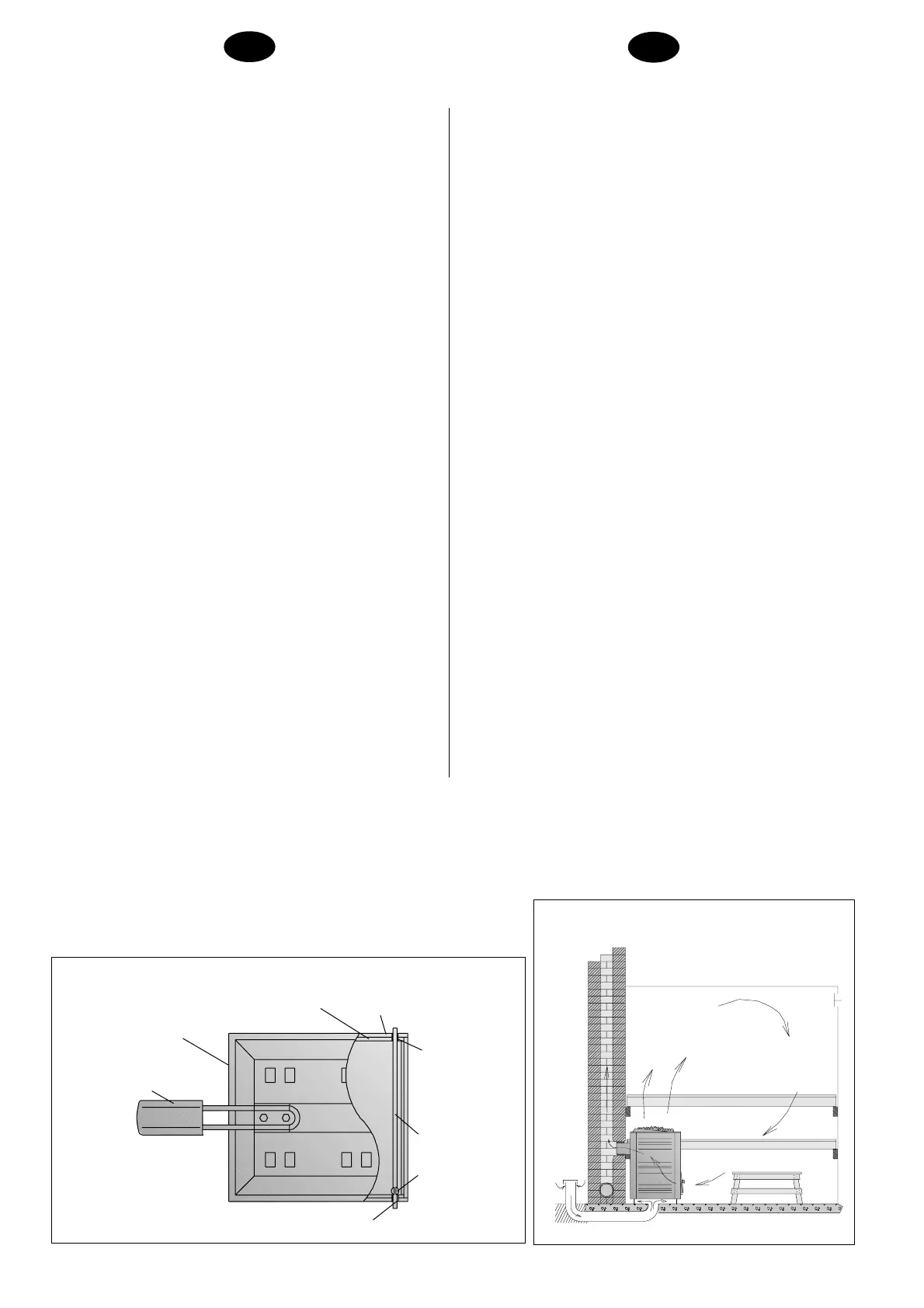
Figure 10.
Abbildung 10.
DE
EN
chamber. Check that the holes of the hinge pin align at the
top edge of the door and push the hinge pin through the
top holes upwards from the bottom. Also, align the holes
at the bottom edge of the door and drop the hinge pin
through the bottom holes to its position. The hinge pin will
stay on top of the bottom holes by means of a spreader that
is compressed in the pin. See figure 9.
Maintenance
The soot gathered in the smoke canals of the stove should
be removed through the round soot doors located on the
sides of the stone chamber.
Heating will cause the stones to disintegrate and therefore
they will have to be reset at least once a year, or even more
often if the stove is much in use. It is advisable to remove,
at the same time, loose stone debris found in the stone
chamber and replace broken stones.
The flue should be swept in regular intervals to ensure
good draught in the flue.
The ash pan of the stove should be emptied always before
next heating so that the combustion air that is led through
the ash pan would cool off the fire grate and lengthen its
service life. It is advisable to get a metal ash pan, preferably
a standing model, for keeping the ashes. Note: as there may
be glowing embers in the removed ashes you should not
keep the ash pan in the vicinity of combustible materials.
Air ventilation in the sauna room
Good air ventilation enhances the enjoyable bathing
experience. Traditional air ventilation based on natural air
circulation can be realised when fresh incoming air is led
close to the floor level near the stove and is exhausted as
far from the stove as possible, near the ceiling (Figure 10).
As the stove circulates air in an effective manner the
function of the outlet is mainly to remove humidity from the
sauna room after bathing.
Incoming air led close to the floor level is transported
between the hot inside and casing of the stove. Heated air
breaks upwards via a grate and warms the air in the sauna
room. Because wood needs a great deal of air to burn, a
suction effect will be created in the heating chamber, which
will force, together with rising air flows, the air in the sauna
room to circulate.
According to the most recent study, the incoming air can
be led above the stove at the height of 500 mm where it
blends with the air flows from the stove and, as a result,
there will be a good circulation of air in the sauna room.
Halten Sie die gelöste Ofentür in der Offen-Stellung in der
Nähe der Feuerungsöffnung. Überprüfen Sie, dass die Löcher
des Scharnierbolzens am oberen Rand der Luke sich
übereinander platzieren und schieben Sie den Scharnierbolzen
von unten nach oben durch die oberen Löcher durch. Richten
Sie auch die Löcher am unteren Rand aus und lassen Sie den
Scharnierbolzen in die Aufnahme fallen. Der Scharnierbolzen
bleibt auf der am Bolzen gepressten Verbreiterung an den
untersten Löchern hängen. Siehe Abb. 9.
Pflege
Der sich im Rauchkanal ansammelnde Ruß muß über die runden
Rußluken an den Seiten der Steinkammer entfernt werden.
Die Saunaofensteine werden während des Gebrauchs
spröde. Aus diesem Grund sollten die Steine mindestens
einmal jährlich neu aufgeschichtet werden, bei starkem
Gebrauch öfter. Bei dieser Gelegenheit entfernen Sie bitte
auch den Gesteinsabfall aus der Steinkammer und ersetzen
beschädigte Steine.
Der Rauchabzug muß regelmäßig gefegt werden, damit im
Abzug ein guter Luftzug erhalten bleibt.
Der Aschekasten des Saunaofens muß vor jedem neuen
Anheizen geleert werden, damit die durch den Aschekasten
geleitete Brennluft den Rost kühlt und die Lebensdauer des
Rosts verlängert. Benutzen Sie für die Asche ein Gefäß aus
Metall, das vorzugsweise mit Stützen versehen ist. Die zu
entfernende Asche kann glühende Funken enthalten,
bewahren Sie das Aschegefäß also nicht in der Nähe
brennbarer Materialien auf.
Durchlüftung der Saunakabine
Eine gute Durchlüftung der Saunakabine sorgt für
angenehmere Aufgüsse. Ein traditioneller, auf der
natürlichen Luftzirkulation basierender Luftaustausch
entsteht, wenn Frischluft in der Nähe des Saunaofens an der
Fußbodengrenze zugeführt und die Abluft in möglichst
weiter Entfernung vom Saunaofen nahe der Decke
abgeführt wird (Abbildung 10).
Da schon der Saunaofen selbst eine effektive Luftzirkulation
in der Sauna bewirkt, dient die Abluftöffnung hauptsächlich der
Feuchtigkeitsabführung aus der Sauna nach dem Saunabad.
Die an der Fußbodengrenze zugeführte Frischluft strömt
zwischen dem heißen Inneren des Saunaofens und dem
Mantel entlang. Die erhitzte Luft strömt durch ein Gitterwerk
nach oben und erwärmt die Luft der Saunakabine. Da Holz zum
Brennen reichlich Luft benötigt, entsteht in der
Feuerungsöffnung ein Sog, der zusammen mit den steigenden
Luftströmungen die Luft in der Saunakabine zirkulieren läßt.
Nach neusten Erkenntnissen kann die Frischluft in einer
Höhe von 500 mm über dem Saunaofen zugeführt werden,
wo sie sich mit den vom Saunaofen aufsteigenden
Luftströmungen vermischt und in der Saunakabine eine
gute Luftzirkulation entsteht.
Door to the heating chamber/
Feuerungsluke
Handle/Griff
Edge of the opening
to the heating chamber/
Feuerungsöffnung
Door's edge/Rand der Luke
Holes for the
hinge pin/
Löcher für den
Scharnierbolzen
Hinge pin/
Scharnierbolzen
Spreader/
Verbreitung
Holes for the hinge pin/
Löcher für den Scharnierbolzen
Figure 9.
Abbildung 9.


 To Previous Page
 Loading...