If the engine is being started using jump
leads and a slave battery, connect the
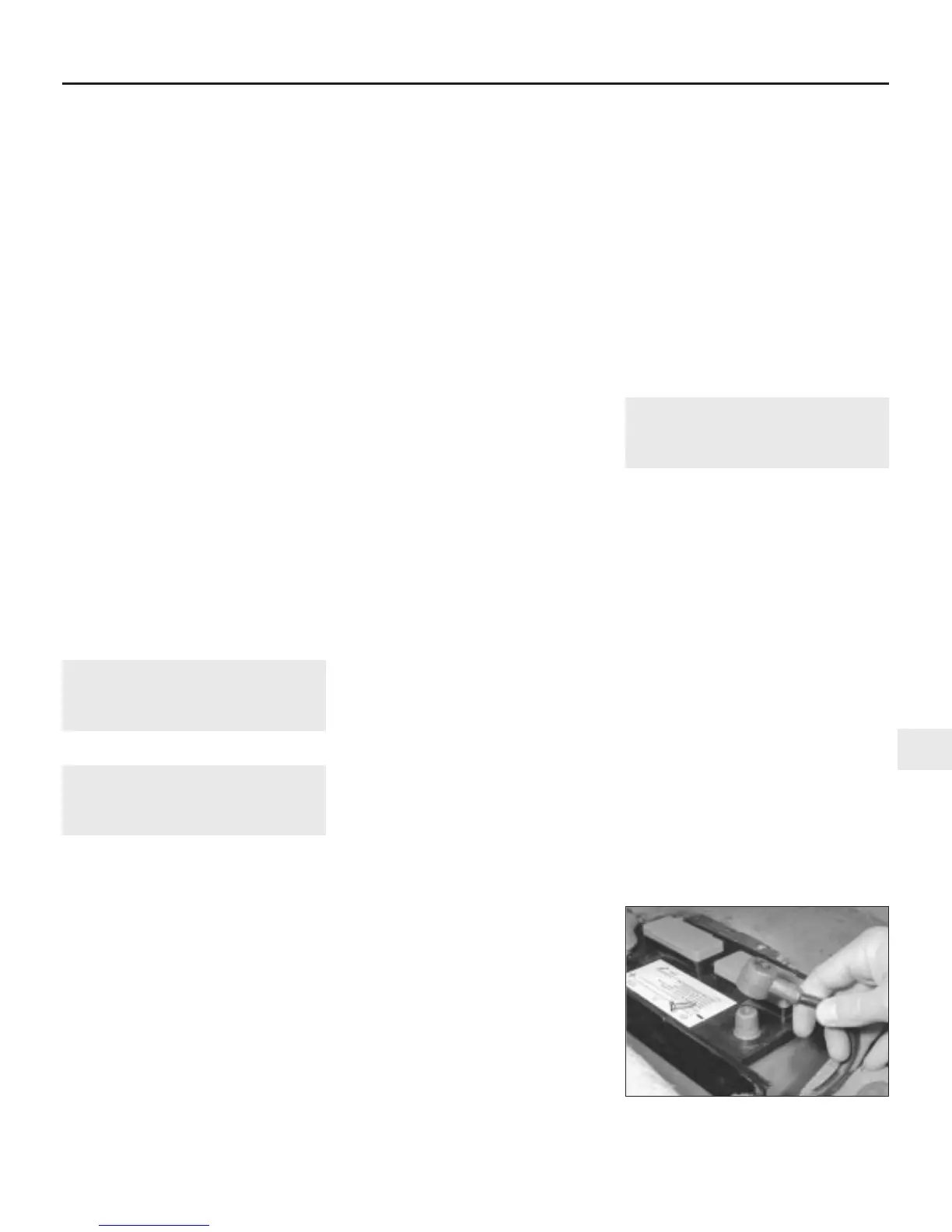
batteries positive-to-positive and negative-to-
negative (see “Jump starting”). This also
applies when connecting a battery charger.
Never disconnect the battery terminals, the
alternator, any electrical wiring or any test
instruments when the engine is running.
Do not allow the engine to turn the alternator
when the alternator is not connected.
Never “test” for alternator output by
“flashing” the output lead to earth.
Never use an ohmmeter of the type
incorporating a hand-cranked generator for
circuit or continuity testing.
Always ensure that the battery negative
lead is disconnected when working on the
electrical system.
Before using electric-arc welding
equipment on the car, disconnect the battery,
alternator and components such as the fuel
injection/ignition electronic control unit to
protect them from the risk of damage.
The radio/cassette units fitted as standard or
optional equipment to later models may be
equipped with a built-in security code to deter
thieves. If the power source to the unit is cut,
the anti-theft system will activate. Even if the
power source is immediately reconnected, the
radio/cassette unit will not function until the
correct security code has been entered.
Therefore, if you do not know the correct
security code for the radio/cassette unit do not
disconnect the negative terminal of the battery
or remove the radio/cassette unit from the car.
Refer to the Owner’s Manual, or your Rover
dealer for further information on security codes.
2 Electrical fault finding -
general information
Refer to Chapter 12.
3 Battery - testing and charging
1
Standard and low maintenance
battery - testing
1 If the vehicle covers a small annual mileage,
it is worthwhile checking the specific gravity
of the electrolyte every three months to
determine the state of charge of the battery.
Use a hydrometer to make the check and
compare the results with the following table.
Ambient temperature 25°C (77°F):
above below
Fully-charged 1.210 to 1.230 1.270 to 1.290
70% charged 1.170 to 1.190 1.230 to 1.250
Fully-discharged 1.050 to 1.070 1.110 to 1.130
Note that the specific gravity readings assume
an electrolyte temperature of 15°C (60°F); for
every 10°C (18°F) below 15°C (60°F) subtract
0.007. For every 10°C (18°F) above 15°C
(60°F) add 0.007.
2 If the battery condition is suspect, first
check the specific gravity of electrolyte in
each cell. A variation of 0.040 or more
between any cells indicates loss of electrolyte
or deterioration of the internal plates.
3 If the specific gravity variation is 0.040 or
more, the battery should be renewed. If the
cell variation is satisfactory but the battery is
discharged, it should be charged as
described later in this Section.
Maintenance-free battery -
testing
4 In cases where a “sealed for life”
maintenance-free battery is fitted, topping-up
and testing of the electrolyte in each cell is not
possible. The condition of the battery can
therefore only be tested using a battery
condition indicator or a voltmeter.
5 If testing the battery using a voltmeter,
connect the voltmeter across the battery and
compare the result with those given in the
Specifications under “charge condition”. The
test is only accurate if the battery has not
been subjected to any kind of charge for the
previous six hours. If this is not the case,
switch on the headlights for 30 seconds, then
wait four to five minutes before testing the
battery after switching off the headlights. All
other electrical circuits must be switched off,
so check that the doors and tailgate are fully
shut when making the test.
6 If the voltage reading is less than 12.2 volts,
then the battery is discharged, whilst a
reading of 12.2 to 12.4 volts indicates a
partially discharged condition.
7 If the battery is to be charged, remove it
from the vehicle (Section 4) and charge it as
described later in this Section.
Standard and low maintenance
battery - charging
Note: The following is intended as a guide
only. Always refer to the manufacturer’s
recommendations (often printed on a label
attached to the battery) before charging a
battery.
8 Charge the battery at a rate of 3.5 to 4
amps and continue to charge the battery at
this rate until no further rise in specific gravity
is noted over a four hour period.
9 Alternatively, a trickle charger charging at the
rate of 1.5 amps can safely be used overnight.
10 Specially rapid “boost” charges which are
claimed to restore the power of the battery in
1 to 2 hours are not recommended, as they
can cause serious damage to the battery
plates through overheating.
11 While charging the battery, note that the
temperature of the electrolyte should never
exceed 37.8°C (100°F).
Maintenance-free battery -
charging
Note: The following is intended as a guide
only. Always refer to the manufacturer’s
recommendations (often printed on a label
attached to the battery) before charging a
battery.
12 This battery type takes considerably
longer to fully recharge than the standard
type, the time taken being dependent on the
extent of discharge, but it can take anything
up to three days.
13 A constant voltage type charger is
required, to be set, when connected, to 13.9
to 14.9 volts with a charger current below 25
amps. Using this method, the battery should
be usable within three hours, giving a voltage
reading of 12.5 volts, but this is for a partially
discharged battery and, as mentioned, full
charging can take considerably longer.
14 If the battery is to be charged from a fully
discharged state (condition reading less than
12.2 volts), have it recharged by your Rover
dealer or local automotive electrician, as the
charge rate is higher and constant supervision
during charging is necessary.
4 Battery - removal and refitting
1
Removal
Note: Make sure that you have a copy of the
radio/cassette unit security code number
(where applicable) before disconnecting the
battery.
1 The battery is located in a recess in the
right-hand side of the luggage compartment
floor on Saloon models, beneath the rear seat
on Estate models, and behind the passenger
seat on the Van and Pick-up.
2 Remove the cover (where fitted) then
disconnect the negative and then the positive
leads from the battery after first removing the
retaining screws or nuts and bolts from the
terminal posts (see illustration).
3 Remove the battery clamp and carefully lift
the battery out of its compartment. Hold the
battery upright to ensure that none of the
electrolyte is spilled.
Refitting
4 Refitting is a direct reversal of this
procedure. Note: Refit the positive lead before
the negative lead and smear the terminals with
petroleum jelly. Never use an ordinary grease.
Starting and charging systems 5A•3
5A
4.2 Disconnecting the battery negative
lead (Saloon model shown)


 To Next Page
 Loading...