5 Dynamo charging system -
testing
2
Note: Refer to the warnings given in “Safety
first!” and in Section 1 of this Chapter before
starting work.
1 If the ignition warning light fails to go out
with the engine running, or if the battery does
not appear to be receiving a charge, the
dynamo may be at fault and should be tested
while still in position on the engine as follows.
2 First check the fan belt condition and adjust
the tension if necessary (see Chapter 1).
3 Check the leads from the dynamo to the
control box (D and F), ensuring that they are
firmly attached and that one has not come
loose from its terminal.
4 To test the dynamo, first ensure that all
electrical equipment is switched off and then
pull the leads off the two dynamo terminals.
Now join the two dynamo terminals together
using a short length of non-insulated wire.
5 Attach to the centre of this short length of
wire the positive clip of a 0 to 20 volt
voltmeter. Connect the negative clip of the
voltmeter to a good earth on the dynamo
yoke.
6 Start the engine and allow it to run at a fast
idle. A reading of approximately 15 volts
should now be indicated on the voltmeter. If
no reading is recorded, it is quite likely that
the dynamo brushes or brush connections are
at fault. If a very low reading is observed then
the field windings or armature may be
suspect.
7 Brush renewal is described in Section 7;
any other repair should be entrusted to an
auto electrician who will be able to determine
if repair is feasible, or whether an exchange
reconditioned unit should be obtained.
8 If the voltmeter readings are satisfactory,
switch off the engine and disconnect the
voltmeter. With the temporary link still in
position, reconnect the two leads to the
dynamo terminals and then disconnect the D
and F terminals at the control box. Connect
the positive clip of the voltmeter to the D lead
and the negative clip to earth. Start the engine
and allow it to run at a fast idle. The reading
on the voltmeter should be identical to that
recorded at the dynamo. If no voltage is
recorded there is a break in the wire. If the
voltage is less than previously recorded check
the terminals for corrosion and the wire for
chafing. Test the F lead in a similar fashion. If
both readings are the same as recorded at the
dynamo, then it will be necessary to test the
control box as described in Section 8.
9 On completion of the tests remove the
temporary link from the dynamo terminals and
reconnect the leads to the dynamo and
control box.
6 Dynamo - removal and
refitting
1
Removal
1 Disconnect the battery negative lead.
2 Slacken the two dynamo upper retaining
bolts and the nut on the adjustment arm.
Move the dynamo towards the engine and lift
the fan belt off the pulley.
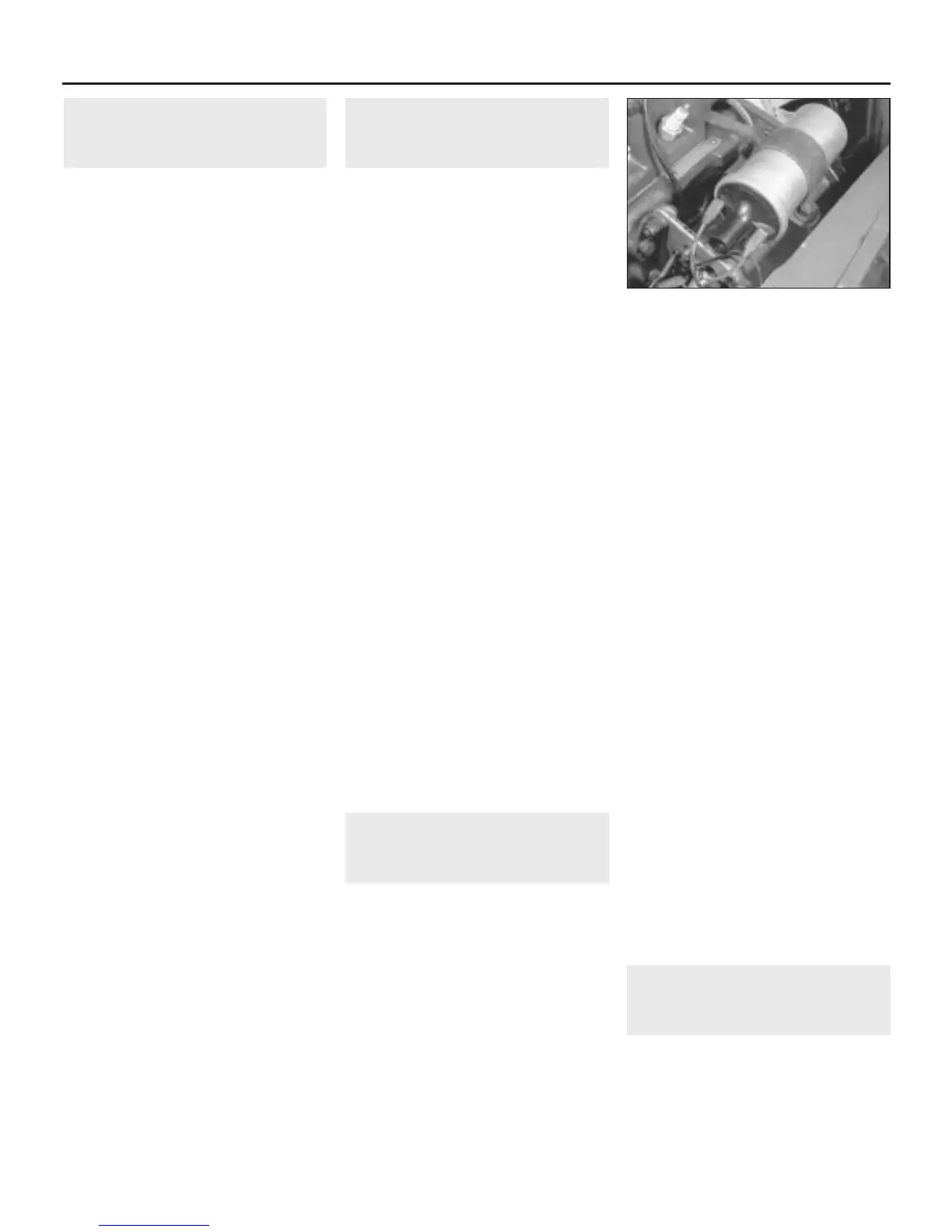
3 Disconnect the two leads from the dynamo
terminals. If the ignition coil is mounted on the
dynamo, slide back the rubber cover and
disconnect the high tension lead from the
centre of the coil, followed by the two low
tension leads (see illustration).
4 Undo and remove the lower bolt securing
the adjustment arm to the dynamo and
remove the two upper retaining bolts, nuts
and washers. The dynamo can now be lifted
off the engine.
Refitting
5 Refitting the dynamo is the reverse sequence
to removal, ensuring that the fan belt is correctly
tensioned as described in Chapter 1 before fully
tightening the retaining bolts.
6 If a new or exchange dynamo is being
fitted, ensure that the unit is correctly
polarised as described below before
installing.
7 In order for the dynamo to function it must
be correctly polarised to suit the electrical
installation to which it is being fitted. To
polarise the dynamo to suit a negative earth
system, connect a suitable length of wire from
the battery earth terminal to the dynamo yoke
or end bracket. Now connect another length
of wire to the battery positive terminal and
flick the other end of the wire several times on
the dynamo F (small) terminal. This will induce
a magnetism of the correct polarity into the
dynamo field windings.
8 The correctly polarised dynamo can now be
fitted to the car.
7 Dynamo brushes - renewal
3
1 Remove the dynamo from the car as
described in Section 6.
2 If the ignition coil is mounted on the
dynamo, undo and remove the clamp
retaining bolts and lift off the coil.
3 Undo and remove the two long screws from
the rear of the dynamo and lift off the
commutator end bracket.
4 Now lift out the armature complete with
drive end bracket and pulley from the dynamo
yoke.
5 Undo and remove the brush lead retaining
screws and lift the brushes out of their
holders. If the brushes have worn to less than
the minimum specified length, they must be
renewed.
6 Check that the brushes slide freely and
easily in their holders. If either of the brushes
has a tendency to stick, clean the brushes
with methylated spirit and a clean rag. If still
stiff, lightly polish the sides of the brush with a
very fine file until the brush moves quite freely
and easily in its holder.
7 If the brushes are in a satisfactory condition
and are to be re-used, ensure that they are
refitted in the same holders from which they
were removed. Check the tension of the brush
springs using a small spring balance if possible.
If the tension is insufficient, renew the springs.
8 Check the condition of the commutator. If
the surface is dirty or blackened, clean it with
methylated spirit and a clean rag. If the
commutator is in good condition, the surface
will be smooth and quite free from pits or
burnt areas, and the insulated segments
clearly defined. If the commutator is severely
worn, seek the advice of an auto electrician as
to whether reconditioning is possible.
Alternatively obtain a reconditioned dynamo.
9 If, after the commutator has been cleaned,
pits and burnt spots are still present, then
wrap a strip of glass paper round the
commutator and rotate the armature.
10 Reassemble the dynamo using the
reverse of the dismantling procedure. When
refitting the commutator end bracket ease
back the springs and lift the brushes half way
out of their holders. Now rest the spring
against the side of the brush to hold it in this
position. This will prevent the brushes from
fouling the commutator as the end bracket is
fitted. With the end bracket in place, push the
brushes down into contact with the
commutator using a screwdriver inserted
through the openings in the end bracket. As
this is done the springs will jump into their
correct position over the brushes.
8 Control box - adjustment
2
Note: Refer to the warnings given in “Safety
first!” and in Section 1 of this Chapter before
starting work.
1 If the battery and dynamo are in sound
condition but the operation of the charging
circuit is still suspect, then the voltage
5A•4 Starting and charging systems
6.3 Disconnecting the coil leads


 To Next Page
 Loading...