3 Hydraulic pipes and hoses -
renewal
3
Note: Before starting work, refer to the
warning at the beginning of Section 2
concerning the dangers of hydraulic fluid.
1 If any pipe or hose is to be renewed,
minimise hydraulic fluid loss by removing the
master cylinder reservoir cap, placing a piece
of plastic film over the reservoir and sealing it
with an elastic band. Alternatively, flexible
hoses can be sealed, if required, using a
proprietary brake hose clamp; metal brake
pipe unions can be plugged (if care is taken
not to allow dirt into the system) or capped
immediately they are disconnected. Place a
wad of rag under any union that is to be
disconnected, to catch any spilt fluid.
2 If a flexible hose is to be disconnected,
unscrew the brake pipe union nut before
undoing the nut which secures the hose to its
mounting. At the front, the other end of the
hose will be screwed into its tapped hole in
the wheel cylinder or brake caliper.
3 To unscrew the union nuts, it is preferable
to obtain a brake pipe spanner of the correct
size; these are available from most large
motor accessory shops. Failing this, a close-
fitting open-ended spanner will be required,
though if the nuts are tight or corroded, their
flats may be rounded-off if the spanner slips.
In such a case, a self-locking wrench is often
the only way to unscrew a stubborn union, but
it follows that the pipe and the damaged nuts
must be renewed on reassembly. Always
clean a union and surrounding area before
disconnecting it. If disconnecting a
component with more than one union, make a
careful note of the connections before
disturbing any of them.
4 If a brake pipe is to be renewed, it can be
obtained, cut to length and with the union
nuts and end flares in place, from Rover
dealers. All that is then necessary is to bend it
to shape, following the line of the original,
before fitting it to the car. Alternatively, most
motor accessory shops can make up brake
pipes from kits, but this requires very careful
measurement of the original, to ensure that
the replacement is of the correct length. The
safest answer is usually to take the original to
the shop as a pattern.
5 Before refitting, blow through the new pipe
or hose with dry compressed air. Do not
overtighten the union nuts. It is not necessary
to exercise brute force to obtain a sound joint.
6 If flexible rubber hoses are renewed, ensure
that the pipes and hoses are correctly routed,
with no kinks or twists, and that they are
secured in the clips or brackets provided.
7 After fitting, bleed the hydraulic system as
described in Section 2, wash off any spilt
fluid, and check carefully for fluid leaks.
4 Brake drum - removal,
inspection and refitting
2
Note: Before starting work, refer to the
warning at the beginning of Section 5
concerning the dangers of asbestos dust.
Removal
1 Chock the wheels then jack up the front or
rear of the car as applicable and support it on
axle stands (see “Jacking and vehicle
support”). Remove the relevant roadwheels.
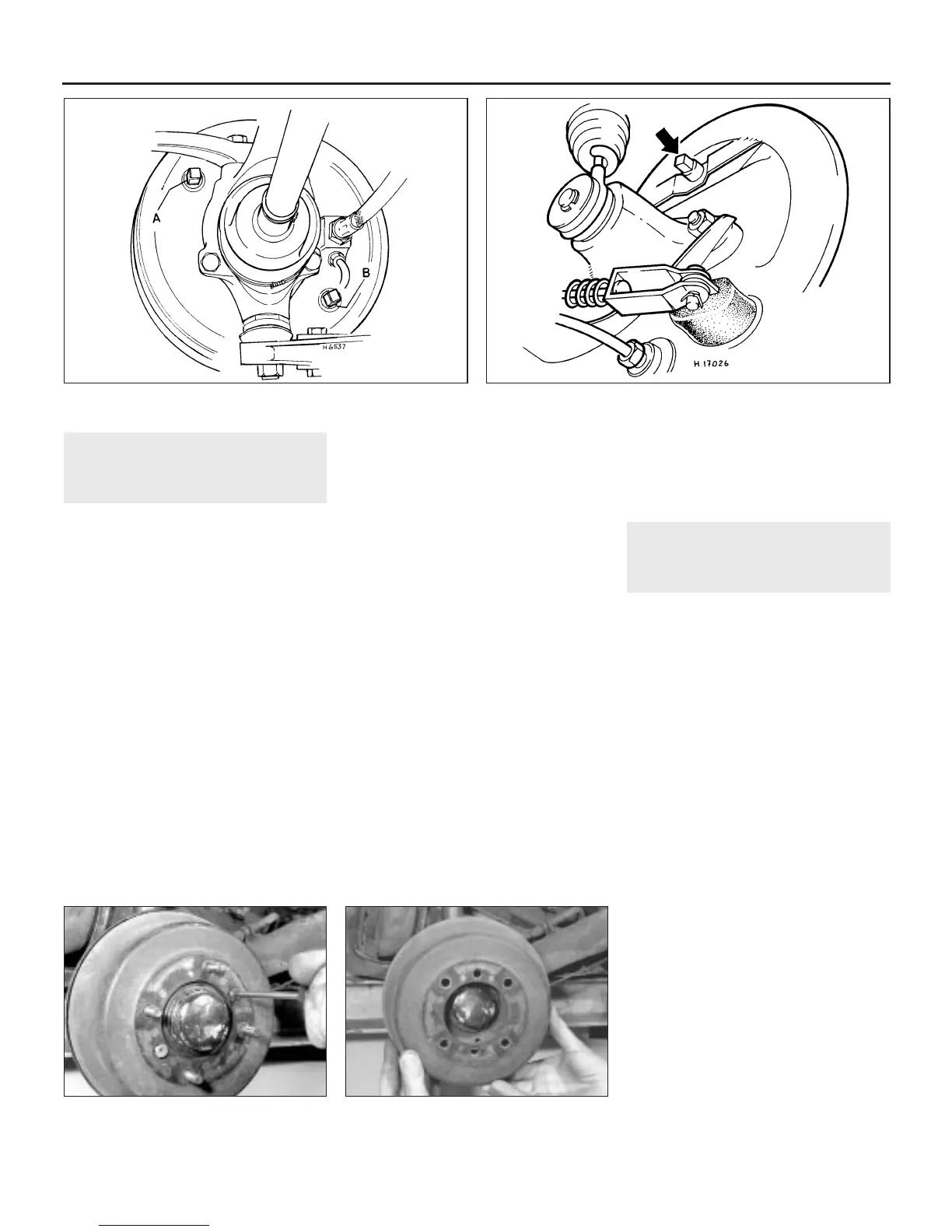
2 Slacken off the brake shoe adjuster(s) from
behind the backplate, then undo and remove
the two brake drum retaining screws (see
illustrations).
3 Remove the brake drum from the wheel hub
(see illustration). If the drum is tight, gently
tap its circumference with a soft-faced mallet.
Inspection
4 Brush the dust and dirt from the brake drum
and carefully inspect the drum interior.
5 If the drum is grooved, owing to failure to
renew worn brake shoes or after a very high
mileage has been covered, then it may be
possible to regrind it, provided the grooving is
not excessive.
6 Even if only one drum is in need of grinding
both drums must be reground to the same
size in order to maintain even braking
characteristics.
7 Judder or a springy pedal felt when the
brakes are applied can be caused by a
distorted (out-of-round) drum. Here again it
may be possible to regrind the drums,
otherwise a new drum will be required.
9•4 Braking system
4.2a Location of the two front brake adjusters - A and B 4.2b Location of the rear brake adjuster - arrowed
4.2c Remove the brake drum retaining
screws . . .
4.3 . . . and withdraw the drum


 To Next Page
 Loading...