2 Compression test -
description and interpretation
2
1 When engine performance is down, or if
misfiring occurs which cannot be attributed to
the ignition or fuel systems, a compression
test can provide diagnostic clues as to the
engine’s condition. If the test is performed
regularly, it can give warning of trouble before
any other symptoms become apparent.
2 The engine must be fully warmed-up to
normal operating temperature, the battery
must be fully charged, and all the spark plugs
must be removed (Chapter 1). The aid of an
assistant will also be required.
3 Disable the ignition system by
disconnecting the ignition coil HT lead from
the distributor cap and earthing it on the
cylinder block. Use a jumper lead or similar
wire to make a good connection.
4 Fit a compression tester to the No 1
cylinder spark plug hole - the type of tester
which screws into the plug thread is to be
preferred.
5 Have the assistant hold the throttle wide
open, and crank the engine on the starter
motor; after one or two revolutions, the
compression pressure should build up to a
maximum figure, and then stabilise. Record
the highest reading obtained.
6 Repeat the test on the remaining cylinders,
recording the pressure in each.
7 All cylinders should produce very similar
pressures; a difference of more than 2 bars
between any two cylinders indicates a fault.
Note that the compression should build up
quickly in a healthy engine; low compression
on the first stroke, followed by gradually-
increasing pressure on successive strokes,
indicates worn piston rings. A low
compression reading on the first stroke, which
does not build up during successive strokes,
indicates leaking valves or a blown head
gasket (a cracked head could also be the
cause). Deposits on the undersides of the
valve heads can also cause low compression.
8 If the pressure in any cylinder is low, carry
out the following test to isolate the cause.
Introduce a teaspoonful of clean oil into that
cylinder through its spark plug hole, and
repeat the test.
9 If the addition of oil temporarily improves
the compression pressure, this indicates that
bore or piston wear is responsible for the
pressure loss. No improvement suggests that
leaking or burnt valves, or a blown head
gasket, may be to blame.
10 A low reading from two adjacent cylinders
is almost certainly due to the head gasket
having blown between them; the presence of
coolant in the engine oil will confirm this.
11 If one cylinder is about 20 percent lower
than the others and the engine has a slightly
rough idle, a worn camshaft lobe could be the
cause.
12 If the compression reading is unusually
high, the combustion chambers are probably
coated with carbon deposits. If this is the
case, the cylinder head should be removed
and decarbonised.
13 On completion of the test, refit the spark
plugs and reconnect the ignition coil HT lead.
3 Top Dead Centre (TDC) for
number one piston - locating
1
1 Top dead centre (TDC) is the highest point
in the cylinder that each piston reaches as the
crankshaft turns. Each piston reaches its TDC
position at the end of its compression stroke
and then again at the end of its exhaust
stroke. For the purpose of engine timing, TDC
refers to the position of No 1 piston at the end
of its compression stroke. On the engines
covered by this manual, No 1 piston is at the
timing chain end of the engine. It is necessary
to set the engine in this position when
carrying out many of the operations in this
Chapter. To do so, proceed as follows.
2 Where fitted, release the three plastic
retaining lugs and lift the ignition shield off the
front of the engine.
3 Spring back the two distributor cap
retaining clips or undo the screws then place
the distributor cap to one side.
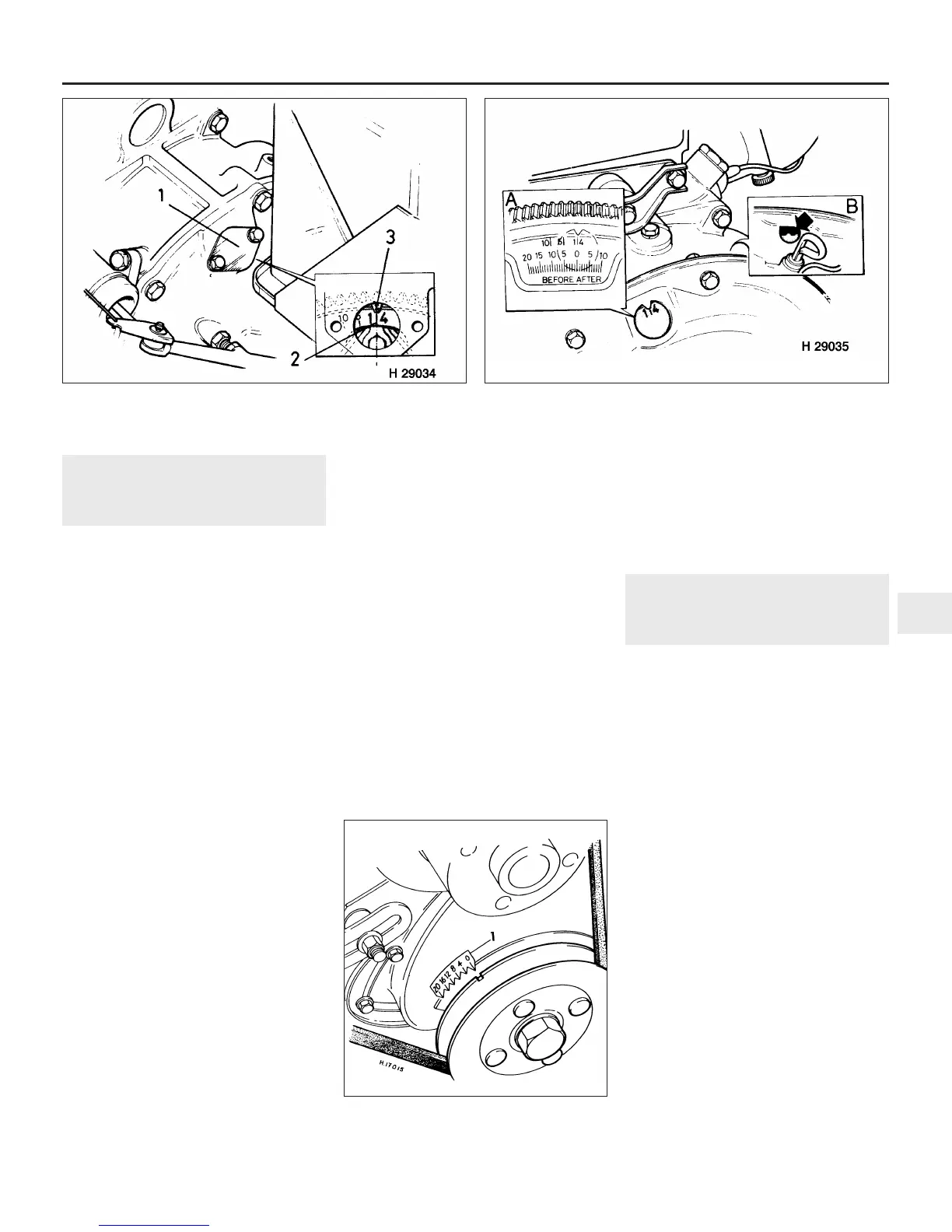
4 Gain access to the ignition timing marks by
undoing the two bolts securing the inspection
plate to the top of the flywheel housing and
lifting off the plate. On automatic transmission
models, withdraw the rubber grommet from
the top of the converter housing (see
illustrations). On later models there is a
timing scale on the timing cover, together with
a notch or pointer on the crankshaft pulley
(see illustration).
5 Turn the engine over until No 1 piston is
approaching TDC on the compression stroke.
Engine in-car repair procedures 2A•3
2A
3.4a Timing mark locations - early manual transmission models
1 Inspection cover 2 Timing marks 3 Pointer A Detail showing alternative
timing marks
B Insert screwdriver to turn
torque converter
3.4b Timing mark locations - automatic transmission models
3.4c Timing scale on timing cover of later
manual transmission models


 To Next Page
 Loading...