Once the nuts have been removed, the head
gasket will be disturbed, and the gasket will
almost certainly leak or blow after refitting. For
this reason, removal of the rocker shaft
assembly cannot be done without removing
the cylinder head and renewing the head
gasket.
Removal
2 Remove the cylinder head as described in
Section 7 or 8 as applicable.
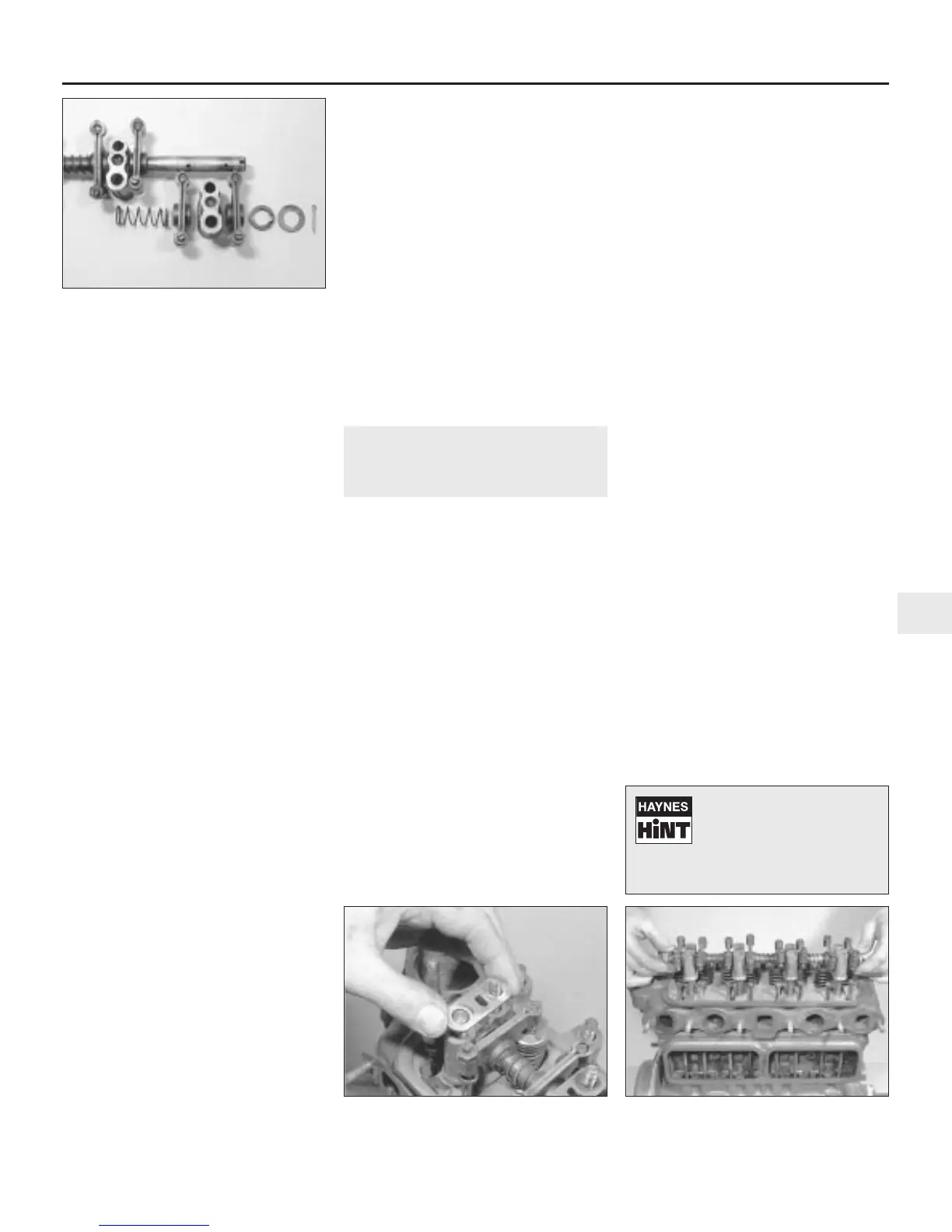
3 To dismantle the rocker shaft assembly,
release the rocker shaft locating screw,
remove the split pins, flat washers, and spring
washers from each end of the shaft and slide
from the shaft the pedestals, rocker arms, and
rocker spacing springs (see illustration).
Keep all the components in order and make a
note of each component’s correct fitted
position and orientation as it is removed, to
ensure it is fitted correctly on reassembly.
Inspection
4 Check the rocker arms for wear of the
rocker bushes, for wear at the rocker arm face
which bears on the valve stem, and for wear
of the adjusting ball-ended screws. Wear in
the rocker arm bush can be checked by
gripping the rocker arm tip and holding the
rocker arm in place on the shaft, noting if
there is any lateral rocker arm shake. If shake
is present, and the arm is very loose on the
shaft, remedial action must be taken. Pressed
steel valve rockers cannot be renovated by
renewal of the rocker arm bush. It is
necessary to fit new rocker arms. Forged
rocker arms which have worn bushes may be
taken to a Rover dealer or engine
reconditioning specialist to have the old bush
drawn out and a new bush fitted. Forged
rockers and pressed steel rockers are
interchangeable in sets of eight, but, where
one or two pressed steel rockers only require
renewal, it is not advised to replace them with
the forged type.
5 Check the tip of the rocker arm where it
bears on the valve head for cracking or
serious wear on the case hardening. If none is
present re-use the rocker arm. Check the
lower half of the ball on the end of the rocker
arm adjusting screw. On high performance
mini engines, wear on the ball and top of the
pushrod is easily noted by the unworn “pip”
which fits in the small central oil hole on the
ball. The larger this “pip” the more wear has
taken place to both the ball and the pushrod.
Check the pushrods for straightness by rolling
them on the bench. Renew any that are bent.
Refitting
6 To reassemble the rocker shaft fit the split
pin, flat washer and spring washer at the rear
end of the shaft and then slide on the rocker
arms, rocker shaft pedestals, and spacing
springs in the same order in which they were
removed.
7 With the front pedestal in position, screw in
the rocker shaft locating screws and slip the
locating plate into position. Finally, fit to the
front of the shaft the spring washer, plain
washer, and split pin, in that order.
8 Refit the cylinder head as described in
Section 7 or 8.
7 Cylinder head (carburettor
engines) - removal and
refitting
3
Note: If working on a pre-1990 engine fitted
with emission control equipment, it will be
necessary to first remove the diverter valve, air
pump and associated hoses before
proceeding with the removal sequence.
Detailed removal procedures for these
components will be found in Chapter 4C.
Removal
1 Disconnect the battery negative lead. For
improved working clearance, remove the
bonnet as described in Chapter 11.
2 Drain the cooling system as described in
Chapter 1.
3 Slacken the clips securing the radiator top
hose and remove the hose.
4 On models fitted with an ignition shield over
the front of the engine, release the three
retaining lugs and lift off the shield.
5 Make a note of the electrical connections at
the ignition coil and disconnect them. Now
undo and remove the nut securing the coil
bracket to the cylinder head and lift away the
coil.
6 Undo and remove the nuts or bolts securing
the radiator upper support bracket to the
thermostat housing and radiator. Remove the
bracket.
7 Refer to Chapter 4A and remove the air
cleaner assembly and carburettor(s).
8 Undo and remove the retaining nuts and
bolts, and lift off the clamps securing the
exhaust front pipe to the manifold. On Cooper
S models, undo and remove the nuts and flat
washers securing the inlet and exhaust
manifolds to the cylinder head. Lift off the inlet
manifold, ease the exhaust manifold back off
the cylinder head studs and tie it securely in
this position.
9 Slacken the water pump-to-cylinder head
bypass hose retaining clips.
10 Slacken the securing clip and remove the
heater hose from the heater valve on the
cylinder head. Now disconnect the control
cable from the valve.
11 Make a note of their positions and then
remove the HT leads from the spark plugs.
12 Detach the temperature gauge electrical
lead from the sender unit.
13 Undo the two rocker cover retaining bolts.
Lift out the bolts along with the ignition shield
brackets and lift the rocker cover and gasket
away. Collect the rocker cover retaining bolt
dished washers from the top of the two rubber
seals.
14 Slacken the four rocker pedestal nuts and
the nine main cylinder head nuts, half a turn at
a time, in the reverse sequence to that shown
(see illustration 7.31). On some 1275 cc
engines an additional nut and bolt are located
at the front and rear of the cylinder head, and
these must be released first. When the tension
is released from all the nuts, they may then be
removed, one at a time, from their studs.
15 Recover the pedestal plate (where fitted)
the lift off the rocker shaft assembly complete
and place it to one side (see illustrations).
16 Lift out the pushrods, keeping them in
order according to their respective valves
(see illustration).
Engine in-car repair procedures 2A•7
2A
6.3 Rocker shaft components dismantled
for inspection
7.15a Recover the pedestal plate
(where fitted) . . .
7.15b . . . then lift off the rocker shaft
assembly
The easiest way to keep the
pushrods in order is to push
them through a sheet of
thick paper or thin card, in
the correct sequence, then number
them 1 to 8.


 To Next Page
 Loading...