paraffin or a suitable solvent and dry
thoroughly. Pay particular attention to the
mating faces of the cover and the engine front
plate, ensuring that all traces of old gasket are
removed.
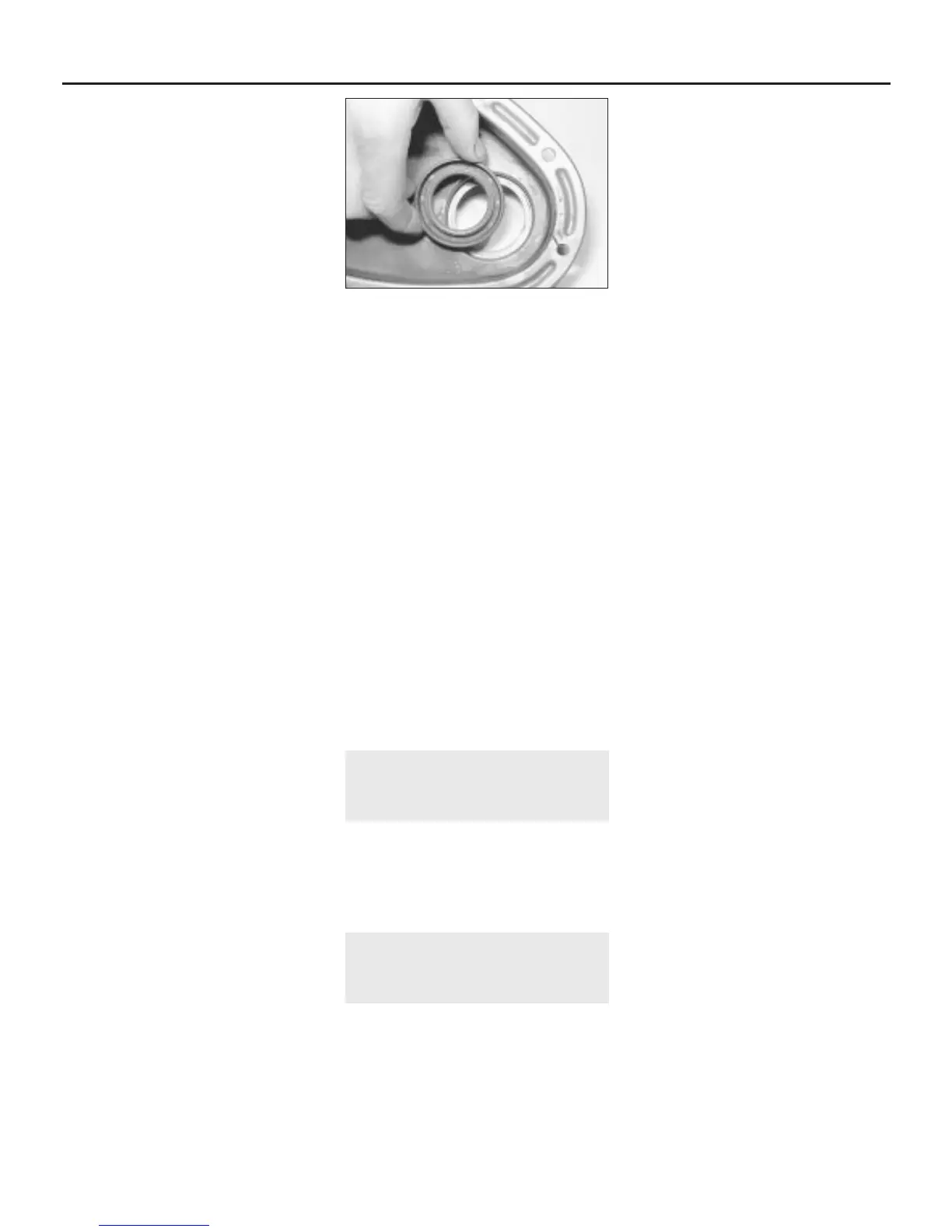
3 Drive out the old seal and tap in the new
one using the old seal to spread the load.
Ensure that the open side of the seal faces
inward, towards the timing chain (see
illustration).
4 Refit the timing cover as described in
Section 5, paragraphs 32 to 39.
Rear (primary gear) oil seal -
manual transmission models
Note: The majority of clutch faults
experienced on Mini power units are caused
by oil contamination of the clutch friction
linings due to the failure of the primary gear oil
seal. It is therefore recommended that the seal
is renewed whenever problems of this nature
are encountered. Note that Rover special tools
18G1068B and 18G1043 will be required for
this operation.
5 Remove the flywheel and clutch assembly
as described in Chapter 6.
6 The primary gear complete with oil seal can
now be withdrawn from the crankshaft and
flywheel housing as described below.
7 Lift off the C-shaped thrustwasher and
backing ring that retain the primary gear in
position.
8 Now screw in the threaded centre bolt of
special tool 18G1068B until the base of the
tool abuts the oil seal. Pull the primary gear
outwards as far as it will go and slide the two
collets of 18G1068B between the groove at
the rear of the primary gear splines and the
base of the tool body.
9 Now slowly unscrew the threaded centre
bolt of the tool while holding the tool body.
This will cause the primary gear to be
withdrawn from the flywheel housing, bringing
the oil seal with it.
10 When the primary gear and oil seal are
clear of the housing, lift them off the end of
the crankshaft, remove the tool and slide the
oil seal off the primary gear.
11 To fit a new oil seal first slide the primary
gear onto the crankshaft and secure with the
C-shaped washer and backing ring.
12 To avoid damage to the oil seal as it is
fitted, place the protective sleeve, special tool
18G1043, over the primary gear, or if this tool
is not available cover the primary gear splines
and the stepped shoulder with masking tape.
13 Lubricate the lip of the oil seal, and very
carefully slide it over the primary gear and into
position against the flywheel housing. The
open part of the seal must be facing towards
the engine.
14 Screw on the threaded centre bolt of
special tool 18G1068B and, when the body of
the tool contacts the seal, fully tighten the
centre bolt, thus forcing the seal squarely into
the housing. Remove the tool when the face
of the seal is flush with the housing.
15 The flywheel and clutch assembly can
now be refitted as described in Chapter 6.
Rear (torque converter output
gear) oil seal - automatic
transmission models
Note: Rover special tools 18G1068B and
18G1098 should ideally be obtained for this
operation.
16 Remove the torque converter as
described in Section 11.
17 Note the fitted depth of the oil seal in the
converter housing so that the new seal may
be fitted in the same position.
18 Using a hooked instrument, or alternatively
Rover special tool 18G1087, extract the oil
seal from the converter housing.
19 To protect the lips of the new seal as it is
fitted, wrap adhesive tape around the
converter output gear splines or preferably
use Rover special tool 18G1098.
20 Using a suitable length of tubing or
preferably Rover special tool 18G1068B, install
the oil seal into the housing to the same
position as noted during removal. Note that if
the seal is not positioned correctly it may cover
an important oil drain hole in the housing.
21 The torque converter can now be refitted
as described in Section 11.
10 Flywheel (manual
transmission models) -
removal and refitting
3
The flywheel on all manual transmission
models is removed complete with the clutch
assembly, the components then being
separated after removal. Full details of clutch
and flywheel removal and refitting are
contained in Chapter 6.
11 Torque converter (automatic
transmission models) -
removal and refitting
3
Removal
Note: Rover special tool special tool 18G1086
will be required to release the torque
converter from the crankshaft.
1 Chock the rear wheels then jack up the
front of the car and support it on axle stands
(see “Jacking and vehicle support”).
2 Disconnect the battery negative lead. If
greater working clearance is required, remove
the bonnet as described in Chapter 11.
3 Remove the front grille as described in
Chapter 11.
4 Detach the heater air duct from the air inlet
under the right-hand front wing. Remove the
air inlet from the inner wing panel.
5 Remove the starter motor as described in
Chapter 5A.
6 On fuel injection models carry out the
following:
a) Remove the air cleaner assembly, the
engine management ECU and the
crankshaft sensor as described in Chapter
4B.
b) Disconnect the oil separator breather
hose from the right-hand end of the
cylinder head, then undo the two bolts
securing the separator to the torque
converter housing. Remove the separator
and hose assembly from the engine,
along with its gasket.
c) Slacken and remove the screw, situated
just to the right of the brake servo unit,
securing the earth leads to the bulkhead.
d) Undo the bolts securing the wiring
harness retaining clip and starter motor
lead brackets to the converter housing,
then position the wiring clear of the
engine.
7 On early models, undo and remove the
screws securing the starter solenoid to the
inner wing panel. Lift off the solenoid and
position it out of the way.
8 If the ignition coil is mounted on the flywheel
housing, or on a bracket secured to one of the
cylinder head studs, remove the coil and
mounting bracket and position it well clear.
9 On later Mini 850 and 1000 models, remove
the horn and place it to one side.
10 Undo and remove the two bolts securing
the engine tie-bar and bracket to the side of
the cylinder block. Note that on later models
one of the bolts also retains the engine earth
strap.
11 Undo and remove the nuts and/or bolts
securing the radiator upper support bracket to
the radiator and thermostat housing.
Withdraw the bracket. Note: It is not
necessary to remove the support bracket if a
large clearance exists between the radiator
and left-hand inner wing panel, as is the case
on later Mini 850 and 1000 models.
12 Place a jack beneath the torque converter
housing end of the transmission casing and
just take the weight of the power unit. Use a
block of wood interposed between the casing
and the jack to spread the load.
13 From beneath the car undo and remove
the two nuts and bolts securing the right-hand
engine mounting to the subframe side
members. The best way to do this is to
engage the help of an assistant to hold the
bolts from above while the nuts are undone
from below. The bolt heads are tucked away
beneath the converter housing and can only
be reached with a small open-ended spanner.
2A•10 Engine in-car repair procedures
9.3 Timing cover oil seal must be fitted
with the open side towards the chain


 To Next Page
 Loading...