EasyManua.ls Logo

Healthy Climate Solutions ERV5-175-TPD - User Manual

Default Icon
60 pages
Print Icon
To Next Page IconTo Next Page
Loading...
INDOOR AIR QUALITY
KIT AND ACCESSORIES
507363-04
2/2021
Supersedes 3/2020
HEALTHY CLIMATE
®
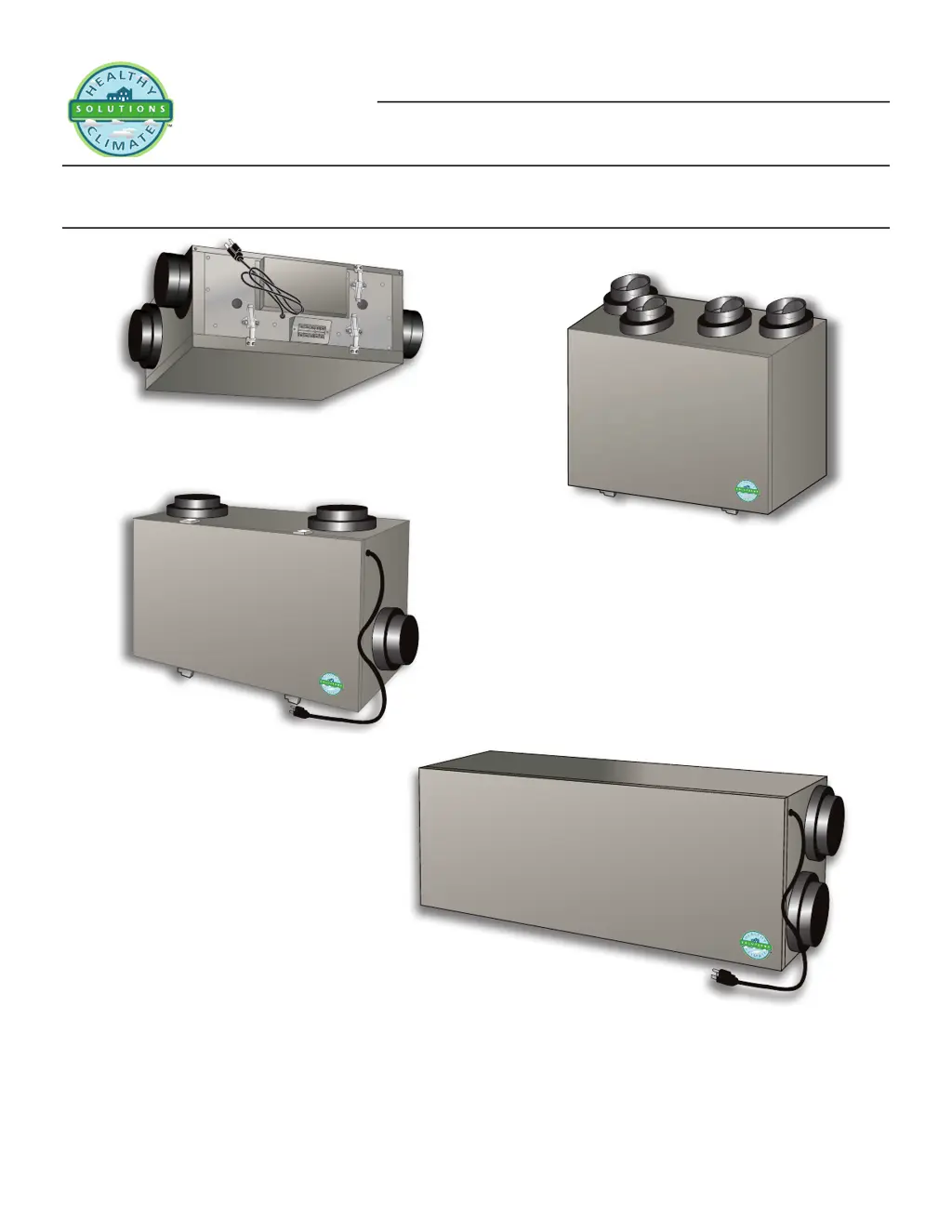
ERV AND HRV VENTILATORS
INSTALLATION INSTRUCTIONS AND HOMEOWNER GUIDE FOR HEALTHY CLIMATE
®
ENERGY RECOVERY VENTILATOR (ERV) AND HEAT RECOVERY VENTILATOR (HRV)
HRV5-150
HRV3-195
HRV3-150-TPD, HRV5-200-TPD,
HRV6-HEX095-TPD, HRV5-270-TPD-ECM,
ERV5-150-TPD, ERV5-175-TPD
ERV5-130
THIS MANUAL MUST BE LEFT WITH THE OWNER
FOR FUTURE REFERENCE

Table of Contents

Questions and Answers

  • A
    Amy RodriguezAug 12, 2025
    Why is there poor airflow from my Healthy Climate Solutions ERV5-175-TPD Fan?
    • M
      Mary CaseyAug 12, 2025
      Poor airflow from your Healthy Climate Solutions Fan can stem from several issues. Check for the following: * Blocked mesh on outside hoods or plugged filters. * An obstructed core or closed/blocked house grilles. * Closed dampers, a poor power supply, or ductwork restrictions. * An improper speed control setting or an improperly balanced ERV/HRV airflow. To resolve this, clean exterior hoods or vents, clean or replace the filter and core (every 3 months if it is MERV 13). Ensure grilles are open, adjust dampers, have an electrician check the power supply, inspect duct installation, increase the ERV/HRV speed, and have a contractor balance the ERV/HRV.
  • F
    Frederick BeckerAug 19, 2025
    Why does the supply air from my Healthy Climate Solutions ERV5-175-TPD feel cold?
    • G
      Gregory NorrisAug 19, 2025
      The supply air from your Healthy Climate Solutions Fan might feel cold due to: poor location of supply grilles, airflow irritating occupants or extremely cold outdoor temperatures. To solve this, locate the grilles high on the walls or under the baseboards, install ceiling mounted diffuser or grilles so as not to direct airflow onto occupants and turn down the ERV/HRV supply speed. A small duct heater (1kW) could be used to temper the supply air. Consider rearranging furniture or opening closed doors that restrict air movement. If supply air is ducted into furnace return, the furnace fan may need to run continuously to distribute ventilation air comfortably.
  • W
    wellsstephenAug 23, 2025
    What to do if my Healthy Climate Solutions ERV5-175-TPD Fan dehumidistat is not operating?
    • S
      smithseanAug 23, 2025
      If the dehumidistat on your Healthy Climate Solutions Fan is not operating, it could be due to a few reasons: the outdoor temperature may be above 59ºF (15ºC), there might be an improper low-voltage connection, an external low voltage short caused by a staple or nail, or the dehumidistat might be set to OFF. Check that the correct terminals have been used and examine external wiring for shorts. Set the dehumidistat at the desired level. Note that the dehumidistat functions normally when the outdoor temperature is above 59ºF (15ºC).
  • M
    Mark DeckerAug 27, 2025
    Why are my Healthy Climate Solutions HRV units or ducts frosting up?
    • N
      nwaltersAug 27, 2025
      HRV units and/or ducts frosting up in your Healthy Climate Solutions system can be caused by improperly balanced HRV air flows or a malfunction of the HRV defrost system. To address this, have an HVAC contractor balance the HRV airflows and ensure the damper defrost is operating during the self-test.
  • J
    Jacob YoungAug 31, 2025
    What causes condensation or ice build-up in the insulated duct to the outside of my Healthy Climate Solutions ERV5-175-TPD Fan?
    • F
      Frank HolmesAug 31, 2025
      Condensation or ice build-up in the insulated duct to the outside of your Healthy Climate Solutions Fan can be due to an incomplete vapor barrier around the insulated duct or a hole/tear in the outer duct covering. To fix this, tape and seal all joints and tape any holes or tears in the outer duct covering. Ensure that the vapor barrier is completely sealed.
  • C
    Crystal EatonSep 3, 2025
    Why are humidity levels too low with my Healthy Climate Solutions Fan?
    • K
      Kathy FisherSep 3, 2025
      Low humidity levels with your Healthy Climate Solutions Fan can occur if the dehumidistat control is set too low, the blower speed of the ERV/HRV is too high, or the ERV/HRV airflows are improperly balanced. To resolve this, set the dehumidistat at a higher level and decrease the ERV/HRV blower speed. You may need to add humidity through the use of humidifiers. Consider having a contractor balance the ERV/HRV airflows.
  • S
    Sheila LopezSep 7, 2025
    Why is there water in the bottom of my Healthy Climate Solutions ERV/HRV unit?
    • V
      Virginia JonesSep 7, 2025
      Water accumulation at the bottom of your Healthy Climate Solutions ERV/HRV unit can be attributed to a few potential causes: plugged drain pans, improper connection of ERV/HRV drain lines, the unit not being level, obstructed drain lines, or the heat exchange core not being properly installed. Ensure the o-ring on the drain nozzle sits properly, check the drain line for kinks, inspect water drain connections, and make sure water drains properly from pan(s).
  • J
    Jonathan MasonNov 14, 2025
    What to do if humidity levels are too high with my Healthy Climate Solutions ERV5-175-TPD and condensation appears on windows?
    • P
      Pamela HodgesNov 14, 2025
      If humidity levels are too high and condensation is appearing on windows while using your Healthy Climate Solutions Fan, it could be due to several reasons: * The dehumidistat might be set too high. * The ERV/HRV unit may be undersized for your home's needs (e.g., if you have a hot tub or indoor pool). * Moisture may be entering from a non-vented crawl space. * Excess moisture may be lingering in washroom and kitchen areas. * The condensation might be a seasonal issue during spring and fall. * The ERV/HRV might be set at too low a speed. To address this, try setting the dehumidistat at a lower level, cover pools or hot tubs when not in use, avoid drying clothes indoors, vent the crawl space, ensure bathroom ducts are effectively removing moist air, and increase the speed of t...

Summary

General Information and Specifications

General Information

Provides an overview of the manual's purpose and scope.

Model and Catalog Number Cross-References

Cross-references product models with catalog numbers.

Specifications

Details the technical specifications of the ERV/HRV units.

Application and Requirements

Application Overview

Explains the purpose of ERV and HRV units in home ventilation.

Required Tools and Materials

Lists essential tools and materials for installation.

Unit Dimensions and Ducting

Unit Dimensions

Provides physical dimensions of the ERV/HRV units.

Shaping Ducting to Fit Oval Ports

Guides on adapting ductwork for oval ports.

Defrost Cycle and Ventilation Modes

Defrost Cycle (ERV;HRV)

Explains the defrost function and its operational logic.

Recirculating Damper Defrost

Details defrost operation using a recirculating damper.

Ventilation Operational Modes

Describes various modes for operating ERV and HRV units.

iComfort Control System Integration

iComfort E30;S30 Control System Guide

Covers system features and installation overview.

Thermostat Ventilation Parameters

Details thermostat settings for ventilation control.

iComfort Control User Guide

Provides user guidance for ventilation home screen and settings.

Wiring Diagrams

ERV and HRV Wiring Diagrams

Provides diagrams for connecting ERV/HRV to controls.

Unit Wiring Diagrams

Shows detailed internal wiring schematics for various models.

Installation Methods

Installation Methods - Simplified (Return;Return)

Describes the basic installation method connecting to the return air.

Installation Methods - Partially Dedicated

Details installation drawing air from specific points and return air.

Installation Methods - Fully Dedicated

Explains installation drawing/supplying air directly to house areas.

Unit Installation and Connections

Unit Installation Location and Suspending

Guides on selecting location and suspending the unit safely.

Installing the Drain Connection

Covers condensate drain setup and optional plug installation.

Electrical Connections and Interlocking

Details electrical hookups and blower interlocking.

Controls and Accessories

Push Button and Deluxe Controls

Describes the features of push button and deluxe controls.

Timers and Repeaters

Details operation of timers, wireless timers, and repeaters.

Mechanical Timers Installation

Guides on installing mechanical timer accessories.

Airflow Balancing

Pitot Tube Balancing Procedure

Step-by-step guide for balancing airflow using a pitot tube.

Door Port Balancing Procedure

Method for balancing airflow using unit door ports.

Airflow Balancing Charts

Provides data tables for airflow balancing at different speeds.

Troubleshooting and Maintenance

Troubleshooting Common Issues

Lists common ERV/HRV problems and their solutions.

Replacement Parts Summary

Lists available replacement parts for ERV/HRV models.

Homeowner Maintenance Information

Provides instructions for routine cleaning and upkeep.

Application Map - ERV;HRV Ventilators

Zone-Based Application Recommendations

Maps climate zones to recommended HRV or ERV usage.

Healthy Climate Solutions ERV5-175-TPD Specifications

General IconGeneral
Airflow Capacity175 CFM
Airflow @ 0.2 in. w.g.175 CFM
Weight60 lbs
TypeEnergy Recovery Ventilator
Motor TypePSC

Related product manuals