EasyManua.ls Logo

Healthy Climate HRV3-150-TPD - User Manual

Default Icon
44 pages
Print Icon
To Next Page IconTo Next Page
Loading...
INDOOR AIR QUALITY
KIT AND ACCESSORIES
507363-02
1/2017
Supersedes 507363-01
HEALTHY CLIMATE
®
HRV AND ERV VENTILATORS
INSTALLATION INSTRUCTIONS AND HOMEOWNER GUIDE FOR HEALTHY CLIMATE
®
HEAT RECOVERY VENTILATOR (HRV) AND ENERGY RECOVERY VENTILATOR (ERV)
THIS MANUAL MUST BE LEFT WITH THE OWNER
FOR FUTURE REFERENCE
WARNING
Improper installation, adjustment, alteration, ser vice or
maintenance can cause property damage, personal injury
or loss of life.
Installation and service must be performed by a li censed
professional HVAC installer (or equivalent) or a service
agency.
CAUTION
As with any mechanical equipment, contact with sharp
sheet metal edges can result in personal injury. Take
care while handling this equipment and wear gloves and
protective clothing.
Shipping and Packing List
Package 1 of 1 contains:
1 - Assembled ventilator
1 - Bag assembly containing:
2 - Drain spout assemblies (HRV units only)
1 - Drain tee (HRV units only)
4 - Hanging straps
1 - Installation instruction
1 - Warranty
1 - Wall-mounted remote control
General Information
This instruction is intended as a general guide and does not
supersede local codes in any way. Consult authorities who
have jurisdiction before installation.
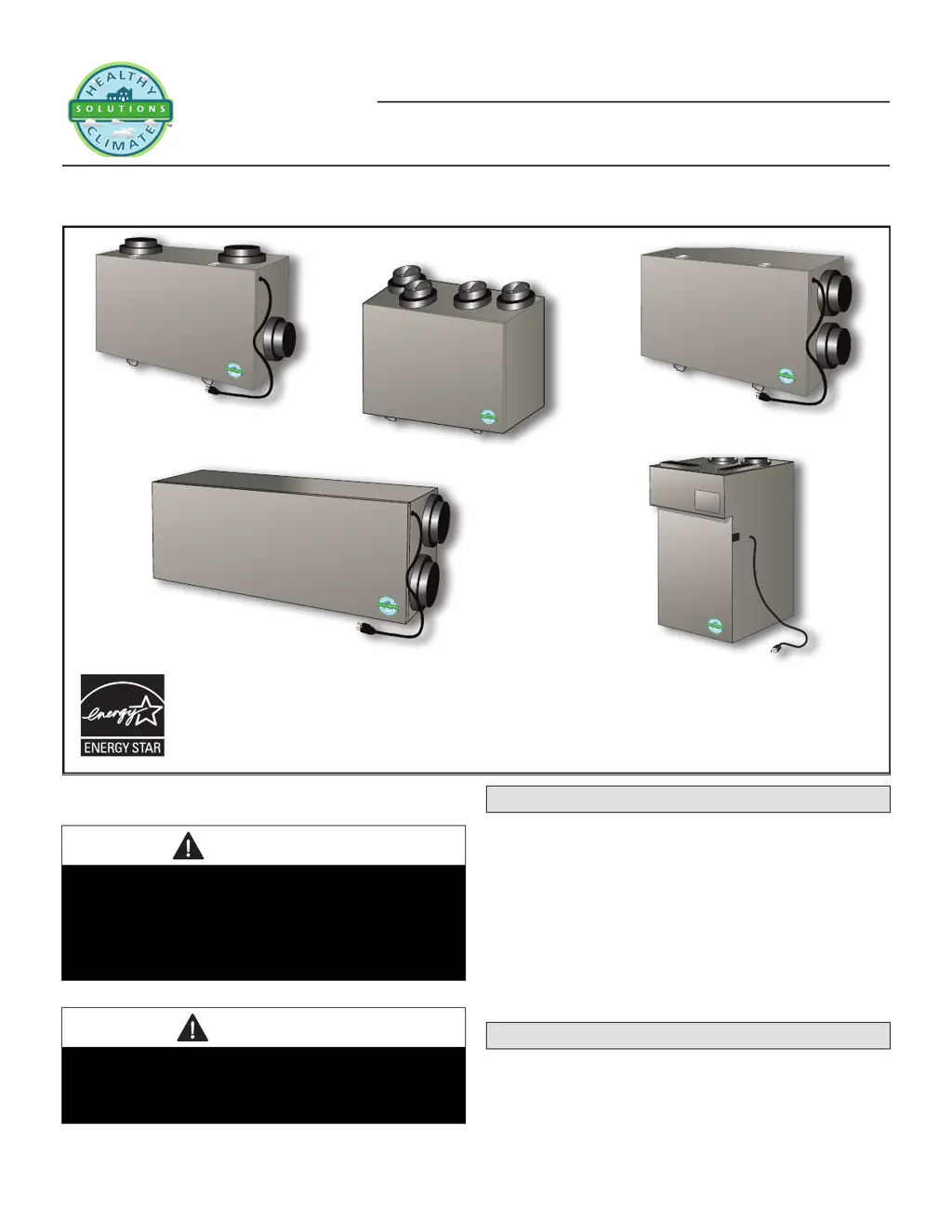
HRV5-150
ERV3-150, -200
HRV3-195, -300
HRV3-095
Certain models have earned the EnErgy Star
®
mark by meeting strict energy
efciency guidelines set by Natural Resources Canada and the US EPA.
These models meet ENERGY STAR requirements only when used in Canada.
HRV3-150-TPD/TPF, HRV5-200-TPD
HRV3-195, -300

Table of Contents

Questions and Answers

  • S
    Sandra VazquezAug 9, 2025
    How to improve poor airflow in my Healthy Climate HRV3-150-TPD Heating System?
    • C
      Crystal RuizAug 10, 2025
      Poor airflow in your Healthy Climate Heating System can stem from several causes. The mesh on outside hoods might be plugged, filters could be clogged, or the core might be obstructed. House grilles might be closed or blocked, and dampers, if installed, could be closed. A poor power supply at the site, ductwork restrictions, an improper speed control setting, or an improperly balanced HRV/ERV airflow can also contribute. To resolve this, clean exterior hoods or vents, remove and clean the filter, remove and clean the core, check and open grilles, open and adjust dampers, have an electrician check the supply voltage, check duct installation, increase the speed of the HRV/ERV, and have a contractor balance the HRV/ERV.
  • C
    Christine ThompsonAug 14, 2025
    Why does the supply air feel cold from my Healthy Climate HRV3-150-TPD?
    • D
      Debbie TuckerAug 14, 2025
      If the supply air from your Healthy Climate Heating System feels cold, it could be due to poor placement of supply grilles, potentially causing discomfort to occupants, or extremely cold outdoor temperatures. To solve this, locate the grilles high on the walls or under the baseboards. Install ceiling-mounted diffusers or grilles to avoid directing airflow onto occupants. Reduce the HRV/ERV supply speed. A small duct heater (1kW) could be used to warm the supply air. Also, consider rearranging furniture or opening closed doors that restrict air movement. If the supply air is ducted into the furnace return, the furnace fan may need to run continuously to distribute ventilation air comfortably.
  • M
    Mr. Timothy ShermanAug 18, 2025
    What to do if there is water in the bottom of my Healthy Climate HRV/ERV unit?
    • D
      Derek Hensley PhDAug 18, 2025
      Water at the bottom of your Healthy Climate HRV/ERV unit can be caused by plugged drain pans, improper connection of drain lines, the unit not being level, obstructed drain lines, or improper installation of the heat exchange core. To resolve this, ensure the o-ring on the drain nozzle sits properly, check for kinks in the drain line, check water drain connections, and ensure water drains properly from the pans.
  • J
    Jason JamesAug 22, 2025
    Why are humidity levels too low with my Healthy Climate HRV3-150-TPD?
    • E
      ellisonraymondAug 22, 2025
      Low humidity levels in your home when using a Healthy Climate Heating System can be caused by a dehumidistat control set too low, the blower speed of the HRV/ERV being too high, occupant lifestyle factors, or improperly balanced HRV/ERV airflows. To address this, set the dehumidistat at a higher level and decrease the HRV/ERV blower speed. You may need to add humidity through the use of humidifiers. Have a contractor balance the HRV/ERV airflows.
  • N
    Natalie PadillaAug 27, 2025
    Why is there condensation in the insulated duct of my Healthy Climate HRV3-150-TPD Heating System?
    • M
      Melissa JohnsonAug 27, 2025
      Condensation or ice build-up in the insulated duct of your Healthy Climate Heating System can be attributed to an incomplete vapor barrier around the insulated duct or a hole or tear in the outer duct covering. To fix this, tape and seal all joints and tape any holes or tears in the outer duct covering, ensuring the vapor barrier is completely sealed.
  • W
    whammondAug 31, 2025
    Why are my Healthy Climate HRV3-150-TPD Heating System HRV units frosting up?
    • V
      volsonAug 31, 2025
      HRV units and/or ducts frosting up in your Healthy Climate Heating System can be due to improperly balanced HRV air flows or a malfunction of the HRV defrost system. To solve this, have an HVAC contractor balance the HRV airflows and ensure the damper defrost is operating during the self-test.
  • V
    Vanessa CollinsNov 4, 2025
    Why are humidity levels too high with my Healthy Climate HRV3-150-TPD Heating System?
    • A
      Austin RodriguezNov 4, 2025
      High humidity levels and condensation on windows with your Healthy Climate Heating System can be due to several factors. The dehumidistat might be set too high, or the HRV/ERV unit may be undersized for your home's needs, especially if you have a hot tub or indoor pool. Moisture might be entering from an un-vented crawl space, or it could be lingering in washroom and kitchen areas. Sometimes, this occurs during seasonal changes like spring and fall. Also, the HRV/ERV might be set at too low a speed. To address this, try setting the dehumidistat to a lower level, cover pools or hot tubs when not in use, avoid drying clothes indoors, vent the crawl space and add a vapor barrier, ensure bathroom ducts are adequate, and increase the HRV/ERV speed. Remember, on humid days during seasonal change...

Summary

Specifications

Defrost Cycle (HRV)

Recirculating Damper Defrost

Recirculating damper closes off supply air, allowing exhaust air to recirculate.

Damper Defrost Five Port Models

Motor-driven damper opens fifth port for warm air intake during defrost.

Fan Defrost (HRV3-150-TPF)

Fresh air motor shuts off; stale air exhaust motor runs during defrost.

Wall Mount 2-Speed Dehumidistat;Ventilation Control (Y8249)

Digital Five Speed; Five Mode Control (Y8250)

Overview of Installation Methods

Installation Methods - Simplified (Return;Return)

Draws stale air from cold air return, introduces fresh air downstream.

Installation Methods - Partially Dedicated

Installation Methods - Fully Dedicated

Installation of the Unit

Installing the Drain Connection (HRV Unit Only)

Installing Main Control

Interlocking HRV;ERV Blower to Air Handler;Furnace Blower

Electrical Connections

Installer Selectable High Speed Settings

Airflow Balancing

Airflow Measuring Gauges

Details on using digital manometers or magnehelic gauges for airflow measurement.

Sequence of Operations

Self-Test Operational Flowchart

HRV Defrost Mode

Troubleshooting

Replacement Parts Summary

Blower Assembly Service (Dealer Only)

Homeowner Maintenance Information

Application Map - HRV;ERV Ventilators

Healthy Climate HRV3-150-TPD Specifications

General IconGeneral
TypeHeat Recovery Ventilator (HRV)
Airflow Capacity150 CFM
Core MaterialPolypropylene
Dimensions24.5" x 21.5" x 14.5"
Weight35 lbs
Voltage120 V

Related product manuals