EasyManua.ls Logo

Heathkit DX-40 - GROUNDING REQUIREMENTS; Importance of Effective Grounding; Grounding System Hints

Heathkit DX-40
20 pages
Print Icon
To Next Page IconTo Next Page
To Previous Page IconTo Previous Page
Loading...
GROUNDING:
The
importance
of
a
good
ground
that
presents
low
impedance
at
all
frequencies
cannot
be
emphasized
too
strongly.
What
may
bea
perfectly
satisfactory
ground
at
80
meters
could
place
the
transmitter
considerably
above
ground
at
the
higher
RF
frequencies.
As
an
ex-
ample,
the
length
of
the
ground
wire
is
sometimes
critical.
An
8
foot
wire
from
the
transmitter
to
ground
would
be
a
direct
short
at
80
meters
but
becomes
one-quarter
wave
length
at
10
meters
and
therefore
places
the
chassis
at
a
high
RF
potential.
Some
hints
that
will
be
of
assistance
in
obtaining
a
good
ground
are:
1.
Connection
for
the
ground
should
be
made
tocold
water
or
well
pipes
and/or
multiple
pipes
or
rods
driven
approximately
eight
or
more
feet
into
moist
earth.
A
salt
solution
poured
around
the
ground
rods
will
further
increase
the
conductivity
to
ground.
A
more
elaborate
installation
might
include
a
system
of
wires
approximately
one-quarter
wave
length
long
laid
a
few
inches
under
the
surface
of
the
earth
in
a
grid
or
radial
pattern.
The
use
of
one
or
all
of
these
grounding
systems
may
be
combined
to
form
a
good
ground
reference.
2.
The
electrical
connection
tothe
ground
point
should
consist
ofa
short
heavy
conductor
(#12
wire
or
heavier,
or
copper
braid).
If
a
short
ground
wire
is
difficult
to
obtain
because
of
transmitter
location,
several
leads
of
random
length
may
be
used.
The
use
of
random
leads
lessens
the
possibility
that
all
leads
should
become
one-quarter
wave
length
at
the
frequency
of
operation.
If
the
transmitter
becomes
hot
with
RF
atone
particular
frequency,
the
addi-
tion
of
a
ground
wirecut
toone-half
wave
length
at
this
frequency
may
clear
up
the
difficulty.
Some
of
the
symptoms
of
inadequate
grounding
are
manifested
in
the
form
of:
Inability
to
load
the
antenna
properly.
High
RF
potentials
on
the
chassis
or
case
of
the
transmitter
as
well
as
the
microphone
and
cable.
Undue
voltage
strain
on
output
circuit
components.
Final
plate
current
reading
affected
by
touching
the
panel
or
case.
Television
or
broadcast
interference.
gape
pe
LOCATION:
The
transmitter
should
be
located
where
free
circulation
of
air
is
possible
and
objects
should
not
be
placed
on
the
case
as
this
might
restrict
the
circulation
of
air.
Good
ven-
tilation
is
essential
to
insure
maximum
component
life.
The
considerations
mentioned
with
re-
gard
to
grounding
will
also
affect
the
selection
of
a
good
location,
as
will
the
point
of
entry
of
the
antenna
feed
line.
OPERATION:
The
tuning
procedure
outlined
previously
will
also
apply
when
loading
an
actual
antenna.
Some
special
cases
involving
particular
antenna
types
will
require
special
considera-
tion
and
will
be
covered
under
antennas.
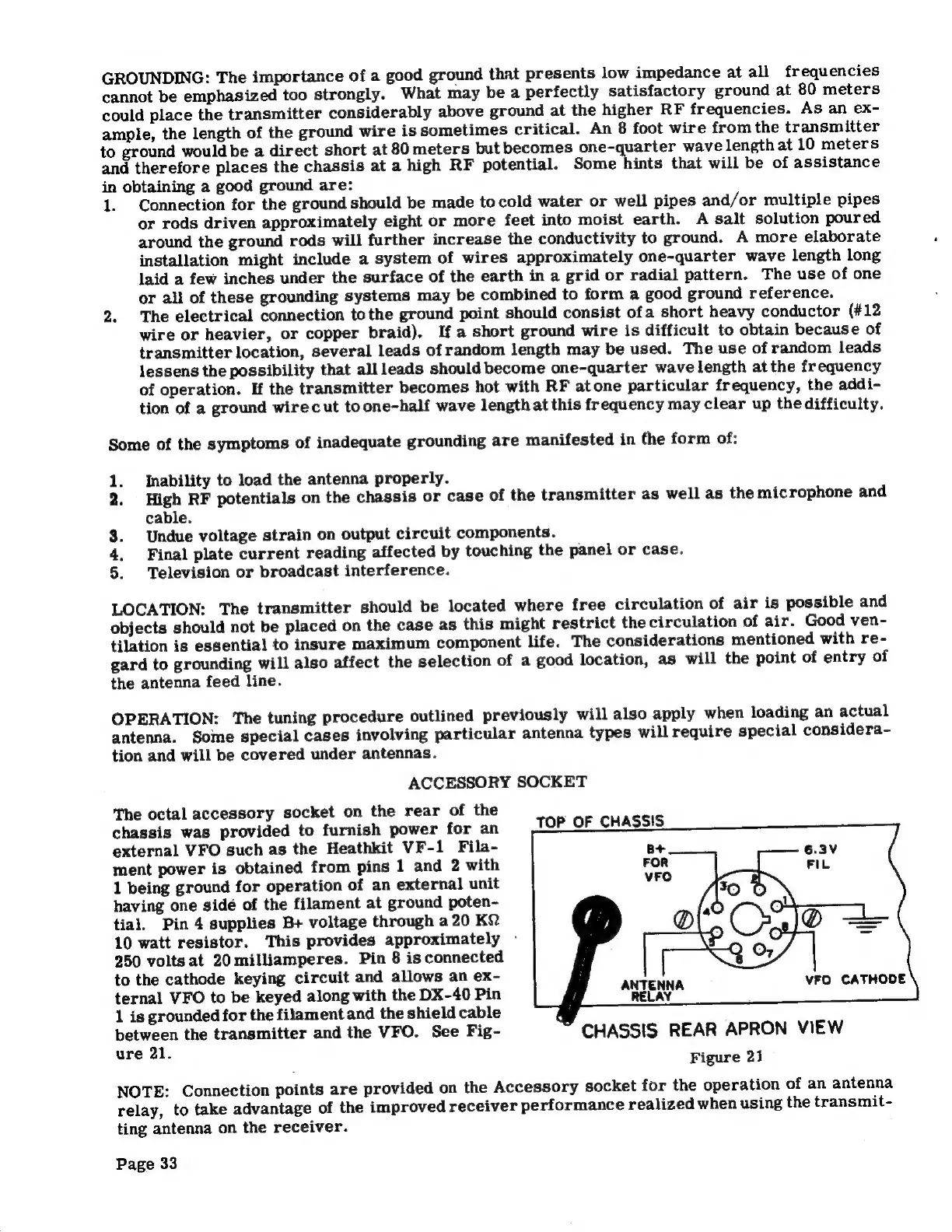
ACCESSORY
SOCKET
The
octal
accessory
socket
on
the
rear
of
the
chassis
was
provided
to
furnish
power
for
an
external
VFO
such
as
the
Heathkit
VF-1
Fila-
ment
power
is
obtained
from
pins
1
and
2
with
1
being
ground
for
operation
of
an
external
unit
having
one
sidé
of
the
filament
at
ground
poten-
tial.
Pin
4
supplies
B+
voltage
through
a
20
KQ
10
watt
resistor.
This
provides
approximately
-
250
volts
at
20
milliamperes.
Pin
8
is
connected
to
the
cathode
keying
circuit
and
allows
an
ex-
TOP
OF
CHASSIS
ANTENNA
VFO
CATHODE
ternal
VFO
to
be
keyed
along
with
the
DX-40
Pin
RELAY
1
is
grounded
for
the
filament
and
the
shield
cable
between
the
transmitter
and
the
VFO.
See
Fig-
CHASSIS
REAR
APRON
VIEW
ure
21.
.
Figure
21
NOTE:
Connection
points
are
provided
on
the
Accessory
socket
for
the
operation
of
an
antenna
relay,
to
take
advantage
of
the
improved
receiver
performance
realized
when
using
the
transmit-
ting
antenna
on
the
receiver.
Page
33

Other manuals for Heathkit DX-40

Related product manuals