EasyManua.ls Logo

Heathkit IM-4100 - Page 46

Heathkit IM-4100
82 pages
Print Icon
To Next Page IconTo Next Page
To Previous Page IconTo Previous Page
Loading...
Page
40
SS
a
CALIBRATION
(‘4
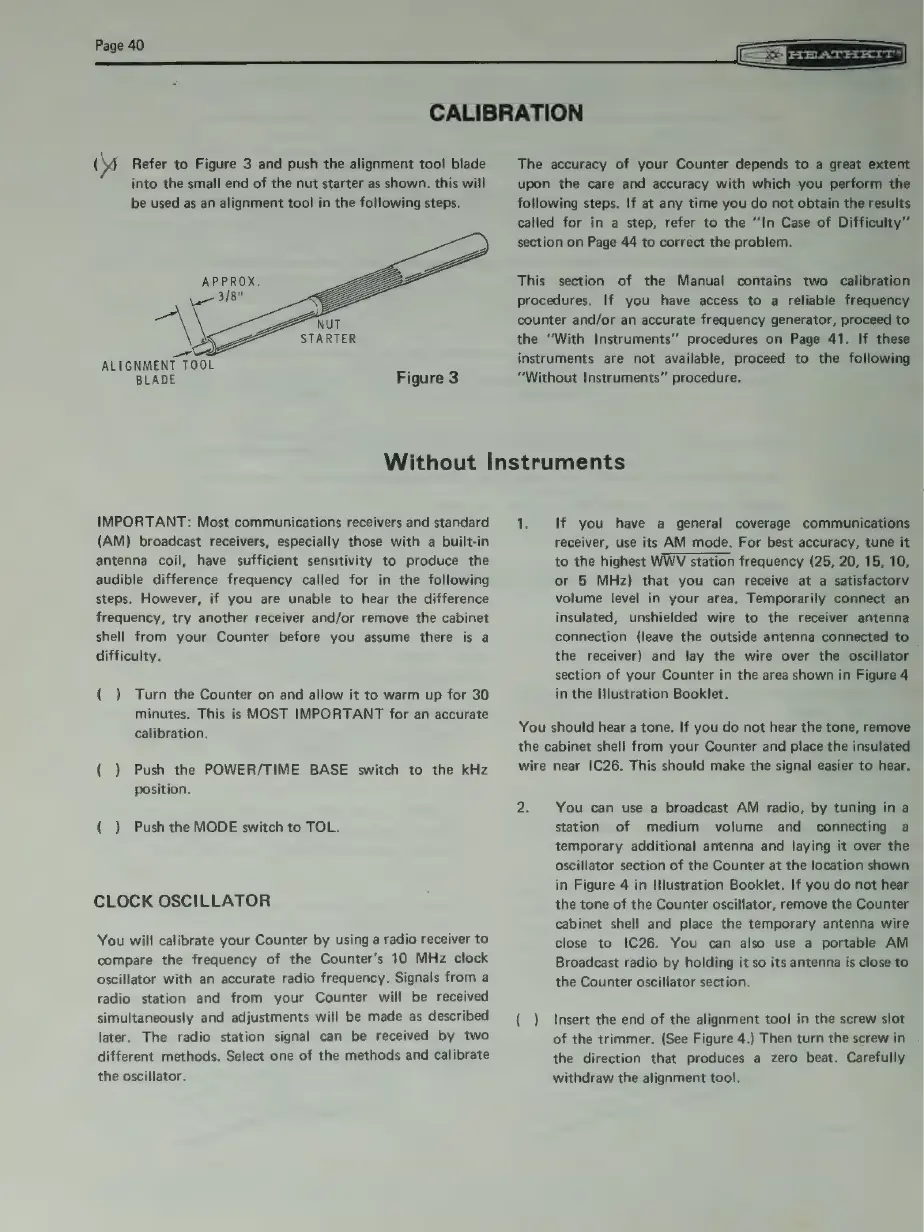
Refer
to
Figure
3
and
push
the
alignment
tool
blade
into
the
small
end
of
the
nut
starter
as
shown.
this
will
be
used
as
an
alignment
tool
in
the
following
steps.
STARTER
ALIGNMENT
TOOL
BLADE
Figure
3
The
accuracy
of
your
Counter
depends
to
a
great
extent
upon
the
care
and
accuracy
with
which
you
perform
the
following
steps.
If
at
any
time
you
do
not
obtain
the
results
called
for
in
a
step,
refer
to
the
“In
Case
of
Difficulty”
section
on
Page
44
to
correct
the
problem.
This
section
of
the
Manual
contains
two
calibration
procedures.
If
you
have
access
to
a
reliable
frequency
counter
and/or
an
accurate
frequency
generator,
proceed
to
the
“With
Instruments”
procedures
on
Page
41.
If
these
instruments
are
not
available,
proceed
to
the
following
“Without
Instruments”
procedure.
Without
Instruments
IMPORTANT:
Most
communications
receivers
and
standard
(AM)
broadcast
receivers,
especially
those
with
a
built-in
antenna
coil,
have
sufficient
sensitivity
to
produce
the
audible
difference
frequency
called
for
in
the
following
steps.
However,
if
you
are
unable
to
hear
the
difference
frequency,
try
another
receiver
and/or
remove
the
cabinet
shell
from
your
Counter
before
you
assume
there
is
a
difficulty.
(_
)
Turn
the
Counter
on
and
allow
it
to
warm
up
for
30
minutes.
This
is
MOST
IMPORTANT
for
an
accurate
calibration.
(
)
Push
the
POWER/TIME
BASE
switch
to
the
kHz
position.
(_
)
Push
the
MODE
switch
to
TOL.
CLOCK
OSCILLATOR
You
will
calibrate
your
Counter
by
using
a
radio
receiver
to
compare
the
frequency
of
the
Counter’s
10
MHz
clock
oscillator
with
an
accurate
radio
frequency.
Signals
from
a
radio
station
and
from
your
Counter
will
be
received
simultaneously
and
adjustments
will
be
made
as
described
later.
The
radio
station
signal
can
be
received
by
two
different
methods.
Select
one
of
the
methods
and
calibrate
the
oscillator.
1.
If
you
have
a
general
coverage
communications
receiver,
use
its
AM
mode.
For
best
accuracy,
tune
it
to
the
highest
WWV
station
frequency
(25,
20,
15, 10,
or
5
MHz)
that
you
can
receive
at
a
satisfactorv
volume
level
in
your
area.
Temporarily
connect
an
insulated,
unshielded
wire
to
the
receiver
antenna
connection
(leave
the
outside
antenna
connected
to
the
receiver)
and
lay
the
wire
over
the
oscillator
section
of
your
Counter
in
the
area
shown
in
Figure
4
in
the
Illustration
Booklet.
You
should
hear
a
tone.
If
you
do
not
hear
the
tone,
remove
the
cabinet
shell
from
your
Counter
and
place
the
insulated
wire
near
1C26.
This
should
make
the
signal
easier
to
hear.
zi
You
can
use
a
broadcast
AM
radio,
by
tuning
in
a
station
of
medium
volume
and
connecting
a
temporary
additional
antenna
and
laying
it
over
the
oscillator
section
of
the
Counter
at
the
location
shown
in
Figure
4
in
Illustration
Booklet.
If
you
do
not
hear
the
tone
of
the
Counter
oscillator,
remove
the
Counter
cabinet
shell
and
place
the
temporary
antenna
wire
close
to
IC26.
You
can
also
use
a
portable
AM
Broadcast
radio
by
holding
it
so
its
antenna
is
close
to
the
Counter
oscillator
section.
(
)
Insert
the
end
of
the
alignment
tool
in
the
screw
slot
of
the
trimmer.
(See
Figure
4.)
Then
turn
the
screw
in
the
direction
that
produces
a
zero
beat.
Carefully
withdraw
the
alignment
tool.