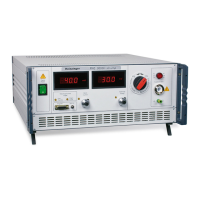
The Heinzinger ERS-BIC is a bidirectional power supply system designed for test bench energy applications, capable of operating as both a power supply and a sink, feeding energy back into the grid. The system is composed of several functional units:
Functional Description:
The ERS-BIC system is optimized for bidirectional operation. From a technical perspective, its output and input can change, allowing it to function as a power supply or a sink that feeds energy back into the grid. The system's core components include:
- Potential Separation: An isolating transformer with two isolated secondary coils provides potential separation to the grid and between the two input channels.
- Active Front End (AFE): Each of the two AFEs consists of a frequency converter operating at 4 kHz switching frequency, generating an intermediate DC voltage circuit of approximately 715 V. The AFE supplies energy to the DC intermediate circuit during source operation and feeds absorbed energy back into the grid during sink operation.
- HTS (Hoch-/Tiefsetzsteller): A Multi-Parallel Converter (MPC) serves as a step-up/down converter in the output stage. It comprises four IGBT modules, each forming a synchronous converter, with a choke for energy storage. These elements enable bidirectional operation by functioning as either a step-up or step-down converter depending on the current direction. A synchronous control distributes current across the modules for increased overall performance. IGBTs are controlled by a control unit with a pulse-width modulated (PWM) signal to manage voltage, current, and power set values. Chokes and capacitors smooth the output current and voltage.
Important Technical Specifications:
- Model Series: ERS BIC 1200-1200/160 2C
- Dimensions:
- Width: 2400 mm
- Height: 1960 mm
- Depth: 800 mm
- Weight: 1500 kg
- Mains Connection:
- Voltage: 3x400 VAC Δ ±10%, 47-63 Hz, 3P/N/PE
- Current Consumption: 3 x 280 A
- Internal Mains Fuse: 300 A/Phase (Circuit breaker)
- External Mains Fuse: >300 A
- Connection/Phase: 1 x eyelet (bolt, Ø 10 mm)
- Output:
- Output Voltage Vnom: 600 V (1200 V)
- Output Current Inom: ±600 A (±1200 A)
- Discharge Time (no load): < 1 minute
- Efficiency: > 93%
- Output Polarity: Floating (optionally positive or negative side can be grounded; voltage to ground >500V possible)
- Output Terminal: Conductor rail, 4 x screwed connection, Ø 10 mm
- Display/Control:
- Output Parameters: Via touch screen
- Configurations: Via touch screen (password protected)
- Service Parameters: Via touch screen (password protected)
- Device ON: Rotary Switch
- Interface (CAN-Bus):
- Control of voltage, current, and power
- Monitoring of voltage, current, power, and device state
- General control of device
- Digital I/O: Potential-free contacts / user-specific
- Voltage Precision:
- Setting Range: 0…UNOM
- Reproducibility: ≤ 0.1% UNOM
- Voltage Ramp-up Time (at step change in set value): < 1 ms [resistive load]
- Control Time at Step in Load (10% to 90%): ≤ 1 ms [resistive load]
- Stability over an 8-hour period (constant conditions): ≤ 0.1% UNOM
- Residual Ripple: ≤ 0.2% UNOM for f = 0 … 1 MHz
- Current Precision:
- Setting Range: 0 A … INOM
- Reproducibility: ≤ 0.1% INOM
- Current Ramp-up Time (at step change in set value): < 1 ms [resistive load]
- Stability over an 8-hour period (constant conditions): ≤ 0.1 % INOM
- Temperature Coefficient: ≤ 0.01% INOM /K
- Residual Ripple: ≤ 0.4 % INOM for f = 0 … 1 MHz
- Cooling:
- Coolant: Water
- Material Heat Sinks: Aluminum
- Supply Temperature: 18°C … 24°C
- Operating Pressure: 2.5 … 5 bar
- Pressure Loss: ca. 1.5 bar (higher at glycol content >10%)
- Required Flow Rate: 28 l/min
- Cooling Power: 12 kW
- Connection: Ø 1“
- Battery Models (optional):
- Range Internal Resistance: 0.1 – 1 Ω [resolution 0.1 mΩ]
- Battery Model (optional): 3 standard battery models as RC network integrated.
- Environmental Conditions:
- Operating Temperature: +5 … + 40°C
- Humidity: 15 … 70% (non-condensing at 18°C)
- Standards:
- Protection Class according EN 60529: IP 22 (with installed base covering)
- EMC: EN 61000-6-2 (grade 3), EN 61000-6-4 (grade 4)
- Harmonic Distortion: THDV = 1.7% (typical)
- Noise Emission: Noise level (A) ≤ 64 dB
Usage Features:
The ERS-BIC supports various operating modes:
- Single Channel Operation: Provides two independent, electrically separated channels.
- Voltage: 2 channels, 600 V
- Current: 2 channels, 600 A each
- Power: 2 channels, 80 kW each
- Parallel Operation: Doubles the output current by wiring the two output units in parallel.
- Voltage: 1 Channel 600 V
- Current: 1 Channel 1200 A
- Power: 1 Channel 160 kW
- Serial Operation: Doubles the output voltage by connecting the two output units in series using a copper bar.
- Voltage: 1 Channel 1200 V
- Current: 1 Channel 600 A
- Power: 1 Channel 160 kW
- Cluster Operation (optional): Allows two ERS devices of the same type to be interconnected in a master/slave configuration to increase current and power. The master device controls the slave device, and operation is only possible via the master's terminal or remote interface. This can be configured for parallel or serial cluster operation.
- Parallel Cluster Operation: Connects four individual channels in parallel, quadrupling the current and doubling the output power.
- Voltage: 1 Channel 600 V
- Current: 1 Channel 2400 A
- Power: 1 Channel 320 kW
- Serial Cluster Operation: Connects the two individual channels of each ERS in parallel, then connects both systems in series, doubling the output power compared to a single device.
- Voltage: 1 Channel 1200 V
- Current: 1 Channel 1200 A
- Power: 1 Channel 320 kW
- Safety Features: Includes main switch, emergency stop switchgear, channel stop (optional), safe separation with redundant contactors (optional), signal lamps (optional), insulation monitoring (optional), quick discharge of internal DC link, and quick discharge circuit for the load (optional).
- Insulation Monitoring (optional): Continuously monitors the total insulation resistance of the DC circuit against ground (PE). Issues warning or error messages if set response values (R〈an〉1=50 kΩ for warning, R〈an〉2=25 kΩ for error) are undershot. In single-channel mode, two insulation monitoring devices are required for safe operation. One device is automatically deactivated in serial or parallel mode.
- Quick Discharge (optional): Actively discharges a connected load via water-cooled power resistors in less than 2 seconds to under 60 V for a maximum capacity of 1 mF and an output voltage of 1000 V. This feature is only available with "battery simulation" and activates when the respective channel is switched off.
Maintenance Features:
- Care and Cleaning: Regular checks (every 6 months) and cleaning are recommended to prevent functional impairments due to dust, dirt, or static charges.
- Venting the Cooling Circuit: Recommended during initial operation and if air enters the system due to work on the cooling circuit.
- Service and Maintenance: Regular maintenance and equipment checks are recommended to ensure long-term availability and safeguard investment. Annual checks by Heinzinger service are advised.
- Not Using the Device: If the device is not used for an extended period, it must be operated for at least one hour every six months to protect the electrolytic capacitors in the DC intermediate circuit from dielectric decomposition. A special switch-on procedure by the manufacturer is required if the device has been stored for a longer period.
- Calibration: A calibration interval of 1 to 2 years for current/voltage calibration is recommended for normal use. For instruments used for regular assessment, occupational safety checks, quality assurance, and services, annual calibration is recommended. DIN EN ISO 9001 compliant calibration is available from Heinzinger electronic upon request.

 Need help?
 General

 To Next Page