Loher Str. 4
58332 Schwelm
Germany
fon: +49 2336 92 98-0
fax: +49 2336 92 98-100
info@henning-gmbh.de
www.henning-gmbh.de
www.henning-cnc.de
Operating Instructions Elevator Buffers LP Page 5 Edition 3.3.1 EN of 03.04.2017
7.2 Oil level check
The elevator buffers series LP are equipped
with a sight glass as an oil indicator. Therefore,
the buffer does not need to be opened for the oil
level check! This inspection should only be car-
ried out with fully extended piston rod (see a/m
point 7.1).
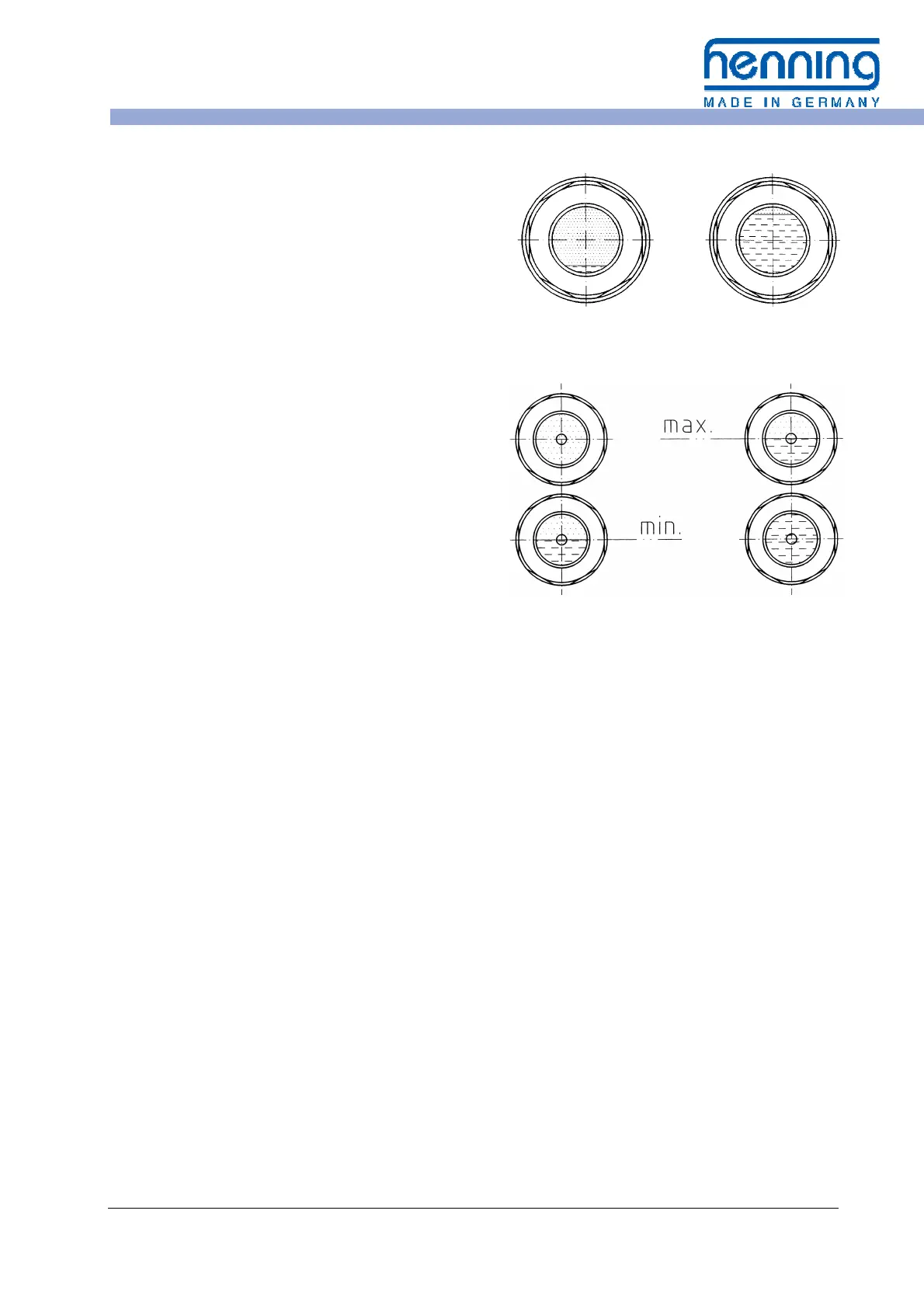
a) Buffer with one sight glass
The oil level should be visible in the
sight glass 9, see Fig. 2a
b) Buffer with two sight glasses
- minimum: the oil level is visible in
the lower sight glass
- maximum: the oil level is below the
top edge of the upper
sight glass
see Fig. 2b
Factory oil filling for buffers with one sight glass
is up to the centre of the sight glass (at ambient
temperatures of 16 °C to 22 °C).
Factory oil filling for buffers with two sight glass-
es is below the top edge of the upper sight
glass.
The oil level is depending on temperature. At
ambient temperatures around freezing point, the
oil level can drop near the minimum. High ambi-
ent temperatures let the oil level rise.
If during the oil level check the oil level is found
to be too high, air bubbles might be in the oil. In
this case first press the piston rod of the (upright
standing) buffer several times as far as possible.
If the oil level is not falling although the piston
rod is fully extended, oil must be removed.
If the oil level is too low, oil must be added (see
point 8.3 "Correction of the oil level"). In this
case check the buffer for leakage.
7.3 Gas pressure check
For resetting the piston rod after a buffer stroke
the buffer is filled with nitrogen. The gas pres-
sure at extended piston rod is 5 bar.
The gas pressure may be checked without using
a measuring instrument. For this purpose press
the piston rod by hand for some centimetres.
If the piston rod then returns automatically to its
initial position, the gas pressure is sufficient.
Otherwise proceed as described under point 8.4
"Gas refilling".
7.4 General visual inspection
Pay attention to oil spots on the floor or on the
buffer. An oil film on the piston rod 2 is normal.
Check the piston rod surface for damage and
tightly adherent contaminations.
Check the state and function of the limit
switch 13.
If leaks or damage is found, the buffer must be
exchanged or repaired.
Oil level minimum Oil level maximum
Fig. 2a: Oil level indication with one sight glass
Oil level minimum Oil level maximum
Fig. 2b: Oil level indication with two sight glasses


 To Next Page
 Loading...