Need help?
Do you have a question about the Hesperide PARAS EQUADOR 3X3M and is the answer not in the manual?
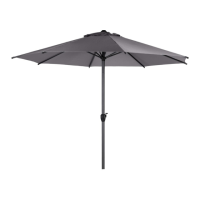
This document describes the Hespéride Parasol Equator 3x3M, a garden parasol designed for outdoor use.
The Hespéride Parasol Equator 3x3M is a garden parasol designed to provide shade and protection from the sun. It features an offset pole design, allowing for flexible placement and coverage without a central obstruction. The parasol can be opened and closed, and its angle can be adjusted to optimize shade throughout the day.
The parasol's structure is composed of aluminum and epoxy-painted steel. Aluminum is chosen for its lightness and resistance, while epoxy-painted steel provides durability and rust protection. The canopy is made of a synthetic fabric, likely polyester, known for its good resistance to tearing and rubbing.
The dimensions of the canopy are 3x3 meters, indicating a square shape. The overall dimensions of the parasol are designed to provide significant shade coverage.
The assembly process involves connecting various parts, including the base, pole, and canopy. The document specifies that the assembly requires adjusting different pieces and that small variations in dimensions (a few millimeters) between elements are normal.
Assembly: The parasol requires assembly. The manual includes a parts list (A-K) and step-by-step illustrations for assembly. Key steps involve attaching the base components, securing the main pole, and then attaching and opening the canopy. The assembly is designed to be performed by adults and should be done in calm weather conditions (no storms, rain, or strong wind). It is recommended to install the parasol on a hard, flat surface. A fixation kit adapted to the type of soil is recommended for optimal stability.
Opening and Closing: The parasol features a crank mechanism (part I and J in the parts list) for opening and closing the canopy. This mechanism allows for easy operation. The angle of the canopy can also be adjusted.
Stability: For optimal stability, especially in windy conditions, it is crucial to secure the parasol to the ground. The manual explicitly states that the parasol should not be used in strong winds, storms, hail, or heavy rain. It is recommended to close the parasol in such conditions. The accumulation of water and/or dead leaves on the canopy can contribute to its degradation and that of the structure; therefore, it is important to clean it regularly and eliminate any pockets of water. It is not recommended to hang products on the frame.
Safety Precautions: The manual emphasizes several safety precautions:
Everyday Maintenance: The product is subject to external elements, so it must be cleaned regularly.
Protection of Screws and Structure: The steel components of the parasol are susceptible to oxidation when exposed to external elements (humidity, salty winds). To prevent rust, the steel furniture is delivered with an epoxy treatment. This layer gradually disappears under the effect of external elements and must be renewed regularly. It is recommended to apply an anti-rust aerosol at least once at the beginning and end of the season (available in hardware stores or DIY stores). Increase the treatment frequency every 3 months for furniture exposed to salty sea winds. If rust spots appear despite treatment, they can be easily treated and removed with common household products such as white vinegar or citric acid. A cloth soaked with car polish can also help remove rust spots. Finish with an anti-rust spray to protect the furniture, applying it regularly.
Water Repellency: The fabric of the parasol has a surface treatment to make water slide off its surface instead of absorbing it. Over time, this treatment will disappear. When the material is exposed to external elements (rain, salty winds, dirt, friction), it is necessary to renew the treatment as soon as the material loses its water repellency or after each wash. The water repellency, however, should not be confused with being waterproof. Even treated, the fabric cannot claim to be perfectly waterproof, especially regarding the seams. Its resistance to rain is therefore limited. A fabric exposed to rain, even when it is water repellent, will be wet and must be dried.
Storage: When not in use for extended periods, it is recommended to store the parasol in a dry, ventilated, and closed place. This helps prevent the appearance of mold and mildew. If the parasol has been wet, it must be completely dried before storage to prevent the formation of mold and unpleasant odors.
Temperature Conditions: The parasol is not designed to withstand very low temperatures. It is sensitive to ambient humidity. It is therefore advisable to store it in a dry, ventilated, and closed place. Putting a tarpaulin on it is not necessarily necessary. Before any storage, clean and dry the product well to prevent the appearance of unpleasant odors or mold. If you do not have a ventilated and closed place, the use of a tarpaulin with a ventilation system is essential to cover the furniture that remains outside. A protective tarpaulin, in fact, reduces the impact of external aggressions (damage due to trees, animals, pollution...). If the floor is damp, it is advisable to insert a wedge between the floor and the feet to avoid transferring humidity. The event of a table that opens to water outside, giving a slight angle also prevents water and dead leaves collecting on the tarpaulin. In the event of prolonged non-use, if the storage and tidying away recommendations are not followed, the result will be an accelerated deterioration of its surface condition and its correct operating.
Tightening: The assembly parts of your product become loose over time. Think of tightening them regularly.
Exposure to UV Rays: Over time, you can see a discoloration of the materials exposed to UV rays (textiles, paint, plastics), a phenomenon also due to the sun's rays as well as those of the moon. This evolution of colors exposed to external elements is normal and concerns in particular bright colors.
 General
| Brand | Hesperide |
|---|---|
| Model | PARAS EQUADOR 3X3M |
| Category | Patio Furniture |
| Language | English |


 To Next Page