EasyManua.ls Logo

Hickok 6000A - Page 15

Default Icon
24 pages
Print Icon
To Next Page IconTo Next Page
To Previous Page IconTo Previous Page
Loading...
BASE
BASE
EMITTER
EMITTER
/
МРМ
РМР
COLLECTOR
COLLECTOR
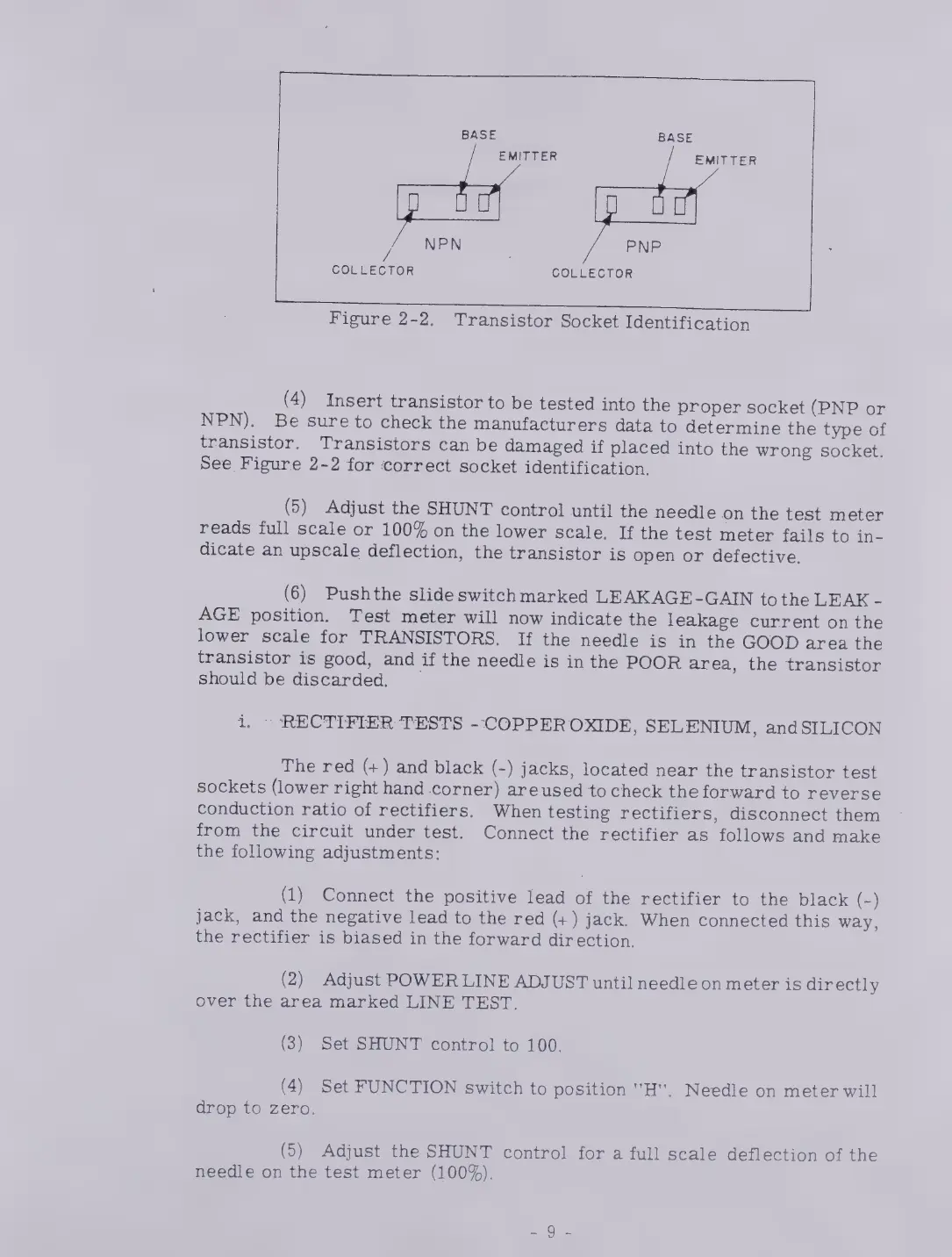
Figure
2-2.
Transistor
Socket
Identification
(4)
Insert
transistor
to
be
tested
into
the
proper
socket
(PNP
or
NPN).
Be
sureto
check
the
manufacturers
data
to
determine
the
type
of
transistor.
Transistors
can
be
damaged
if
placed
into
the
wrong
socket.
See
Figure
2-2
for
correct
socket
identification.
(5)
Adjust
the
SHUNT
control
until
the
needle
on
the
test
meter
reads
full
scale
or
100%
on
the
lower
scale.
If
the
test
meter
fails
to
in-
dicate
an
upscale
deflection,
the
transistor
is
open
or
defective.
(6)
Pushthe
slide
switch
marked
LEAKAGE-GAIN
tothe
LEAK
-
AGE
position.
Test
meter
will
now
indicate
the
leakage
current
on
the
lower
scale
for
TRANSISTORS.
If
the
needle
is
in
the
GOOD
area
the
transistor
is
good,
and
if
the
needle
is
in
the
POOR
area,
the
transistor
should
be
discarded.
`
i
RECTIFIER
TESTS
-
COPPER
OXIDE,
SELENIUM,
andSILICON
The
red
(+)
and
black
(-)
jacks,
located
near
the
transistor
test
sockets
(lower
right
hand
corner)
areused
to
check
the
forward
to
reverse
conduction
ratio
of
rectifiers.
When
testing
rectifiers,
disconnect
them
from
the
circuit
under
test.
Connect
the
rectifier
as
follows
and
make
the
following
adjustments:
(1)
Connect
the
positive
lead
of
the
rectifier
to
the
black
(-)
jack,
and
the
negative
lead
to
the
red
(+)
jack.
When
connected
this
way,
the
rectifier
is
biased
in
the
forward
direction.
(2)
Adjust
POWER
LINE
ADJUST
until
needle
on
meter
is
dir
ectly
over
the
area
marked
LINE
TEST.
(3)
Set
SHUNT
control
to
100.
(4)
Set
FUNCTION
switch
to
position
"H",
Needle
on
meter
will
drop
to
zero.
(5)
Adjust
the
SHUNT
control
for
a
full
scale
deflection
of
the
needle
on
the
test
meter
(100%).

Related product manuals