DIFFERENTIAL CARRIER (MERITOR RS17.19.21&23)DF02–30
6. ADJUSTMENT OF PINION BEARING PRELOAD BY PRESS
METHOD
If a press is not available, or the press does not have a pressure
gauge, use the yoke or flange method to adjust pinion bearing pre-
load. Refer to DF02-31.
NOTICE
Do not read starting torque. Read only the torque value after the cage
starts to rotate. Starting torque will give an incorrect reading.
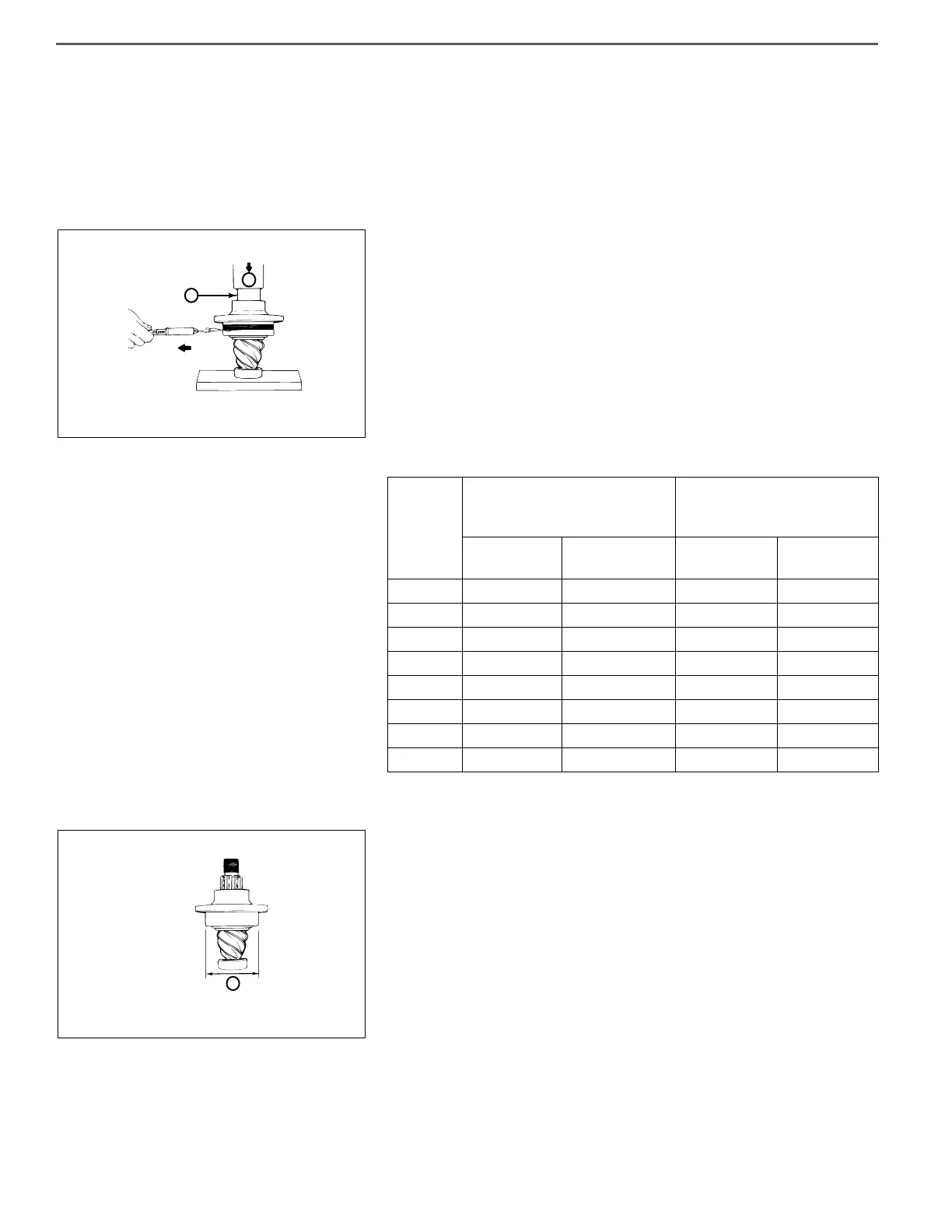
(1) Place the drive pinion and cage assembly in a press, gear head or
teeth toward the bottom.
(2) Install a sleeve of the correct size against the inner race of the outer
bearing.
(3) Apply and hold the correct amount of pressure to the pinion bearings.
Refer to table below. As pressure is applied, rotate the bearing cage
several times so that the bearings make normal contact.
(4) While pressure is held against the assembly, wind a cord around the
bearing cage several times.
(5) Attach a spring scale to the end of the cord.
(6) Pull the cord on a horizontal line. As the bearing cage rotates, read
the value indicated on the scale. Record the reading.
(7) Measure the diameter of the bearing cage where the cord was wound.
Measure in inches or centimeters.
(8) Divide the dimension in half to get the radius. Record the radius
dimension.
Thread
Size of
Pinion
Shaft
Press Pressure Needed on
Bearings for Correct Preload
Torque Value Needed on
Pinion Nut for Correct
Bearing Preload
pounds/
tons
(kg/metric-
tons)
lb-ft (Nm)
7/8"-20 22,000/1 (9979/10) 200-275 (271-373)
1"-20 30,000/15 (13 608/13.6) 300-400 (407-542)
1-1/4"-12 54,000/27 (24 494/24.5) 700-900 (949-1220)
1-1/4"-18 54,000/27 (24 494/24.5) 700-900 (949-1220)
1-1/2"-12 54,000/27 (24 494/24.5) 800-1100 (1085-1491)
1-1/2"-18 54,000/27 (24 494/24.5) 800-1100 (1085-1491)
1-3/4"-12 50,000/25 (22 680/22.7) 900-1200 (1220-1627)
2"-12 50,000/25 (22 680/22.7) 1200-1500 (1627-2034)
1 Measure diameter of cage.
1



 To Next Page