
 Need help?
Do you have a question about the Hisense HRCF144 and is the answer not in the manual?
This document outlines the operation and maintenance of a Hisense chest freezer, models HRCF144 and HRCF199, designed for household and similar applications.
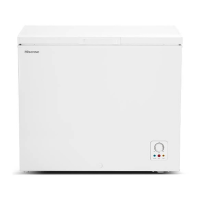
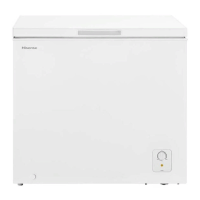
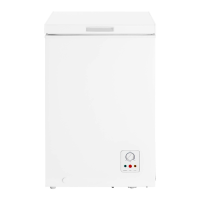
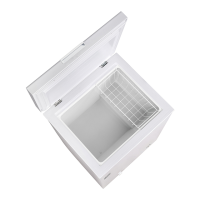
The Hisense chest freezer is designed for storing food and beverages in a household setting. It features a single compartment that can be set to either refrigerator or freezer mode, depending on the temperature control knob setting. The appliance uses isobutene (R600a) as a refrigerant, a natural gas with high environmental compatibility, which is flammable. The unit is equipped with a temperature control knob, a drain for defrosting, and a power supply cord with a plug. It includes a basket for organized storage and a door with a knob and hinge for access.
Before initial use, it is crucial to remove all shipping packaging and tape, then ventilate the appliance by leaving the doors open for a while. The interior should be cleaned once after delivery. The unit requires a grounded single-phase 220-240 V power supply. After plugging in, allow the unit to operate for about one hour to cool the compartment before placing items inside. When restarting the unit after it has been turned off, wait at least five minutes to prevent damage to the compressor or electrical system.
To optimize energy consumption, open and close the door quickly and keep it open for the shortest possible time. The unit should be installed in a well-ventilated location, avoiding direct sunlight or proximity to heat sources like radiators or cookers. Adequate air circulation around the appliance is essential to prevent overheating, with recommended clearances of 50mm from the back to the wall and on its two sides, and over 100mm from the top. The appliance should be level to eliminate vibration, which can be adjusted using the front adjusters.
The temperature control dial on the front-bottom side of the chest freezer allows users to adjust the internal temperature. Settings from "1" to "8" are available, with "1-2" indicating refrigerator mode and "5-8" indicating freezer mode, with "8" being the coldest setting. If cooling performance is insufficient, turn the dial towards "8"; if it's too cold, turn it towards "1". For optimal refrigeration or freezing, refer to the recommended positions. If the unit needs to be temporarily stopped, unplug the power cord or turn off the power outlet.
Food storage guidelines emphasize preventing contamination. Children aged 3 to 8 years are allowed to load and unload refrigerating appliances. Food should not directly contact the inner box surface. Frozen food should be sealed in non-toxic, tasteless, impermeable, waterproof material to prevent moisture loss and odor. Hot food must be cooled to room temperature before being placed in the freezer to avoid affecting other foods and increasing power consumption. Different food types should be stored according to the compartments and target temperatures. For instance, the fridge compartment (+2~+6°C) is suitable for eggs, cooked food, fruits, vegetables, dairy products, cakes, and drinks. The refrigerator compartment (0~+4°C) is for fresh pork, beef, fish, and chicken, recommended for consumption within 3 days. Freezer compartments (e.g., ***-Freezer at <-18°C) are for seafood and meat products, with recommended storage durations of 1 to 3 months depending on the star rating. One-, two-, and three-star compartments are not suitable for freezing fresh food.
Flammable gases or liquids, explosive substances like aerosol cans with flammable propellants, and electrical appliances (e.g., ice cream makers) should not be stored or operated inside the appliance. Hot items should be kept away from plastic components. Food products should not be placed directly against the air outlet on the rear wall. Pre-packed frozen food should be stored according to the manufacturer's instructions. Overloading door racks or crisper drawers should be avoided to prevent items from falling.
Regular cleaning and defrosting are essential for the appliance's longevity and hygiene. Before any maintenance, switch off the appliance and disconnect the mains plug. The exterior can be wiped with a soft, dry cloth, or a cloth moistened with detergent for heavier soiling, followed by a clean, damp cloth. Avoid splashing water directly onto the chest freezer or washing it with water to prevent short-circuits or electrical shocks. Do not use polishing powder, soap powder, benzine, oil, or hot water, as these can damage the painting and plastic components. Ventilation openings must be kept clear of obstruction.
Defrosting should be performed two or three times a year when the ice layer reaches about 4 mm thick. To defrost, set the thermostat to "8" at least 12 hours prior, then switch off the appliance by removing the plug. Remove all food, wrap it in paper, and store it in a cold place, then leave the door open. Once defrosting is complete, clean and wipe the compartment dry. After defrosting, switch the appliance back on, set the thermostat to "8", wait at least one hour, and then replace the foodstuffs. The thermostat can be reset to the original position after a few hours. Melted water during the defrosting process should be cleaned and wiped dry. Mechanical devices or other artificial means should not be used to accelerate defrosting, other than those recommended by the manufacturer.
If the appliance is left empty for long periods, it should be switched off, defrosted, cleaned, dried, and the door left open to prevent mold development. Food needs to be packed in bags, and liquids in bottles or capped containers, to prevent cleaning difficulties.
In case of issues, a troubleshooting guide is provided. If problems persist after remedial actions, disconnect the power cord, transfer stored items to another container, and contact the dealer or customer service. Any electrical work or servicing must be carried out by a qualified electrician or authorized service person using genuine spare parts. The LED light should not be replaced by the user; contact customer helpline for assistance if it is damaged.
For disposal, the appliance should not be treated as household waste. Packaging materials with the recycle symbol are recyclable and should be disposed of in a suitable waste collection container. Before disposing of the appliance itself, disconnect the main plug and cut off the main cable. The product should be taken to an appropriate waste collection point for the recycling of electrical and electronic equipment to prevent negative environmental and health consequences.
 General
| Freezer Type | Chest |
|---|---|
| Capacity (cu. ft.) | 14.4 |
| Color | White |
| Defrost Type | Manual |
| Defrosting System | Manual Defrost |
| Noise Level | 42 dB |
| Capacity | 408L |


 To Next Page